
Categories
Art Collection Curatorial European

From the Collection– “Head of a Noblewoman” tomb effigy

French, Head of a Noblewoman, 14th century. Marble; H: 11 3/4 in. Milwaukee Art Museum, Gift of The William Randolph Hearst Foundation through the Milwaukee Sentinel M1958.67. Photo by John Nienhuis.

Just as you walk into the Museum’s Gallery #3 (Northern Renaissance artworks), on your right is a display case that holds a marble sculpture.

It’s an unobtrusive work labeled Head of a Noblewoman, French, 14th century.   I’m sure many Museum visitors have walked right by it and not even thought twice.  The most interesting thing for those that look closer may be the way the artwork is positioned in the case–it is shown lying down, not upright.

This sculpture is more than just a portrait of a French noblewoman.  It’s a portrait of the noble French woman from her tomb!

Originally, the Museum’s head sculpture would have been part of a full body sculpture of the woman lying down, and it would have rested above her tomb. You can be certain of this orientation because the back of her head is unfinished.

Although funerary portraits were used as far back as the ancient Egyptians, medieval Europe saw an explosion of them.  Examples are known from the 11th century, and by the 13th century they were filling churches and abbeys.  Of course, only those who could afford to have an elaborate tomb could have such an elaborate sculpture, so most examples are of kings, queens, and other nobility, including knights, such as Jean d’Alluye, whose tomb effigy is now at the Metropolitan Museum of Art.
Categories
Art Collection Curatorial European Exhibitions

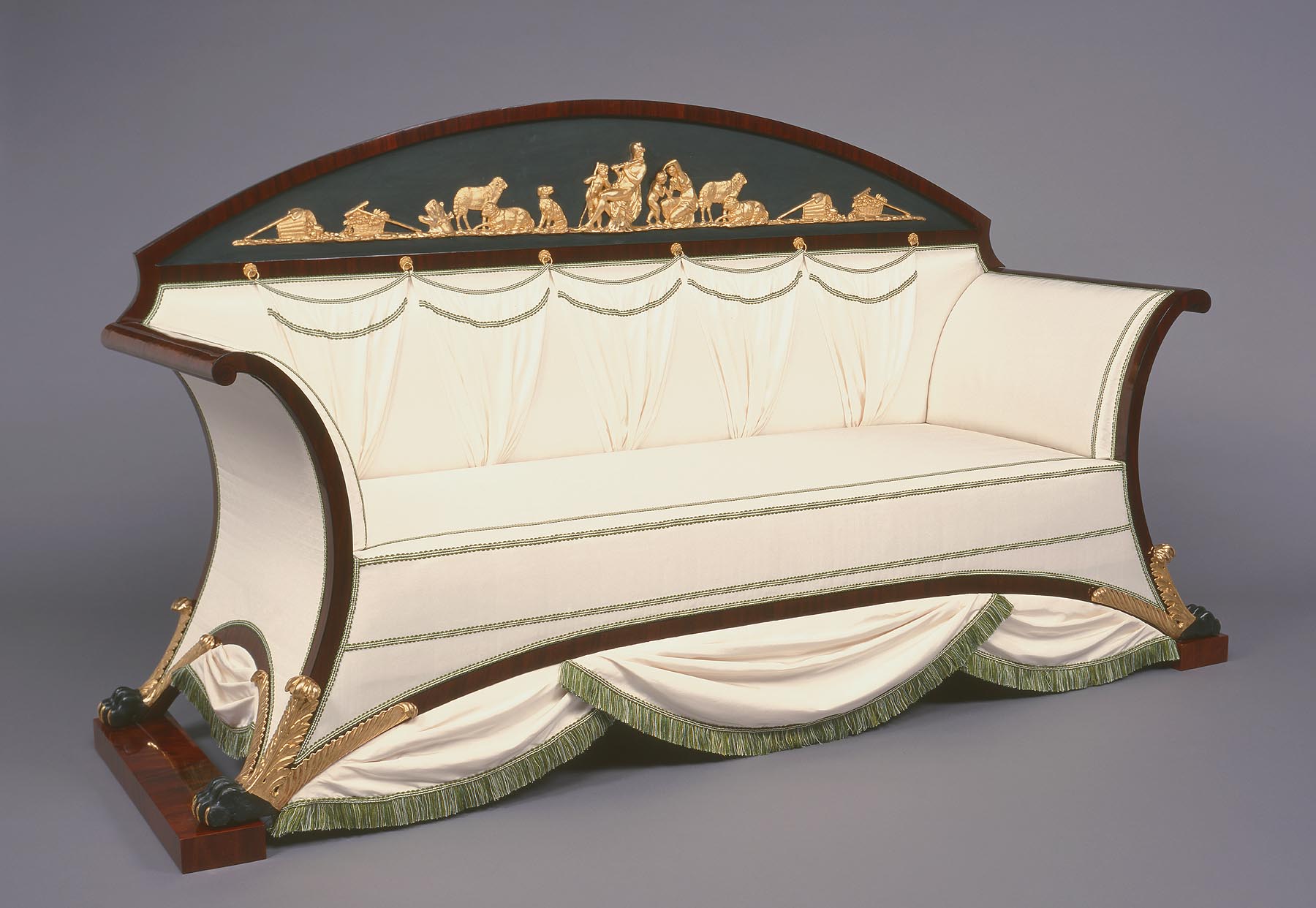
From the Collection–Biedermeier Settee

In 2006, when the Milwaukee Art Museum organized the exhibition Biedermeier: The Invention of Simplicity, it established itself as a center of study for the Beidermeier style that was popular in Central and Northern Europe from about 1815 to 1835.

Building upon the Museum’s strength in German and Austrian art—partly due to the ethnic background of Milwaukee—the exhibition brought to the spotlight to Biedermeier art.  This period of art and design history was not only little-known in the United States, but the exhibition also proposed a whole new interpretation of the style that changed scholarship in Europe as well.  You can read more about Biedermeier here in this review from the New York Times.

Or better yet, read the exhibition catalogue, available for purchase on the Museum Store site.

Categories
Art Collection Curatorial European

From the Collection–Jacques de l’Ange’s “Gluttony”

Jacques de l'Ange (Flemish, active in Antwerp 1631–1642) Gluttony, ca. 1642 Oil on canvas 49 1/4 x 40 1/4 in. (125.1 x 102.24 cm) Gift of Frank A. Murn M2006.45 Photo credit John R. Glembin
Jacques de l'Ange (Flemish, active in Antwerp 1631–1642), Gluttony, ca. 1642. Oil on canvas, 49 1/4 x 40 1/4 in. Milwaukee Art Museum, Gift of Frank A. Murn M2006.45. Photo credit John R. Glembin.

Alas, the Milwaukee Art Museum does not own a Caravaggio painting.

Michelangelo Merisi da Caravaggio (Italian, 1571-1610) was a revolutionary painter who combined theatrical compositions and lighting with realistic depictions of humans to make some of the most dramatic and memorable paintings from the early Baroque period.

Unfortunately, he died young and his paintings are hard to come by.  Some of my favorites are The Calling of Saint Matthew in Rome and Saint John the Baptist in the Wilderness in Kansas City’s Nelson-Atkins Museum.

But no need to despair!  Many artists who traveled to Italy in the 17th century—and lots who didn’t—were inspired to use the style of the great artist Caravaggio.  The Milwaukee Art Museum has great paintings by some of these northern European artists, which hang in Gallery #5 with Northern Baroque paintings.  Two of them—Christ before the High Priest by Mathias Stom and Mars, God of War by Gerrit von Honthorst—are by well-known artists of the phenomenon.

I’ve found myself recently admiring one in particular, by the least-known artist in the gallery: Gluttony by Jacques de l’Ange.

Categories
Art Collection Curatorial European

From the Collection— “A Roman Amateur” by Lawrence Alma-Tadema

Lawrence Alma-Tadema (English, b. Dutch, 1836–1912), A Roman Amateur (also known as A Roman Art Lover), 1870. Oil on wood panel, 29 x 39 1/2 in. Milwaukee Art Museum, Layton Art Collection, Gift of the following Layton Art Gallery Trustees, plus Layton funds, between 1892-96: George Dickens, Frederick Layton, William Plankinton, B.K. Miller, Samuel Marshall, J.H. Van Dyke, L149. Photo by John Neinhuis.
Lawrence Alma-Tadema (English, b. Dutch, 1836–1912), A Roman Amateur, 1870. Oil on wood panel, 29 x 39 1/2 in. Milwaukee Art Museum, Layton Art Collection, Gift of the following Layton Art Gallery Trustees, plus Layton funds, between 1892-96: George Dickens, Frederick Layton, William Plankinton, B.K. Miller, Samuel Marshall, J.H. Van Dyke, L149. Photo by John Neinhuis.

On December 14, 1894, Frederick Layton, the Milwaukee meat packer and philanthropist who founded the Layton Art Gallery (the predecessor of the Milwaukee Art Museum), wrote a letter to Julius Gugler of the Milwaukee Art Association.

Layton requested the organization to raise $10,000 by subscription to purchase a painting by Lawrence Alma-Tadema which was currently on display at Milwaukee’s Pfister Hotel as a loan from one of Layton’s art dealer friends.

The subscription must have been successful, because the Layton Art Collection at the Milwaukee Art Museum has a wonderful painting by Alma-Tadema!

This painting, called A Roman Amateur, can be found in Gallery #10 with other works of 19th-century European art.

Categories
Art Collection Curatorial European

From the Collection–Virgin and Child

Virgin and Child South German ca. 1550 Solnhofen stone 7 1/4 x 6 1/2 x 1 3/4 in. (18.42 x 16.51 x 4.45 cm) Gift of Anne H. and Frederick Vogel III in loving memory of his sister Grace Vogel Aldworth (1932-2002)
South German, Virgin and Child, ca. 1550. Solnhofen stone, 7 1/4 x 6 1/2 x 1 3/4 in. Milwaukee Art Museum, Gift of Anne H. and Frederick Vogel III in loving memory of his sister Grace Vogel Aldworth (1932-2002), M2003.67. Photo by John R. Glembin.

Sometimes with the rush of the holiday season, it is nice to take a deep breath and spend some time on your own.

In that spirit, I’d like to consider a small-scale stone relief Virgin and Child, ca. 1550.  You’ll find it at the Museum tucked in a case in Gallery #3, with works of the Northern Renaissance.

The artwork, carved in stone, is done in low relief and is set into a wood and silk case with a two-part hinged cover.   The small size allowed the owner to hold it in the palm of his or her hand for private contemplation and prayer.  The case is probably a later replacement, but it certainly would have had something similar to protect it when slipped into a drawer or carried for devotion during travel.

And what a beautiful image to inspire! 

Categories
Art Collection Curatorial European

From the Collection–Neapolitan crèche (Nativity scene)

Naples Italy, Nativity Scene (Crèche), mid 1700s. Milwaukee Art Museum, Gift of Loretta Howard Sturgis. Photo by John R. Glembin.
Naples Italy, Nativity Scene (Crèche), mid 1700s. Milwaukee Art Museum, Gift of Loretta Howard Sturgis, M2006.9.1-.20. Photo by John R. Glembin.

[Again for the 2011 holiday season, the Milwaukee Art Museum is thrilled to display the beloved Neopolitan crèche. Visit the Museum soon to enjoy this tradition with your family–the Nativity Scene will be on view through January 2012. Re-posted below is curator Catherine Sawinski’s 2010 blog post sharing the history of this artwork. ]

It’s that time of year again! The Museum’s Neapolitan crèche is on view in the galleries for the holiday season. You’ll find it in Gallery 4 of the Collection Galleries, with European art.

The origin of the popular Christmas tradition of re-staging the Nativity scene is usually credited to Saint Francis of Assisi in 1223. The custom reached its artistic height in eighteenth-century Naples, when the Museum’s version was made.

Categories
Art Collection Curatorial European

From the Collection–Girolamo Mengozzi’s “Architectural Fantasy with Figures”

M1982.37
Attributed Girolamo Mengozzi, Architectural Fantasy with Figures, ca. 1750. Oil on canvas34 3/8 x 28 in. Milwaukee Art Museum, Gift of Mr. and Mrs. Myron Laskin,M1982.37. Photo by P. Richard Eels.

I have always loved architecture. As a child, nothing excited me more than a big old Victorian farmhouse. Greek Revival, Carpenter Gothic, Second Empire, Queen Anne—I was probably one of the only Wisconsin middle-schoolers who knew the nuances of American house design and could read—and draw—a floor plan.

As an undergraduate, one of my majors was Classical Civilization, and my interest in architecture easily translated to ancient buildings. When I studied in Rome during my junior year and was able to see ruins that I had been studying in photographs, I was so excited.

I actually cried a little when I walked into the Pantheon for the first time!

Working in the European department at the Milwaukee Art Museum doesn’t allow me a lot of possibilities to directly study architecture, but I have found one way to explore it indirectly. Tucked away in the corner of the Italian Baroque gallery (Gallery #6) is a painting that most visitors probably miss. It is Architectural Fantasy with Figures attributed to Girolamo Mengozzi (Italian, ca. 1688–ca. 1766).

Categories
Art Collection Curatorial European

From the Collection–Léon Augustin Lhermitte’s “Haymaking Time”

Léon-Augustin Lhermitte, Haymaking Time (La Fenaison), 1897. Oil on canvas, 29 1/2 x 38 1/4 in. Milwaukee Art Museum, Purchase with funds from Avis Martin Heller in honor of the Fine Arts Society, M2010.68. Photo by John R. Glembin.

On October 14, the Milwaukee Art Museum opened the exhibition Impressionism: Masterworks on Paper.

The exhibition perfectly sets the scene for looking at a painting recently acquired by the Milwaukee Art Museum, shown at left as it looks mid-conservation.

Haymaking Time (La Fenaison) by the French artist Léon Augustin Lhermitte (1844–1925) is one of the most important paintings by an artist who was extremely influential in his day, but is not a household name today.

This painting can begin a conversation about how wide-ranging the term “impressionism” can be, and who was part of that celebrated movement, and who was not.

Categories
Art Collection Curatorial European Modern

From the Collection–Hans Baluschek’s “Working-class City”

Hans Baluschek (German, 1870–1935), Arbeiterstadt (Working-class City), 1920. Oil on Canvas, 48 7/16 x 36 1/4 in. Milwaukee Art Museum, Purchase with funds from Avis Martin Heller in honor of the Fine Arts Society M2010.49. Photo by John R. Glembin
Hans Baluschek (German, 1870–1935), Arbeiterstadt (Working-class City), 1920. Oil on Canvas, 48 7/16 x 36 1/4 in. Milwaukee Art Museum, Purchase with funds from Avis Martin Heller in honor of the Fine Arts Society M2010.49. Photo by John R. Glembin.

The industrial revolution of the 19th century brought drastic and sometimes violent changes to European cities. By the beginning of the 20th century, artists in Germany were responding to the time’s social struggles and political unrest through their revolutionary artistic style and new subject matter.

The German Expressionists were one such art movement that reacted to these changes. Turning to simplified or distorted forms and bold colors, these artists tended to focused on humanistic themes and high emotion.

German Expressionism is one of the strengths of the Milwaukee Art Museum’s collection, which includes multiple works by Ernst Ludwig Kirchner (Street at Schöneberg City Park, 1912–13), Ludwig Meidner (Portrait of a Young Man, 1912), Käthe Kollwitz (Self-Portrait; from the deluxe periodical The Creators, vol. 5, no. 1, 1924), Emil Nolde (Roses on Path, 1935), and Max Pechstein (Calla Lilies, 1914).

In October 2010, the Museum added a new dimension to its early 20th-century German collection by acquiring a painting by the artist Hans Baluschek (German, 1870-1935), which has just been put on display in Gallery #12 with other European Modernism.

Categories
Art Collection Curatorial European

From the Collection–Wilhelm Trübner’s “Salome”

Salome Wilhelm Trübner 1898 Oil on cardboard 39 3/4 x 21 in. (100.97 x 53.34 cm) Purchase, René von Schleinitz Memorial Fund M1978.2
Wilhelm Trübner (German, 1851–1917), Salome, 1898. Oil on cardboard, 39 3/4 x 21 in. Milwaukee Art Museum, Purchase, René von Schleinitz Memorial Fund, M1978.2. Photo by Larry Sanders.

German artist Wilhelm Trübner’s depiction of Salome shows the New Testament character brazenly nude, holding the head of John the Baptist on a platter.

When this painting by an admittedly-minor artist was recently rotated into the permanent collection gallery #11, it was hung alongside masterpieces by Monet and Caillebotte. I was stunned that my eyes left Boating on the Yerres to look instead at this girl, Salome, painted in vibrant colors with dramatic light and shadow on the model’s skin.

I was also stunned that after a childhood of of attending Sunday school, I needed to turn to Wikipedia to learn more about Salome.

I learned that this temptress-of-legend has been the inspiration for everything from an Oscar Wilde one-act play to a B-side song by U2.

The Biblical story explains that Salome, daughter of Herodias and therefore stepdaughter of King Herod Antipas, danced to entertain and seduce the ruler of Galilee at his 1st century AD birthday celebration. Her dance survives in our cultural imagination as the “Dance of the Seven Veils,” during which seven veils are sequentially and tauntingly removed. You can watch femme fatale Rita Hayworth performing the dance in her 1953 film Salomé.