
Categories
Art Collection Curatorial European Exhibitions

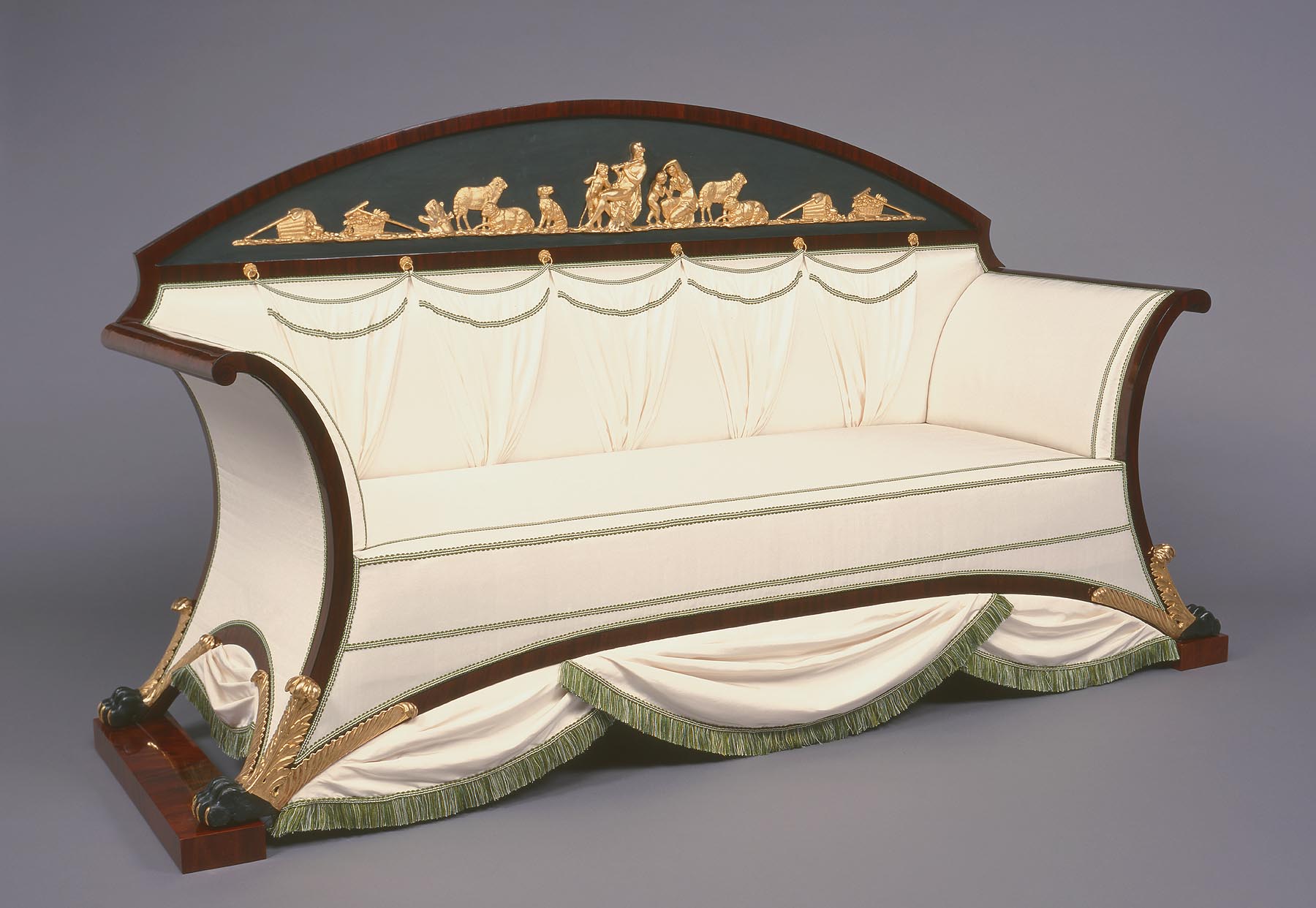
From the Collection–Biedermeier Settee

In 2006, when the Milwaukee Art Museum organized the exhibition Biedermeier: The Invention of Simplicity, it established itself as a center of study for the Beidermeier style that was popular in Central and Northern Europe from about 1815 to 1835.

Building upon the Museum’s strength in German and Austrian art—partly due to the ethnic background of Milwaukee—the exhibition brought to the spotlight to Biedermeier art.  This period of art and design history was not only little-known in the United States, but the exhibition also proposed a whole new interpretation of the style that changed scholarship in Europe as well.  You can read more about Biedermeier here in this review from the New York Times.

Or better yet, read the exhibition catalogue, available for purchase on the Museum Store site.

Categories
20th and 21st Century Design Art Behind the Scenes Collection Curatorial

Celebrating the 50th Anniversary of the American Studio Glass Movement

American Studio Glass installation. Photo by the author.

The year 2012 is considered the 50th anniversary of the American Studio Glass movement. The anniversary is being celebrated with exhibitions and events across the country, organized in large part by the Art Alliance for Contemporary Glass.

The Milwaukee Art Museum has a terrific collection of studio glass, and we were thrilled to be part of the celebration. Along one wall of the newly-designed Kohl’s Art Generation Studio is a new installation that celebrates using glass as a medium of creative impulse.

The glass sparkles, tells an important art history story, and I hope that its visual beauty inspires young artists as they create their own artwork nearby.

What is the American Studio Glass movement, and what is this anniversary?

Categories
Art Collection Curatorial Folk and Self-Taught

From the Collection: Possum Trot

Dolls
Calvin Black (American, 1903-1972) and Ruby Black (American, 1913-1980), Possum Trot Midget Doll Theatre, ca. 1950-1972 (detail). Wood, wood paneling, laminated Masonite, nails, bolts, paint, electrical components, and carved and painted wooden dolls. The Michael and Julie Hall Collection of American Folk Art M1989.325.
Calvin Black (American, 1903-1972) and Ruby Black (American, 1913-1980). Possum Trot Midget Doll Theatre. ca. 1950-1972. Wood, wood paneling, laminated Masonite, nails, bolts, paint, electrical components, and carved and painted wooden dolls. The Michael and Julie Hall Collection of American Folk Art M1989.325.
Calvin Black (American, 1903-1972) and Ruby Black (American, 1913-1980), Possum Trot Midget Doll Theatre, ca. 1950-1972. Wood, wood paneling, laminated Masonite, nails, bolts, paint, electrical components, and carved and painted wooden dolls. The Michael and Julie Hall Collection of American Folk Art M1989.325.

It’s back! After being off view for nearly ten years, the Museum’s popular Possum Trot is back, and it’s kicking, spinning, and singing up a storm.  Not to mention riding a bike.

Possum Trot was one of the most famous, extensive environments of self-taught art ever made.

Categories
Art Collection Curatorial European

From the Collection–Jacques de l’Ange’s “Gluttony”

Jacques de l'Ange (Flemish, active in Antwerp 1631–1642) Gluttony, ca. 1642 Oil on canvas 49 1/4 x 40 1/4 in. (125.1 x 102.24 cm) Gift of Frank A. Murn M2006.45 Photo credit John R. Glembin
Jacques de l'Ange (Flemish, active in Antwerp 1631–1642), Gluttony, ca. 1642. Oil on canvas, 49 1/4 x 40 1/4 in. Milwaukee Art Museum, Gift of Frank A. Murn M2006.45. Photo credit John R. Glembin.

Alas, the Milwaukee Art Museum does not own a Caravaggio painting.

Michelangelo Merisi da Caravaggio (Italian, 1571-1610) was a revolutionary painter who combined theatrical compositions and lighting with realistic depictions of humans to make some of the most dramatic and memorable paintings from the early Baroque period.

Unfortunately, he died young and his paintings are hard to come by.  Some of my favorites are The Calling of Saint Matthew in Rome and Saint John the Baptist in the Wilderness in Kansas City’s Nelson-Atkins Museum.

But no need to despair!  Many artists who traveled to Italy in the 17th century—and lots who didn’t—were inspired to use the style of the great artist Caravaggio.  The Milwaukee Art Museum has great paintings by some of these northern European artists, which hang in Gallery #5 with Northern Baroque paintings.  Two of them—Christ before the High Priest by Mathias Stom and Mars, God of War by Gerrit von Honthorst—are by well-known artists of the phenomenon.

I’ve found myself recently admiring one in particular, by the least-known artist in the gallery: Gluttony by Jacques de l’Ange.

Categories
American Art Collection Curatorial

From the Collection–John Henry Belter Sofa

Attributed to John Henry Belter (American, b. Germany, 1804–1863), Sofa, ca. 1850. Rosewood, rosewood laminate, modern velvet upholstery, 54 x 93 1/2 x 40 in. Milwaukee Art Museum, Bequest of Mary Jane Rayniak in memory of Mr. and Mrs. Joseph G. Rayniak M1987.16. Photo credit Larry Sanders.

I’m a Modernist. Give me George Nelson over the Herter Brothers any day.

But all my normal predilections aside, I do love this sofa in the Museum’s collection. It is positively dripping with flowers and leaves and fruit, puffed up with ornament and upholstery stuffing, and tufted on every square inch of its way-too-high-to-be-practical back.

This sofa is exactly the type of “disingenuous” factory-produced Victorian-era object that the reforming Modern designers of the early 20th century–heck, many stylish designers of today–decried as soulless.

So in the spirit of Valentine’s Day–a holiday that is also decried by cynics (me included) as soulless, mass-produced, and disingenuous–I thought I’d ignore all the star-crossed and wanton lovers in Museum paintings to point out this great red sofa that seems to embody all the over-the-top love and lust and chocolate truffles of this greeting card holiday.

This is the Valentine’s Day of furniture. A guilty pleasure we love.

Categories
Art Curatorial

From the Chipstone Collection—Puzzle Jug

Puzzle Jug, 1771. Bristol, England. Buff earthenware/Bluish-white tin glaze. Chipstone Foundation Collection; Photo by Gavin Ashworth

My form has puzzled many a fertile Brain
The brightest Wits my Liquor could not gain
And still profusely spill it on the Ground
The Reason is no Suction they have found
Now honest Friend advance thy Genius try
Spill ne’or a Drop and strive to drink me dry

Drinking games conjure up images of college students, Ping-Pong balls and red plastic cups. As the verse above suggests, though, this was not always the case. The puzzle jug was at the center of a humorous drinking game popular from the 16th to the 19th century. The jug, examples of which can be seen in the Hidden Dimensions exhibition on the Lower Level of the Milwaukee Art Museum, was meant for use in inns and public houses.

Categories
Art Collection Curatorial Prints and Drawings

A one-hour exhibition: “Winter Scenes Across the Ages”

East Side Street in Winter Richard H. Jansen  n.d. Gouache sheet: 17 1/4 x 23 3/4 in. (43.82 x 60.33 cm)  Layton Art Collection, Gift of Layton Art League
Richard H. Jansen (American, 1910–1988), East Side Street in Winter, n.d. Gouache sheet: 17 1/4 x 23 3/4 in. Milwaukee Art Museum, Layton Art Collection, Gift of Layton Art League, L1948.2.

Last week I had the opportunity to drop in on a new event at the Museum. It was a one-hour exhibition featuring “Winter Scenes Across the Ages” from the prints and drawings collection. It was a perfect winter day, all blizzardy as I walked to my internship at the Museum. A better setting could not have been wished for to coincide with the winter theme of the pop-up exhibition.

I had encountered this event through the Museum’s Web site, on the Calendar + Events page. I try to check it regularly as not to miss out on the numerous special programs that are available. I was thrilled at the  opportunity to encounter art that is so rarely seen by the public (how exciting!) And, as someone interested in the inner workings of museums, I thought it was simply a brilliant idea! Museums try to find new ways to engage the public and share their collections, and to me this seemed like a lively way to see prints and drawings based on a timely issue. In this case: Winter!

Categories
Art Collection Curatorial European

From the Collection— “A Roman Amateur” by Lawrence Alma-Tadema

Lawrence Alma-Tadema (English, b. Dutch, 1836–1912), A Roman Amateur (also known as A Roman Art Lover), 1870. Oil on wood panel, 29 x 39 1/2 in. Milwaukee Art Museum, Layton Art Collection, Gift of the following Layton Art Gallery Trustees, plus Layton funds, between 1892-96: George Dickens, Frederick Layton, William Plankinton, B.K. Miller, Samuel Marshall, J.H. Van Dyke, L149. Photo by John Neinhuis.
Lawrence Alma-Tadema (English, b. Dutch, 1836–1912), A Roman Amateur, 1870. Oil on wood panel, 29 x 39 1/2 in. Milwaukee Art Museum, Layton Art Collection, Gift of the following Layton Art Gallery Trustees, plus Layton funds, between 1892-96: George Dickens, Frederick Layton, William Plankinton, B.K. Miller, Samuel Marshall, J.H. Van Dyke, L149. Photo by John Neinhuis.

On December 14, 1894, Frederick Layton, the Milwaukee meat packer and philanthropist who founded the Layton Art Gallery (the predecessor of the Milwaukee Art Museum), wrote a letter to Julius Gugler of the Milwaukee Art Association.

Layton requested the organization to raise $10,000 by subscription to purchase a painting by Lawrence Alma-Tadema which was currently on display at Milwaukee’s Pfister Hotel as a loan from one of Layton’s art dealer friends.

The subscription must have been successful, because the Layton Art Collection at the Milwaukee Art Museum has a wonderful painting by Alma-Tadema!

This painting, called A Roman Amateur, can be found in Gallery #10 with other works of 19th-century European art.

Categories
Art Curatorial Exhibitions

Calling All Milwaukee Makers!

Title wall for The Tool at Hand. Photo by the author

Have you had the opportunity to stop by The Tool at Hand yet?

Last month, I wrote about an awesome performance that took place at Sweet Water Organics in preparation of the Chipstone Foundation’s Tool at Hand exhibition at the Milwaukee Art Museum.

The Tool at Hand’s premise is simple: create a work of art using only one tool. Last spring, Ethan Lasser, the exhibition’s curator, sent out a video invitation to 18 artists located in Europe and the United States. Of these 18, 16 agreed to participate in the exhibition. The video, created by Nicola Probert, was itself made with just one tool. In it, one can see a video camera being taken apart as Nicola describes the challenge.

The artists are not told what material to use, what tool to use, or how to use it. They can interpret the exercise as they see fit, as long as they keep in mind certain questions.

Why did you choose this tool?

Where did this tool come from?

Are you using it for the task for which it was intended?

The aim of the exhibition is to explore artists’ attachment to their tools, as well as set up an experiment to find out what happens when artists are faced with an interesting constraint.

Categories
American Art Collection Curatorial

From the Collection—Severin Roesen’s Still Life

Severin Roesen (American, born Germany, ca. 1815-1872).  Still Life.  ca. 1852.  Oil on canvas.  Milwaukee Art Museum, gift of Anita Vogel Hinrichs in memory of Ferdinand Hinrichs, M1988.133. Photo credit: Dedra Walls.

White grapes? Check.

Red grapes? Check.

Peeled lemon? Yep.

Champagne? Yep.

More flowers than a bouquet offered by an apologetic husband the day after he forgets an anniversary? Got those, too.

A bird’s nest with three tiny eggs? Wait a minute.  A bird’s nest?!?

The next time you visit the American Collections in the Museum’s Lower Level, take a look closely at Severin Roesen’s monumental still life of around 1852.  It’s full of all of the objects listed above, from the expected to the unexpected.

And it’s all part of a very elaborate tradition of painting—with unexpected twists—that served this nineteenth-century painter very, very well.