
![Edgar Degas (French, 1834–1917), Dancer Holding Her Right Foot in Her Right Hand [Danseuse tenant son pied droit dans la main droit], ca. 1904; cast 1919–20. Bronze. Purchase, Bradley Conservation Endowment Fund M1984.70. Photo credit: John R. Glembin.](http://blog.mam.org/wp-content/uploads/2014/08/degasr_m1984_70.jpg?w=235)
Tag: From the Collection

A young boy kneels at the beach, drawing a sailboat into the wet sand with a stick. The sun beats on his bare skin and makes him almost glow with warmth and light. Behind him, water licks at his feet, cool and tempting. Although he is intent on his project, we know that once he has gotten too hot, he will lose interest and go back into the water.
Now that’s it September, I thought we’d have one more taste of summer by exploring Drawing in the Sand by Joaquin Sorolla y Bastida (Spanish, 1863-1923), which is on view in Gallery 11.

or South German,
Nautilus Cup, 1575/1625.
Shell, gilt bronze, copper, silver, and semiprecious gems;
12 1/2 x 7 1/2 x 3 3/4 in. Purchase, with funds from Donald and Donna Baumgartner, M2002.170.
Photo credit John Nienhuis.
At first glance, the Museum’s stunning Nautilus Cup looks like an impractical way to drink. Tankards and beakers, which are also on display in the Museum’s Gallery #2, make sensible drinking vessels. In comparison the nautilus cup, a chambered nautilus shell mounted with elaborate metal work, perhaps could function as a drinking vessel, but seems more convincing as an aesthetic object.
Because it is gorgeous.
Would anyone use this stunning object to serve beverages? If not, why would anyone have this kind of odd-shaped cup? What did it mean?
In directly combing man’s art with God’s nature, a nautilus cup was the type of treasure that would have been housed in a Renaissance Wunderkammer.
Wunderkammer were privately-owned collections that are considered the predecessor of the modern museum. German for “room of wonder” or “cabinet of curiosities,” Wunderkammer developed in mid-16th-century Europe and celebrated man-made arts and also natural arts, with minerals, ivory, ostrich eggs, coconut shells, nautilus shells, and other exotic objects.
The Museum’s own American Galleries on the Lower Level are installed as a type of Wunderkammer.

Summer traditionally ends with dog days. You know those hot, listless, airless spans in August that have people dreaming of thunderstorms and cold fronts.
But why not begin summer with a thought about dogs?
This is not hard for me, as my life is ruled by two dogs (below you’ll find a picture of one of them, my alpha Westie, Alice). Thus, this blog post combines two of my favorite things—portraiture and dogs—to take a closer look at a work of art in the Museum’s permanent collection.
Around 1735, the New York artist Gerardus Duyckinck I painted the portrait of young Jacomina Winkler, who was probably ten or twelve. Jacomina’s father had been a merchant in the Dutch East Indies and had settled in Colonial New York, a place with long-standing ancestral Dutch colonial ties.
There is a lot to love in this portrait, from young Jacomina’s sweet expression to the hard-edged, linear quality of Duyckinck’s contour lines. The folds in the red mantle (coat) that Miss Winkler wears are stiffer than beaten meringue peaks.
But what I love the best, of course, is the dog in her lap. This is not just any old dog, but a Cavalier King Charles Spaniel…and a very unhappy Cavalier King Charles Spaniel, at that. You just know that this dog is the kind who’s going to snap at you if you try to pet it.

Just as you walk into the Museum’s Gallery #3 (Northern Renaissance artworks), on your right is a display case that holds a marble sculpture.
It’s an unobtrusive work labeled Head of a Noblewoman, French, 14th century. I’m sure many Museum visitors have walked right by it and not even thought twice. The most interesting thing for those that look closer may be the way the artwork is positioned in the case–it is shown lying down, not upright.
This sculpture is more than just a portrait of a French noblewoman. It’s a portrait of the noble French woman from her tomb!
Originally, the Museum’s head sculpture would have been part of a full body sculpture of the woman lying down, and it would have rested above her tomb. You can be certain of this orientation because the back of her head is unfinished.
Although funerary portraits were used as far back as the ancient Egyptians, medieval Europe saw an explosion of them. Examples are known from the 11th century, and by the 13th century they were filling churches and abbeys. Of course, only those who could afford to have an elaborate tomb could have such an elaborate sculpture, so most examples are of kings, queens, and other nobility, including knights, such as Jean d’Alluye, whose tomb effigy is now at the Metropolitan Museum of Art.
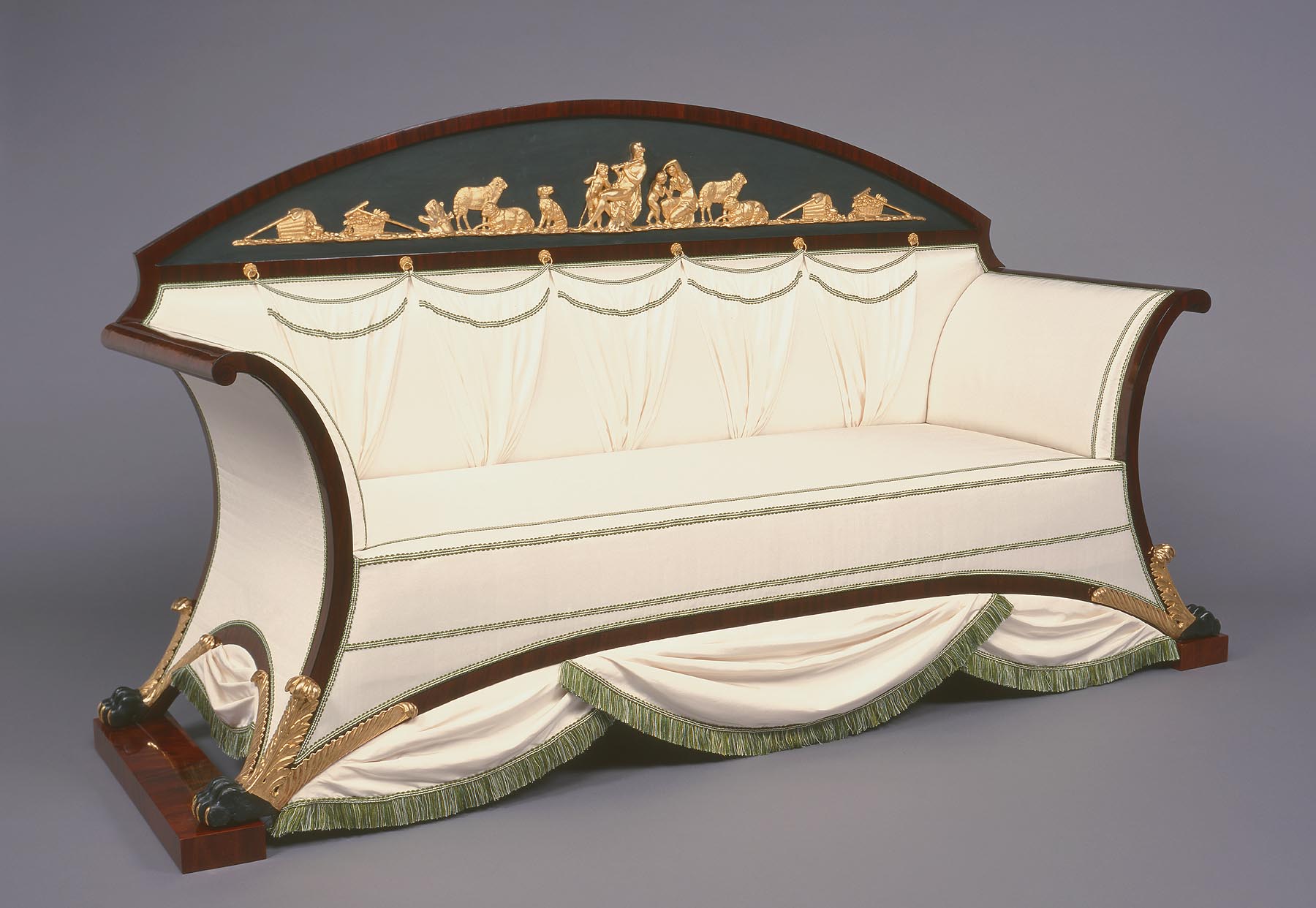
In 2006, when the Milwaukee Art Museum organized the exhibition Biedermeier: The Invention of Simplicity, it established itself as a center of study for the Beidermeier style that was popular in Central and Northern Europe from about 1815 to 1835.
Building upon the Museum’s strength in German and Austrian art—partly due to the ethnic background of Milwaukee—the exhibition brought to the spotlight to Biedermeier art. This period of art and design history was not only little-known in the United States, but the exhibition also proposed a whole new interpretation of the style that changed scholarship in Europe as well. You can read more about Biedermeier here in this review from the New York Times.
Or better yet, read the exhibition catalogue, available for purchase on the Museum Store site.


It’s back! After being off view for nearly ten years, the Museum’s popular Possum Trot is back, and it’s kicking, spinning, and singing up a storm. Not to mention riding a bike.
Possum Trot was one of the most famous, extensive environments of self-taught art ever made.

Alas, the Milwaukee Art Museum does not own a Caravaggio painting.
Michelangelo Merisi da Caravaggio (Italian, 1571-1610) was a revolutionary painter who combined theatrical compositions and lighting with realistic depictions of humans to make some of the most dramatic and memorable paintings from the early Baroque period.
Unfortunately, he died young and his paintings are hard to come by. Some of my favorites are The Calling of Saint Matthew in Rome and Saint John the Baptist in the Wilderness in Kansas City’s Nelson-Atkins Museum.
But no need to despair! Many artists who traveled to Italy in the 17th century—and lots who didn’t—were inspired to use the style of the great artist Caravaggio. The Milwaukee Art Museum has great paintings by some of these northern European artists, which hang in Gallery #5 with Northern Baroque paintings. Two of them—Christ before the High Priest by Mathias Stom and Mars, God of War by Gerrit von Honthorst—are by well-known artists of the phenomenon.
I’ve found myself recently admiring one in particular, by the least-known artist in the gallery: Gluttony by Jacques de l’Ange.

I’m a Modernist. Give me George Nelson over the Herter Brothers any day.
But all my normal predilections aside, I do love this sofa in the Museum’s collection. It is positively dripping with flowers and leaves and fruit, puffed up with ornament and upholstery stuffing, and tufted on every square inch of its way-too-high-to-be-practical back.
This sofa is exactly the type of “disingenuous” factory-produced Victorian-era object that the reforming Modern designers of the early 20th century–heck, many stylish designers of today–decried as soulless.
So in the spirit of Valentine’s Day–a holiday that is also decried by cynics (me included) as soulless, mass-produced, and disingenuous–I thought I’d ignore all the star-crossed and wanton lovers in Museum paintings to point out this great red sofa that seems to embody all the over-the-top love and lust and chocolate truffles of this greeting card holiday.
This is the Valentine’s Day of furniture. A guilty pleasure we love.

On December 14, 1894, Frederick Layton, the Milwaukee meat packer and philanthropist who founded the Layton Art Gallery (the predecessor of the Milwaukee Art Museum), wrote a letter to Julius Gugler of the Milwaukee Art Association.
Layton requested the organization to raise $10,000 by subscription to purchase a painting by Lawrence Alma-Tadema which was currently on display at Milwaukee’s Pfister Hotel as a loan from one of Layton’s art dealer friends.
The subscription must have been successful, because the Layton Art Collection at the Milwaukee Art Museum has a wonderful painting by Alma-Tadema!
This painting, called A Roman Amateur, can be found in Gallery #10 with other works of 19th-century European art.