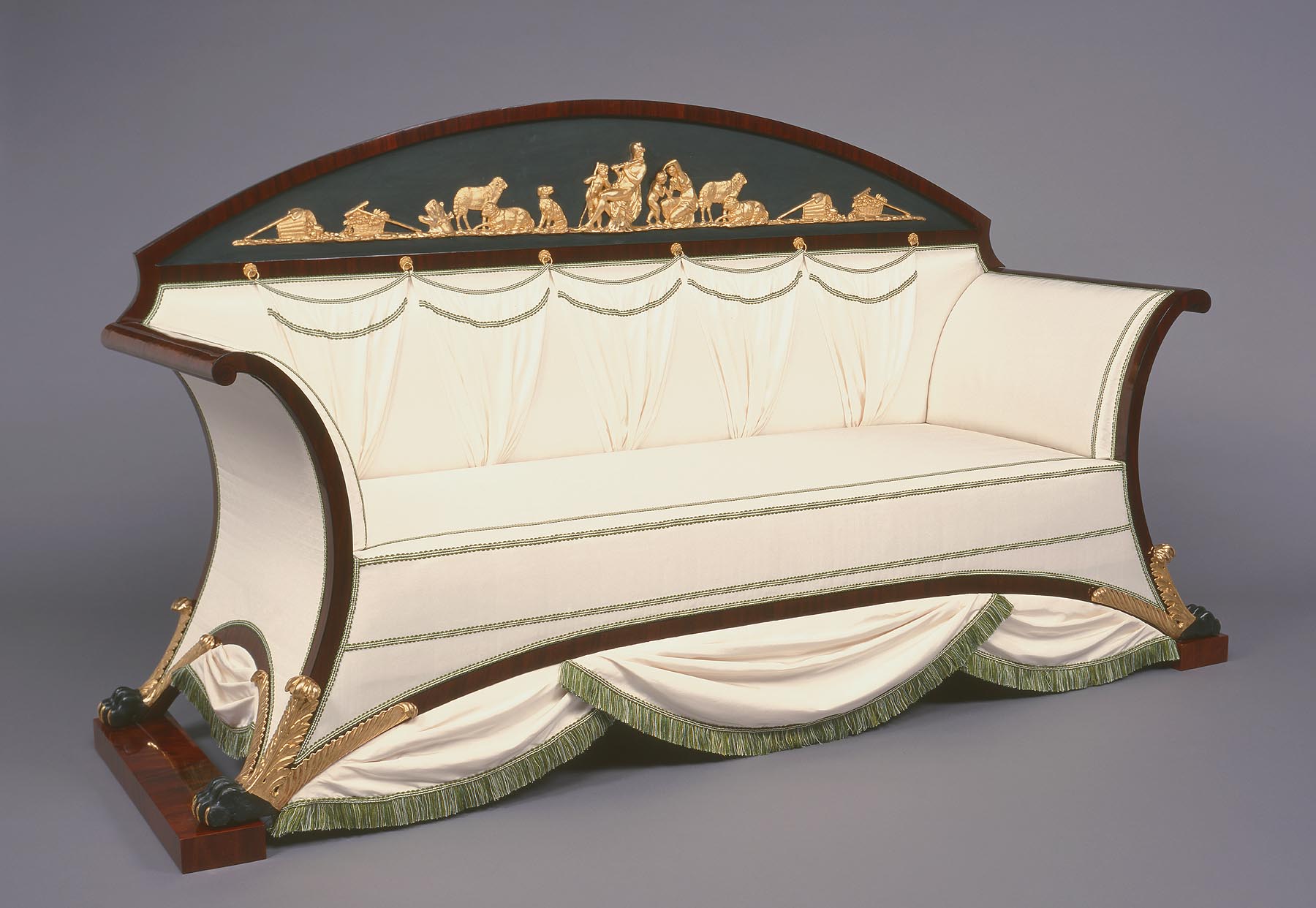
Franz Ittenbach (German, 1813–1879), Mother of the World, 1872. Oil on panel. Milwaukee Art Museum, Purchase, René von Schleinitz Memorial Fund and with funds in memory of Betty Croasdaile and John E. Julien.
From the glittery gold background to the touching depiction of the Madonna and child, the Milwaukee Art Museum’s new acquisition Mother of the World by Franz Ittenbach (German, 1813–1879) is a perfect subject for our blog post during the weeks leading up to Christmas.
Camille Pissarro (French, 1830–1903), Vegetable Market at Pontoise, 1891. Etching, drypoint, and aquatint. Milwaukee Art Museum, Maurice and Esther Leah Ritz Collection M2004.283. Photo credit: Efraim Lev-er.
A bustling market welcomes the viewer of Impressionist artist Camille Pissarro’s Vegetable Market at Pontoise. We can almost hear the commotion of the rural village where he lived for some time.
Playing the part of both voyeur and companion, we stand behind a woman selling her vegetables. A young woman stops in front of us, deliberating whether or not she would like to buy what is gently offered to her. We can nearly hear their more quiet conversation in the midst of the lively square where all individuals congregate without segregation of rank. There are men with top hats conversing and women in fine dresses strolling, while others are clearly from a more modest upbringing.
A number of artists featured in the special exhibitionOf Heaven and Earth: 500 Years of Italian Painting from Glasgow Museums are represented in the collection of the Milwaukee Art Museum. This is the third in a series of blog posts that will highlight Milwaukee’s paintings during the run of the exhibition.
Antonio Mancini (Italian, 1852–1930), On the Eve of Her Wedding, ca. 1882. Oil on canvas. Milwaukee Art Museum, Gift of Mrs. S. S. Merrill M1919.33. Photo by John Glembin.
In researching a museum’s collection, the story behind the acquisition of an artwork can sometimes be just as interesting as the artwork itself. The Milwaukee Art Museum’s On the Eve of Her Wedding by Antonio Mancini (Italian, 1852-1930) is a great example.
Mancini began his artistic studies at the age of 12. In 1875 and again in 1877, he visited Paris—then the center of the avant-garde world—where he met French Impressioninists Edgar Degas (French, 1834-1917) and Edouard Manet (French, 1832-1883). Mancini’s loose, expressive brushstroke and dark color choices were clearly influenced by Manet. At one point, John Singer Sargent (American, 1856-1925) declared Mancini to be the greatest living painter.
Edgar Degas (French, 1834–1917), Dancer Holding Her Right Foot in Her Right Hand [Danseuse tenant son pied droit dans la main droit], ca. 1904; cast 1919–20. Bronze. Purchase, Bradley Conservation Endowment Fund M1984.70. Photo credit: John R. Glembin.Though many of his formal principles are similar, Edgar Degas (1834–1917) stands out from the other major Impressionists because of his decision to depict urban spaces and the people that inhabit them, rather than natural landscapes. Arguably Degas’ most famous subject is the Parisian Opéra and its ballet dancers.
Edward William Cooke (English, 1811–1880). The Pilot Boat (Trouville Fishing Boat in a Fresh Breeze), ca. 1839. Oil on canvas. Milwaukee Art Museum, Layton Art Collection, Gift of Frederick Layton. Photo credit John R. Glembin
Last month we explored the history of the salon-hang style used in Gallery 10, which has been reopened as Mr. Layton’s Gallery. A glance around tells a lot about what kind of art was popular in the late 19th century in America: sculpture is clean, white marble; paintings by European and American artists fit into easily described categories (landscape, genre, still-life), or they are inspired by the classical past.
There is nothing truly avant-garde here. No Courbet, no Manet, no Monet, no Gauguin. Most of this artwork stands firmly in the tradition of art as it was understood for centuries. In fact, Homer and His Guide may even have been a direct rebuttal to the type of artwork shown at the First Impressionist Exhibition of 1874. Bougereau’s powerful painting reflects the survival of the classical, in both poetry and art, while facing adversity.
Although most of the beautiful objects from the early history of the Layton Art Collection are not ground-breaking, they are important to the time. And many of them still show the influence of the artists leading the attack on the art establishment.
So let’s take a look at some of the paintings that have come “out of the vault!”
The Museum’s current exhibition Posters of Paris: Toulouse-Lautrec and his Contemporaries features a number of posters by Pierre Bonnard (French, 1867-1947)—including the fantastic France-Champagne lithograph, a work that inspired the master Henri de Toulouse-Lautrec to make ground-breaking posters.
Did you know that the Museum’s Permanent Collection has two paintings by Bonnard?
The paintings are gorgeous, and can be found on the upper level in the Bradley Collection Galleries.
One of the two paintings, Girl in Straw Hat (Femme au Chapeau Rouge), has long been one of my personal favorite artworks. I suspect that Girl in Straw Hat was also one of Mrs. Bradley’s favorites, and there is good reason why.
Mihály Munkácsy (Hungarian, 1844–1900), The Rivals (Little Kittens), 1885. Oil on wood panel, 34 3/4 x 45 11/16 in. Milwaukee Art Museum, Layton Art Collection, Gift of Frederick Layton L139. Photo credit P. Richard Eells.
The painting shows a woman (mother #1) and her child on a sofa watching two kittens wrestling. Meanwhile, a cat (mother #2) sits on the floor, watching the tussle from below.
Dated 1885, The Rivals shows us a comfortable French drawing room of what Americans recognized as the Victorian period. This family is clearly well-off financially, with up-to-date furnishings, opulent red decorations, and a fantastic potted plant. Visible in the lower left, even the cat has her own fur-lined bed. In fact, having housecats at all meant the family was of means. In the late 19th century, it had become a popular trend for the upper middle class to own cats.
As can be deduced by the family-oriented subject, the painting was aimed at a bourgeois market interested in displaying ideals such as domesticity, prosperity, and refinement. These were known as salon pictures, which is the French word for living room.
Face Jug, 1860-1880. Chipstone Foundation. Photo by Jim Wildeman.
Last month I wrote about the Chipstone Foundation’s new acquisition, an early Edgefield face jug with writing on the back. Since then, our curatorial team has uncovered the meaning behind the elusive inscription. Before revealing this discovery, I’ll catch you up on new research for Face Jugs: Art and Ritual in 19th-Century South Carolina, on view until August 5 at the Milwaukee Art Museum.
“Face jugs” is a term created by art historians, historians and archeologists to refer to turned stoneware vessels with applied faces. The eyes and the teeth are made of kaolin, a white river clay that is one of the primary components of porcelain. You will notice when you visit the exhibition that there are also face cups and face pitchers.
Many different cultures have created pottery with faces or human elements, but the Edgefield face jugs are unique.
In 2006, when the Milwaukee Art Museum organized the exhibition Biedermeier: The Invention of Simplicity, it established itself as a center of study for the Beidermeier style that was popular in Central and Northern Europe from about 1815 to 1835.
Building upon the Museum’s strength in German and Austrian art—partly due to the ethnic background of Milwaukee—the exhibition brought to the spotlight to Biedermeier art. This period of art and design history was not only little-known in the United States, but the exhibition also proposed a whole new interpretation of the style that changed scholarship in Europe as well. You can read more about Biedermeier here in this review from the New York Times.
But all my normal predilections aside, I do love this sofa in the Museum’s collection. It is positively dripping with flowers and leaves and fruit, puffed up with ornament and upholstery stuffing, and tufted on every square inch of its way-too-high-to-be-practical back.
This sofa is exactly the type of “disingenuous” factory-produced Victorian-era object that the reforming Modern designers of the early 20th century–heck, many stylish designers of today–decried as soulless.
So in the spirit of Valentine’s Day–a holiday that is also decried by cynics (me included) as soulless, mass-produced, and disingenuous–I thought I’d ignore all the star-crossed and wanton lovers in Museum paintings to point out this great red sofa that seems to embody all the over-the-top love and lust and chocolate truffles of this greeting card holiday.
This is the Valentine’s Day of furniture. A guilty pleasure we love.



![Edgar Degas (French, 1834–1917), Dancer Holding Her Right Foot in Her Right Hand [Danseuse tenant son pied droit dans la main droit], ca. 1904; cast 1919–20. Bronze. Purchase, Bradley Conservation Endowment Fund M1984.70. Photo credit: John R. Glembin.](http://blog.mam.org/wp-content/uploads/2014/08/degasr_m1984_70.jpg?w=235)