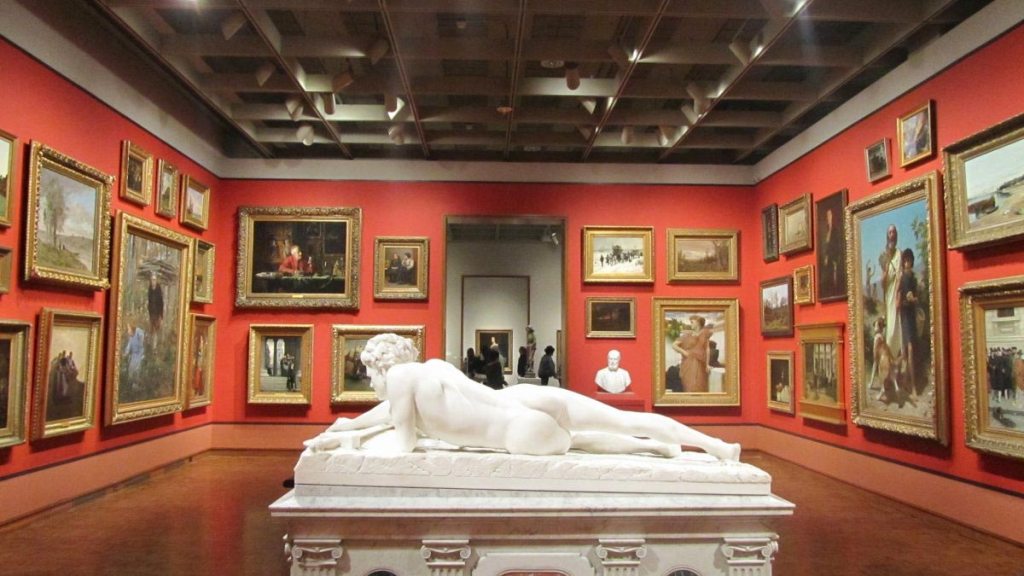
If you’ve been in the European galleries in the last few weeks, you’ve probably noticed a dramatic transformation in Gallery 10!
The gallery has been reinstalled as part of the celebrations of the 125th anniversary of the founding of the Layton Art Gallery, which laid the foundation for what would become the Milwaukee Art Museum. We’ve decided to call it Mr. Layton’s Gallery, after Milwaukee philanthropist Frederick Layton, who started it all.
Anthony van Dyck and Studio. Margaret, Lady Tufton, ca. 1632. Oil on canvas. Milwaukee Art Museum, Gift of Mr. and Mrs. William D. Vogel. Photo credit John R. Glembin
Recently brought out of the vault for display in Gallery #5 is a portrait of Margaret, Lady Tufton (1636-1687). A beauty of the English court, she was the granddaughter of Edward, 1st Baron Wotton, a diplomat and court official for Queen Elizabeth I.
Margaret is shown in her elegant silk gown (which is actually an informal dress because of the loose, flowing fabric and lack of lace collar and cuffs; it shows a significant amount of bare skin!). She has beautifully arranged curls and wears expensive matched pearls. To accentuate her loveliness, she holds delicate roses in her lap.
When this painting entered the Milwaukee Art Museum’s collection in 1956, it was heralded as a masterpiece of the Flemish painter Anthony van Dyck (1599–1641). Van Dyck was one of the greatest portrait painters of all time. He influenced generations of later portrait painters, including Thomas Gainsborough (English, 1727-1788). Using brilliant brushwork, elegant compositions, and luscious textiles, he gives his subjects an easy aristocratic air while still making it clear that they are beautiful, virtuous, and powerful.
But now the artist of this work is listed as “Anthony van Dyck and Studio.” What does this mean?
In the manner of David Altenstetter Augsburg, Germany, d. 1617. Mirror, ca. 1600. Enamel, silver, and gilt. Milwaukee Art Museum, Purchase, with funds from Avis Martin Heller in honor of the Fine Arts Society. Photo credit John R. Glembin.
Created around 1600 in the metalworking center of Augsburg, Germany, it demonstrates the technical skill and fantastic design indicative of the region. The mount includes cherubs, mythological figures, and foliate designs that masterfully come together in one fabulous whole. These decorative elements are most likely based upon contemporary books published by German artists, which in turn are Renaissance in style because they draw inspiration from antiquity.
In particular, the basse-taille technique (when colored glass fills a pattern engraved or carved into the metal), which is used on the inner frame, makes this mirror a rare object. This high-quality version of the enamel was pioneered by the Augsburg goldsmith David Altenstetter (ca. 1547-1617). Only a handful of objects in museums world-wide incorporate this type of enamel-work, which puts the Museum in the company of institutions such as the Wallace Collection in London and the Kunsthistorisches Museum in Vienna.
Ernst Ferdinand Oehme (German, 1797–1855), Meissen in Winter, 1854. Detail. Oil on canvas; 27 x 23 in. Milwaukee Art Museum, Gift of the René von Schleinitz Foundation M1962.105. Photo credit P. Richard Eells.
Speaking of the holidays, one of my favorite paintings in the Museum Collection is Meissen in Winter by German artist Ernst Ferdinand Oehme. Oehme (pronounced EHR-ma) shows us a snowy street in the German town, with the church tower silhouetted against the dusky sky, and a single star shining brightly.
I’ve seen many evenings like this in Wisconsin!
A few inhabitants have braved the cold, crisp air in this Meissen scene: a couple is talking a walk, a man makes his way up the hill, and a gentleman in the foreground has stopped to gaze up at a brightly lit bay window with a cheerfully decorated Christmas tree shown in the detail at left.
The holiday scene is subtle, quiet and calm—and clearly chilly—but I think that the happy glow of that window and the hopeful promise of the single star in the darkening sky are reassuring in what could be a desolate winter scene.
John Hoppner (English, 1758–1810), Portrait of Jane Emma Orde, ca. 1806. Oil on canvas; 30 1/8 x 25 7/16 in. (76.52 x 64.61 cm). Milwaukee Art Museum, Bequest of Josephine S. McGeoch in Memory of her husband, Gordon McGeoch M1983.197 Photo credit John R. Glembin
Through January 13, 2013, the Milwaukee Art Museum will have on display 48 fantastic paintings by some of the most important artists in history. Rembrandt, Van Dyck, Gainsborough: Treasures from the Kenwood House, London is a great opportunity to see art that usually resides across the Atlantic Ocean in England.
But did you know that there are some works by these same artists in the Museum’s permanent collection?
Corrado Giaquinto (Italian, 1703–1766), The Triumph of Galatea, ca. 1752. Detail. Oil on canvas; 33 1/2 x 48 1/2 in. Milwaukee Art Museum, Gift of Mr. and Mrs. Myron Laskin M1970.68.2 Photo credit Larry Sanders.
In my August post for the Museum’s blog, Mythology at the Milwaukee Art Museum-Part 1, I focused on some great examples of Classical mythological figures in the Museum’s Collection—hopefully with the result that you will be able to identify those characters the next time you see them.
This month, I am going to explore another aspect of mythology in art. (Don’t worry, we’ll still learn how to identify a myth or two.) But we’ll also see that classical mythology can be both straightforward and convoluted at the same time.
First, let’s start with a basic question: what is “myth”?
There is a lot of scholarship on the definition and meaning of myth in disciplines such as anthropology.
Detail of Athena pendant. Sofonisba Anguissola, The Artist’s Sister Minerva Anguissola, ca. 1564. Layton Art Collection. Full image below.
It’s hard to study art and not learn something about classical mythology. The gods and heroes of ancient Greece and Rome are not only prevalent in ancient art (as in the Museum’s two Greek Hydria), but in later periods such as the Renaissance (which saw a “rebirth” of classical antiquity, which you can see in our Orpheus Clock) and the Neoclassical era (a perfect example is Hiram Powers’ Proserpine).
So, for the next two months, I want to take you on a tour of the Museum Collection with mythology as our theme. And what’s fun about myth is that once you learn some of the basics in iconography, or the standard in how figures and stories are depicted, you’ll be able to recognize it in other works at other museums, and even in daily walks around your city or shopping mall.
The Museum’s current exhibition Posters of Paris: Toulouse-Lautrec and his Contemporaries features a number of posters by Pierre Bonnard (French, 1867-1947)—including the fantastic France-Champagne lithograph, a work that inspired the master Henri de Toulouse-Lautrec to make ground-breaking posters.
Did you know that the Museum’s Permanent Collection has two paintings by Bonnard?
The paintings are gorgeous, and can be found on the upper level in the Bradley Collection Galleries.
One of the two paintings, Girl in Straw Hat (Femme au Chapeau Rouge), has long been one of my personal favorite artworks. I suspect that Girl in Straw Hat was also one of Mrs. Bradley’s favorites, and there is good reason why.
Flemish or South German, Nautilus Cup, 1575/1625. Shell, gilt bronze, copper, silver, and semiprecious gems; 12 1/2 x 7 1/2 x 3 3/4 in. Purchase, with funds from Donald and Donna Baumgartner, M2002.170. Photo credit John Nienhuis.
At first glance, the Museum’s stunning Nautilus Cup looks like an impractical way to drink. Tankards and beakers, which are also on display in the Museum’s Gallery #2, make sensible drinking vessels. In comparison the nautilus cup, a chambered nautilus shell mounted with elaborate metal work, perhaps could function as a drinking vessel, but seems more convincing as an aesthetic object.
Because it is gorgeous.
Would anyone use this stunning object to serve beverages? If not, why would anyone have this kind of odd-shaped cup? What did it mean?
In directly combing man’s art with God’s nature, a nautilus cup was the type of treasure that would have been housed in a Renaissance Wunderkammer.
Wunderkammer were privately-owned collections that are considered the predecessor of the modern museum. German for “room of wonder” or “cabinet of curiosities,” Wunderkammer developed in mid-16th-century Europe and celebrated man-made arts and also natural arts, with minerals, ivory, ostrich eggs, coconut shells, nautilus shells, and other exotic objects.
Mihály Munkácsy (Hungarian, 1844–1900), The Rivals (Little Kittens), 1885. Oil on wood panel, 34 3/4 x 45 11/16 in. Milwaukee Art Museum, Layton Art Collection, Gift of Frederick Layton L139. Photo credit P. Richard Eells.
The painting shows a woman (mother #1) and her child on a sofa watching two kittens wrestling. Meanwhile, a cat (mother #2) sits on the floor, watching the tussle from below.
Dated 1885, The Rivals shows us a comfortable French drawing room of what Americans recognized as the Victorian period. This family is clearly well-off financially, with up-to-date furnishings, opulent red decorations, and a fantastic potted plant. Visible in the lower left, even the cat has her own fur-lined bed. In fact, having housecats at all meant the family was of means. In the late 19th century, it had become a popular trend for the upper middle class to own cats.
As can be deduced by the family-oriented subject, the painting was aimed at a bourgeois market interested in displaying ideals such as domesticity, prosperity, and refinement. These were known as salon pictures, which is the French word for living room.