The Museum’s current exhibition Posters of Paris: Toulouse-Lautrec and his Contemporaries features a number of posters by Pierre Bonnard (French, 1867-1947)—including the fantastic France-Champagne lithograph, a work that inspired the master Henri de Toulouse-Lautrec to make ground-breaking posters.
Did you know that the Museum’s Permanent Collection has two paintings by Bonnard?
The paintings are gorgeous, and can be found on the upper level in the Bradley Collection Galleries.
One of the two paintings, Girl in Straw Hat (Femme au Chapeau Rouge), has long been one of my personal favorite artworks. I suspect that Girl in Straw Hat was also one of Mrs. Bradley’s favorites, and there is good reason why.
Cyril Colnik (American, b. Austria, 1871–1958), Hanging Basket, ca. 1900. Detail. Iron, glass; 35 x 8 x 8 in. Milwaukee Art Museum, Purchase, with funds from the American Arts Society M2012.299a–d. Photo by the author.
Though the Museum’s mission is to present, in our official lingo, “four floors of over forty galleries of art with works from antiquity to the present,” I’m probably not alone among curators in getting most excited when we acquire and exhibit world-class artwork made in Milwaukee, Wisconsin.
This year, I was thrilled to work with our Museum’s support group dedicated to American fine and decorative arts (the American Arts Society, or AAS) to bring to the Museum’s Collection a fantastic iron hanging basket that was designed, made, and kept in Milwaukee.
While operating The Ornamental Iron Shop for over 60 years in Milwaukee, master iron artisan Cyril Colnik (American, b. Austria, 1871–1958) moved with changing fashions of his posh clientele in the finest homes of this city.
It you see stunning ironwork in Milwaukee, it’s probably by Colnik. To walk on the East Side, or along Lake Drive, is to enjoy a veritable open air Colnik museum.
And now, thanks to the American Arts Society, his artwork is also within the galleries of the Museum!
Flemish or South German, Nautilus Cup, 1575/1625. Shell, gilt bronze, copper, silver, and semiprecious gems; 12 1/2 x 7 1/2 x 3 3/4 in. Purchase, with funds from Donald and Donna Baumgartner, M2002.170. Photo credit John Nienhuis.
At first glance, the Museum’s stunning Nautilus Cup looks like an impractical way to drink. Tankards and beakers, which are also on display in the Museum’s Gallery #2, make sensible drinking vessels. In comparison the nautilus cup, a chambered nautilus shell mounted with elaborate metal work, perhaps could function as a drinking vessel, but seems more convincing as an aesthetic object.
Because it is gorgeous.
Would anyone use this stunning object to serve beverages? If not, why would anyone have this kind of odd-shaped cup? What did it mean?
In directly combing man’s art with God’s nature, a nautilus cup was the type of treasure that would have been housed in a Renaissance Wunderkammer.
Wunderkammer were privately-owned collections that are considered the predecessor of the modern museum. German for “room of wonder” or “cabinet of curiosities,” Wunderkammer developed in mid-16th-century Europe and celebrated man-made arts and also natural arts, with minerals, ivory, ostrich eggs, coconut shells, nautilus shells, and other exotic objects.
Carl Andre’s 144 Pieces of Zinc is one of the few artworks in the Museum’s Collection that is meant to be experienced physically, and that visitors may touch. The artist felt that the qualities inherent in the material were the most important aspect of his work, and that they were meant to be discovered through touch.
Imagine 144 Pieces of Zinc wasn’t in a museum, but, say, come upon in a hardware store surrounded by a bunch of home improvement tiles. You don’t have to imagine. The Tate Museum did it. They installed their collection’s 144 Magnesium Square on the floor in a hardware store in Liverpool, England, and then asked residents of Liverpool what they thought about seeing the minimalist work in a non-art context.
Attributed to Gerardus Duyckinck I (American, 1695–1746), Portrait of Jacomina Winkler, ca. 1735. Oil on canvas, 30 x 25 in. Milwaukee Art Museum, Layton Art Collection, Purchase L1994.2. Photo by John R. Glembin.
Summer traditionally ends with dog days. You know those hot, listless, airless spans in August that have people dreaming of thunderstorms and cold fronts.
But why not begin summer with a thought about dogs?
This is not hard for me, as my life is ruled by two dogs (below you’ll find a picture of one of them, my alpha Westie, Alice). Thus, this blog post combines two of my favorite things—portraiture and dogs—to take a closer look at a work of art in the Museum’s permanent collection.
Around 1735, the New York artist Gerardus Duyckinck I painted the portrait of young Jacomina Winkler, who was probably ten or twelve. Jacomina’s father had been a merchant in the Dutch East Indies and had settled in Colonial New York, a place with long-standing ancestral Dutch colonial ties.
There is a lot to love in this portrait, from young Jacomina’s sweet expression to the hard-edged, linear quality of Duyckinck’s contour lines. The folds in the red mantle (coat) that Miss Winkler wears are stiffer than beaten meringue peaks.
But what I love the best, of course, is the dog in her lap. This is not just any old dog, but a Cavalier King Charles Spaniel…and a very unhappy Cavalier King Charles Spaniel, at that. You just know that this dog is the kind who’s going to snap at you if you try to pet it.
Mihály Munkácsy (Hungarian, 1844–1900), The Rivals (Little Kittens), 1885. Oil on wood panel, 34 3/4 x 45 11/16 in. Milwaukee Art Museum, Layton Art Collection, Gift of Frederick Layton L139. Photo credit P. Richard Eells.
The painting shows a woman (mother #1) and her child on a sofa watching two kittens wrestling. Meanwhile, a cat (mother #2) sits on the floor, watching the tussle from below.
Dated 1885, The Rivals shows us a comfortable French drawing room of what Americans recognized as the Victorian period. This family is clearly well-off financially, with up-to-date furnishings, opulent red decorations, and a fantastic potted plant. Visible in the lower left, even the cat has her own fur-lined bed. In fact, having housecats at all meant the family was of means. In the late 19th century, it had become a popular trend for the upper middle class to own cats.
As can be deduced by the family-oriented subject, the painting was aimed at a bourgeois market interested in displaying ideals such as domesticity, prosperity, and refinement. These were known as salon pictures, which is the French word for living room.
French, Head of a Noblewoman, 14th century. Marble; H: 11 3/4 in. Milwaukee Art Museum, Gift of The William Randolph Hearst Foundation through the Milwaukee Sentinel M1958.67. Photo by John Nienhuis.
Just as you walk into the Museum’s Gallery #3 (Northern Renaissance artworks), on your right is a display case that holds a marble sculpture.
It’s an unobtrusive work labeled Head of a Noblewoman, French, 14th century. I’m sure many Museum visitors have walked right by it and not even thought twice. The most interesting thing for those that look closer may be the way the artwork is positioned in the case–it is shown lying down, not upright.
This sculpture is more than just a portrait of a French noblewoman. It’s a portrait of the noble French woman from her tomb!
Originally, the Museum’s head sculpture would have been part of a full body sculpture of the woman lying down, and it would have rested above her tomb. You can be certain of this orientation because the back of her head is unfinished.
Although funerary portraits were used as far back as the ancient Egyptians, medieval Europe saw an explosion of them. Examples are known from the 11th century, and by the 13th century they were filling churches and abbeys. Of course, only those who could afford to have an elaborate tomb could have such an elaborate sculpture, so most examples are of kings, queens, and other nobility, including knights, such as Jean d’Alluye, whose tomb effigy is now at the Metropolitan Museum of Art.
Since Easter is Sunday, I thought it would be fitting to write an Easter-themed blog post for the occasion. But other than choosing a piece of art depicting the crucifixion of Christ, I wasn’t exactly sure how I could approach the topic.
Therefore in the spirit of Easter egg hunts I have decided to make a two-fold hunt of my own to find out more about pieces in the Museum’s collection as well as creating a post that is related to the holiday.
Let’s use a little game by the name of “Six Degrees of Kevin Bacon” (or more simply “Six Degrees of Separation”) to relate a non-Easter-themed work of art to the holiday!
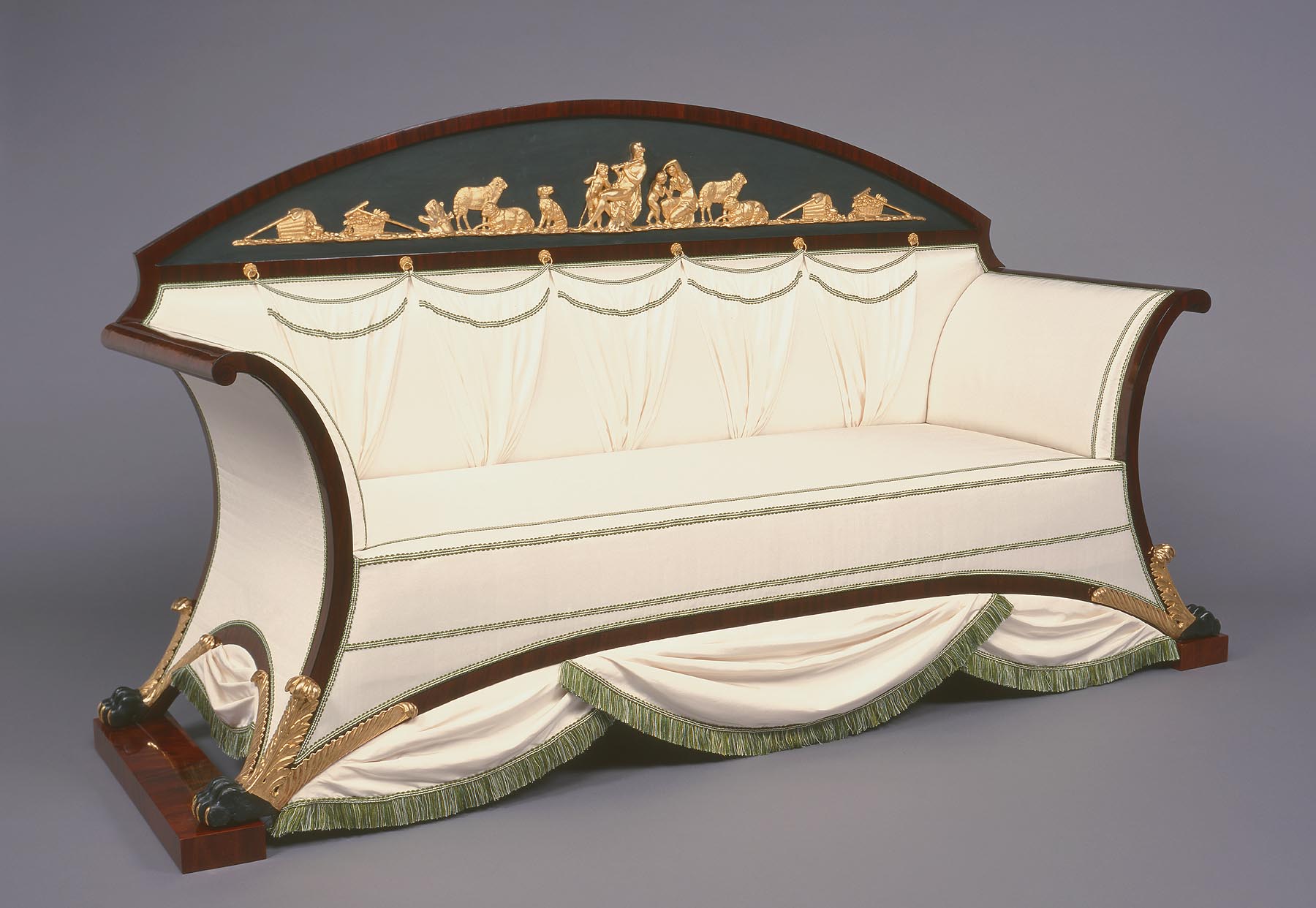
In 2006, when the Milwaukee Art Museum organized the exhibition Biedermeier: The Invention of Simplicity, it established itself as a center of study for the Beidermeier style that was popular in Central and Northern Europe from about 1815 to 1835.
Building upon the Museum’s strength in German and Austrian art—partly due to the ethnic background of Milwaukee—the exhibition brought to the spotlight to Biedermeier art. This period of art and design history was not only little-known in the United States, but the exhibition also proposed a whole new interpretation of the style that changed scholarship in Europe as well. You can read more about Biedermeier here in this review from the New York Times.
The year 2012 is considered the 50th anniversary of the American Studio Glass movement. The anniversary is being celebrated with exhibitions and events across the country, organized in large part by the Art Alliance for Contemporary Glass.
The Milwaukee Art Museum has a terrific collection of studio glass, and we were thrilled to be part of the celebration. Along one wall of the newly-designed Kohl’s Art Generation Studio is a new installation that celebrates using glass as a medium of creative impulse.
The glass sparkles, tells an important art history story, and I hope that its visual beauty inspires young artists as they create their own artwork nearby.
What is the American Studio Glass movement, and what is this anniversary?