Categories
Art Collection Contemporary Curatorial

Can I walk on it?

Carl Andre (American, b. 1935) 144 Pieces of Zinc, 1967 Zinc plates each plate: 12 x 12 x 3/8 in. (30.48 x 30.48 x 0.95 cm) Purchase, National Endowment for the Arts Matching Funds M1969.22 Photo credit Larry Sanders © Carl Andre/Licensed by VAGA, New York, NY
Carl Andre (American, b. 1935), 144 Pieces of Zinc, 1967. Zinc plates;
each plate: 12 x 12 x 3/8 in. Milwaukee Art Museum, Purchase, National Endowment for the Arts Matching Funds M1969.22.
Photo by Larry Sanders.
© Carl Andre/Licensed by VAGA, New York, NY

Yes!

Carl Andre’s 144 Pieces of Zinc is one of the few artworks in the Museum’s Collection that is meant to be experienced physically, and that visitors may touch.  The artist felt that the qualities inherent in the material were the most important aspect of his work, and that they were meant to be discovered through touch.

Imagine 144 Pieces of Zinc wasn’t in a museum, but, say, come upon in a hardware store surrounded by a bunch of home improvement tiles.   You don’t have to imagine.  The Tate Museum did it.  They installed their collection’s 144 Magnesium Square on the floor in a hardware store in Liverpool, England, and then asked residents of Liverpool what they thought about seeing the minimalist work in a non-art context.

As you see in the video, people have strong feelings about this sort of thing…

Categories
American Art Collection Curatorial

From the Collection—Duyckinck’s Jacomina Winkler (and her crabby dog!)

Attributed to Gerardus Duyckinck I (American, 1695–1746), Portrait of Jacomina Winkler, ca. 1735. Oil on canvas, 30 x 25 in. Milwaukee Art Museum, Layton Art Collection, Purchase L1994.2. Photo by John R. Glembin.

Summer traditionally ends with dog days. You know those hot, listless, airless spans in August that have people dreaming of thunderstorms and cold fronts.

But why not begin summer with a thought about dogs?

This is not hard for me, as my life is ruled by two dogs (below you’ll find a picture of one of them, my alpha Westie, Alice).  Thus, this blog post combines two of my favorite things—portraiture and dogs—to take a closer look at a work of art in the Museum’s permanent collection.

Around 1735, the New York artist Gerardus Duyckinck I painted the portrait of young Jacomina Winkler, who was probably ten or twelve.  Jacomina’s father had been a merchant in the Dutch East Indies and had settled in Colonial New York, a place with long-standing ancestral Dutch colonial ties.

There is a lot to love in this portrait, from young Jacomina’s sweet expression to the hard-edged, linear quality of Duyckinck’s contour lines.  The folds in the red mantle (coat) that Miss Winkler wears are stiffer than beaten meringue peaks.

But what I love the best, of course, is the dog in her lap.  This is not just any old dog, but a Cavalier King Charles Spaniel…and a very unhappy Cavalier King Charles Spaniel, at that.  You just know that this dog is the kind who’s going to snap at you if you try to pet it.

Categories
Art Collection Curatorial European

From the Collection—The Rivals (Little Kittens) by Mihály Munkácsy

Mihály Munkácsy (Hungarian, 1844–1900) The Rivals (Little Kittens), 1885 Oil on wood panel 34 3/4 x 45 11/16 in. (88.27 x 116.05 cm) Layton Art Collection, Gift of Frederick Layton L139 Photo credit P. Richard Eells
Mihály Munkácsy (Hungarian, 1844–1900), The Rivals (Little Kittens), 1885. Oil on wood panel, 34 3/4 x 45 11/16 in. Milwaukee Art Museum, Layton Art Collection, Gift of Frederick Layton L139. Photo credit P. Richard Eells.

In honor of mother’s day this month, I thought that I would write about a painting that not only features one mother, but two!  You’ll find The Rivals (Little Kittens) by Mihály Munkácsy (Hungarian, 1844-1900) in the Museum’s Gallery #10 with 19th-century European paintings.

The painting shows a woman (mother #1) and her child on a sofa watching two kittens wrestling.  Meanwhile, a cat (mother #2) sits on the floor, watching the tussle from below.

Dated 1885, The Rivals shows us a comfortable French drawing room of what Americans recognized as the Victorian period. This family is clearly well-off financially, with up-to-date furnishings, opulent red decorations, and a fantastic potted plant.  Visible in the lower left, even the cat has her own fur-lined bed.  In fact, having housecats at all meant the family was of means.  In the late 19th century, it had become a popular trend for the upper middle class to own cats.

As can be deduced by the family-oriented subject, the painting was aimed at a bourgeois market interested in displaying ideals such as domesticity, prosperity, and refinement. These were known as salon pictures, which is the French word for living room.

Categories
Art Curatorial Exhibitions

Face Jugs—Art and Ritual

Face Jug, 1860-1880 Chipstone Foundation Photo by Jim Wildeman
Face Jug, 1860-1880. Chipstone Foundation. Photo by Jim Wildeman.

Last month I wrote about the Chipstone Foundation’s new acquisition, an early Edgefield face jug with writing on the back. Since then, our curatorial team has uncovered the meaning behind the elusive inscription. Before revealing this discovery, I’ll catch you up on new research for Face Jugs: Art and Ritual in 19th-Century South Carolina, on view until August 5 at the Milwaukee Art Museum.

“Face jugs” is a term created by art historians, historians and archeologists to refer to turned stoneware vessels with applied faces. The eyes and the teeth are made of kaolin, a white river clay that is one of the primary components of porcelain. You will notice when you visit the exhibition that there are also face cups and face pitchers.

Many different cultures have created pottery with faces or human elements, but the Edgefield face jugs are unique.

For starters, we know very little about them.

Categories
Art Behind the Scenes Curatorial

Restoring Duane Hanson’s Beloved “Janitor”

Duane Hanson (American, 1925-1996), Janitor, 1973. Polyester, fiberglass, and mixed media; 65 1/2 x 28 x 22 in. Milwaukee Art Museum, Gift of Friends of Art M1973.91. Photo credit John Nienhuis. © Estate of Duane Hanson/Licensed by VAGA, New York, NY.

Duane Hanson’s lifelike Janitor (1973) is one of the Museum’s most beloved works of art. It generates curiosity on many levels: How did the artist make the sculpture so realistic? What does this photo-realistic artwork mean? What does he wear under his uniform? How does the Museum take care of this unusual work of art?

To that final question, “carefully and creatively” is the answer that the Museum’s Docents recently learned from senior conservator Jim DeYoung. The Milwaukee Art Museum agreed to loan Janitor to the Walker Art Center for the Lifelike exhibition, Feb 25 – May 27, 2012. In preparation for the artwork’s exhibition in Minneapolis, Jim’s conservation team turned their restoration attention and considerable skills to making Janitor appear in pristine condition and ready for travel.

The details of this restoration are fascinating.

Curious about how a conservator cleans 40-year-old human hair affixed to plastic? Hint: They don’t use Head and Shoulders shampoo. Read on to find out more!

Categories
Art Collection Curatorial European

From the Collection– “Head of a Noblewoman” tomb effigy

French, Head of a Noblewoman, 14th century. Marble; H: 11 3/4 in. Milwaukee Art Museum, Gift of The William Randolph Hearst Foundation through the Milwaukee Sentinel M1958.67. Photo by John Nienhuis.

Just as you walk into the Museum’s Gallery #3 (Northern Renaissance artworks), on your right is a display case that holds a marble sculpture.

It’s an unobtrusive work labeled Head of a Noblewoman, French, 14th century.   I’m sure many Museum visitors have walked right by it and not even thought twice.  The most interesting thing for those that look closer may be the way the artwork is positioned in the case–it is shown lying down, not upright.

This sculpture is more than just a portrait of a French noblewoman.  It’s a portrait of the noble French woman from her tomb!

Originally, the Museum’s head sculpture would have been part of a full body sculpture of the woman lying down, and it would have rested above her tomb. You can be certain of this orientation because the back of her head is unfinished.

Although funerary portraits were used as far back as the ancient Egyptians, medieval Europe saw an explosion of them.  Examples are known from the 11th century, and by the 13th century they were filling churches and abbeys.  Of course, only those who could afford to have an elaborate tomb could have such an elaborate sculpture, so most examples are of kings, queens, and other nobility, including knights, such as Jean d’Alluye, whose tomb effigy is now at the Metropolitan Museum of Art.

Categories
Art Collection Curatorial Modern

From Joan Miró to Easter – Six Degrees of Separation

Joán Miró (Spanish, 1893–1983), The King's Jester (Le Fou Du Roi), 1926. Oil, pencil and charcoal on canvas; 45 x 57 1/2 in. Milwaukee Art Museum, Gift of Mr. and Mrs. Maurice W. Berger M1966.142. Photo credit John Nienhuis, Dedra Walls © Successió Miró / Artists Rights Society (ARS), New York / ADAGP, Paris.
Joán Miró (Spanish, 1893–1983), The King's Jester (Le Fou Du Roi), 1926. Oil, pencil and charcoal on canvas; 45 x 57 1/2 in. Milwaukee Art Museum, Gift of Mr. and Mrs. Maurice W. Berger M1966.142.
Photo credit John Nienhuis, Dedra Walls © Successió Miró / Artists Rights Society (ARS), New York / ADAGP, Paris.

Since Easter is Sunday, I thought it would be fitting to write an Easter-themed blog post for the occasion. But other than choosing a piece of art depicting the crucifixion of Christ, I wasn’t exactly sure how I could approach the topic.

Therefore in the spirit of Easter egg hunts I have decided to make a two-fold hunt of my own to find out more about pieces in the Museum’s collection as well as creating a post that is related to the holiday.

Let’s use a little game by the name of “Six Degrees of Kevin Bacon” (or more simply “Six Degrees of Separation”) to relate a non-Easter-themed work of art to the holiday!

Categories
Art Curatorial Exhibitions

Where in the World is….?

In honor of Spring Break, and spring travelers everywhere, let’s send a shout-out to some of our painted friends who have also hit the road lately.  The last time I checked, our artworks were not boozing it up on the beach…but then again, I’m a firm believer that works of art have distinct personalities, so perhaps they do get a little crazy when they’re away from home.

As you may know, museums frequently lend works of art to each other for special exhibitions.  This is why—if you’re an art dork like me—when I visit a temporary exhibition, I always look at the labels next to each work to see where each one has come from.  Sometimes you automatically know, because you recognize something very famous.  And sometimes it’s a great surprise, as in:  “Who knew that there was a Museum of Bellybutton Lint AND that they just happened to have a major painting by Joe Schmo?”

Those of you who attended the Museum’s fall 2011 exhibition Impressionism: Masterworks on Paper exhibition saw fantastic and rare works of art borrowed from our friends and partners at the Albertina in Vienna (where the exhibition is now on view); as well as the Harvard Art Museums and the Art Institute of Chicago, among many others.

In case you’re traveling yourselves over the next few months, you might run into some of your Milwaukee hometown artistic pals in the following shows.

Categories
Art Collection Curatorial European Exhibitions

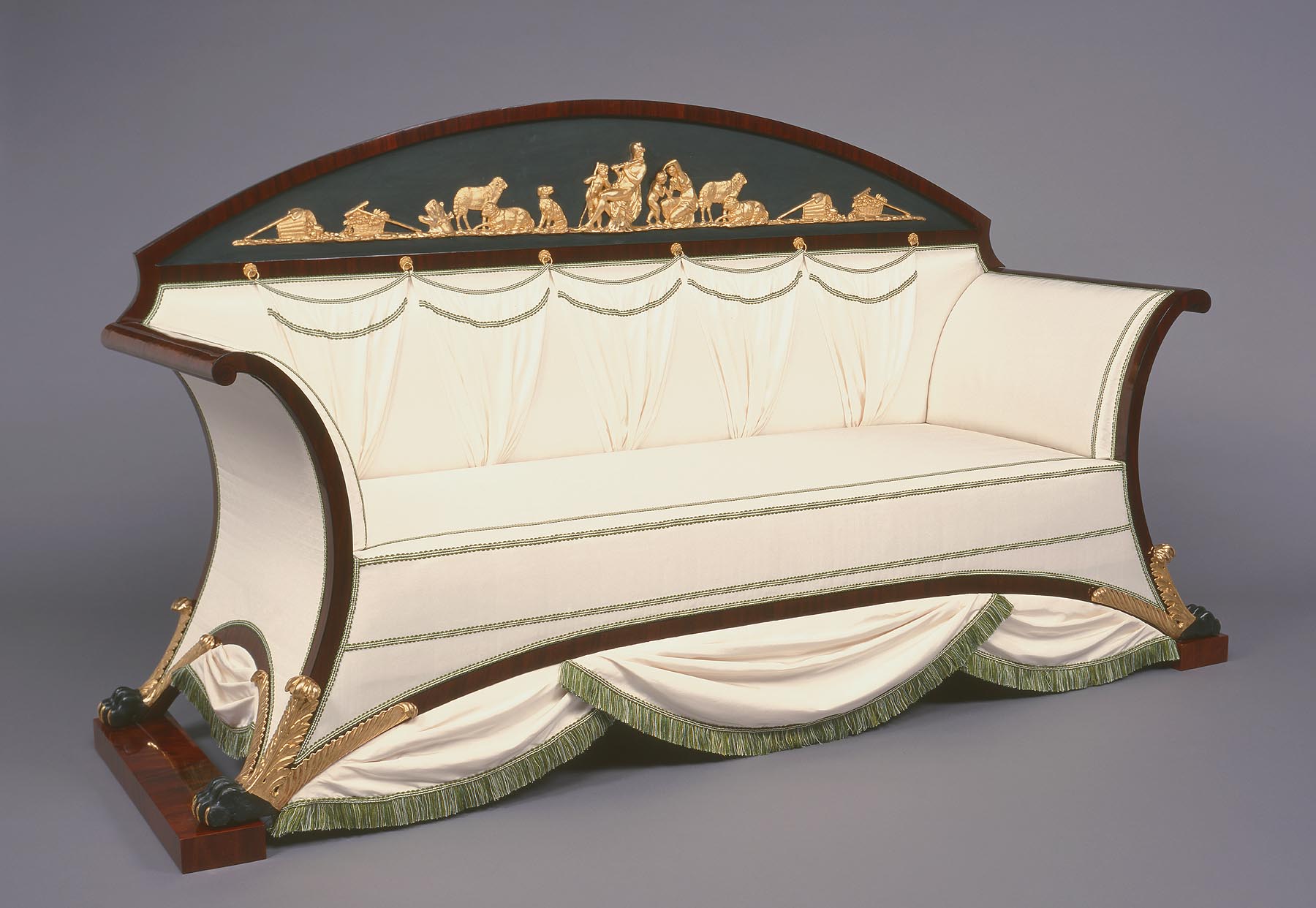
From the Collection–Biedermeier Settee

In 2006, when the Milwaukee Art Museum organized the exhibition Biedermeier: The Invention of Simplicity, it established itself as a center of study for the Beidermeier style that was popular in Central and Northern Europe from about 1815 to 1835.

Building upon the Museum’s strength in German and Austrian art—partly due to the ethnic background of Milwaukee—the exhibition brought to the spotlight to Biedermeier art.  This period of art and design history was not only little-known in the United States, but the exhibition also proposed a whole new interpretation of the style that changed scholarship in Europe as well.  You can read more about Biedermeier here in this review from the New York Times.

Or better yet, read the exhibition catalogue, available for purchase on the Museum Store site.

Categories
Art

Chipstone Foundation Acquisition—Face Jug

Face jug.

The Chipstone Foundation’s upcoming exhibition at the Milwaukee Art Museum Face Jugs: Art and Ritual in 19th-century South Carolina opens April 26. I will write more about the exhibition next month, but I want to give you a preview of one of the objects that the Chipstone Foundation just acquired for its collection.

In preparation for the Museum exhibition, I have been researching face jugs and visiting institutions and collectors around the United States for the past year; viewing their collections and learning more about the different forms. Chipstone owned one face jug, which is what first piqued my interest in the subject, but the rest of the objects for the exhibition needed to be borrowed from other institutions and private collections. There is a limited number of the early African American made face jugs, and they don’t come up for sale often.

So then, imagine my surprise and excitement when a few weeks ago Chipstone was offered the opportunity to purchase one of these rare 19th-century vessels!