Categories
Art Curatorial

Matisse versus Picasso

Matisse's colorful "La Musique" is featured in the exhibition Van Gogh to Pollock: Modern Rebels. Come check it out! Photo by the author.
Matisse’s colorful “La Musique” is featured in the exhibition Van Gogh to Pollock: Modern Rebels. Come check it out! Photo by the author.

“If I were not making the paintings I make, I would paint like Matisse,” Pablo Picasso once said of his rival and dear friend, Henri Matisse. Both artists are featured in the Milwaukee Art Museum’s latest exhibition, Van Gogh to Pollock: Modern Rebels.

In the early twentieth century, the relationship between Picasso and Matisse had developed out of a nature of competitiveness and grew to be one of mutual admiration—at times. When Picasso came onto the European modern art scene, Matisse, being eleven years older, had already established himself as a rebel in that world. After meeting in 1906 at the Parisian salon of famous writer Gertrude Stein, the two artists would continuously look to one another’s work to both pose criticism and find inspiration.

Categories
Art Collection Curatorial Modern

From the Collection: Chaïm Soutine’s Children and Geese

Two young children walking in a field
Chaïm Soutine (Russian, 1893–1943, active in France), Children and Geese, 1934 (detail). Oil on canvas. Milwaukee Art Museum, Gift of Mrs. Harry Lynde Bradley M1959.375. Photo credit: Efraim Lev-er. ©2010 Artists Rights Society (ARS), New York / ADAGP, Paris.
Two young children walking in a field
Chaïm Soutine (Russian, 1893–1943, active in France), Children and Geese, 1934. Oil on canvas. Milwaukee Art Museum, Gift of Mrs. Harry Lynde Bradley M1959.375. Photo credit: Efraim Lev-er. ©2010 Artists Rights Society (ARS), New York / ADAGP, Paris.

Many of the artists featured in the special exhibition Van Gogh to Pollock: Modern Rebels, Masterworks from the Albright-Knox Art Gallery are also represented in the collection of the Milwaukee Art Museum. This is the third in a series of blog posts that will highlight Milwaukee’s artworks during the run of the exhibition.

Comparing the painting by Chaïm Soutine (Russian, 1893–1943, active in France) in the Modern Rebels show (Carcass of Beef) with the one in the Milwaukee Art Museum’s collection (Children and Geese), it is almost difficult to believe that the two works are by the same artist. The former depicts the body of a cow, flayed open from neck to tail, its scarlet inner organs glistening vividly against the shadowed blue background. In contrast, the artwork within Milwaukee’s own collection is a simple rural scene: a young boy and girl walking down a country path, with abstract brushstrokes suggesting a flock of white geese beside them.

A shockingly graphic image of blood and death versus an innocent, bucolic portrayal of childhood. How could these two works have been painted by the same artist?

Categories
Ancient Mediterranean Art Art Collection Curatorial

From the Collection: Roman Portrait of a Man

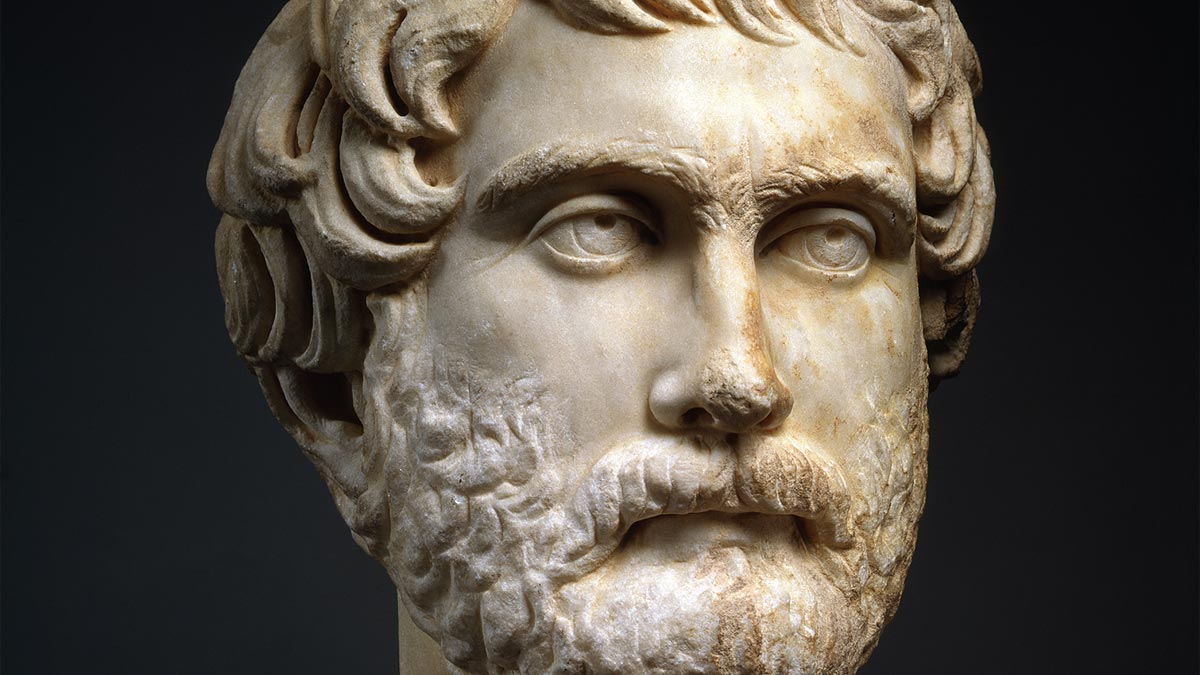
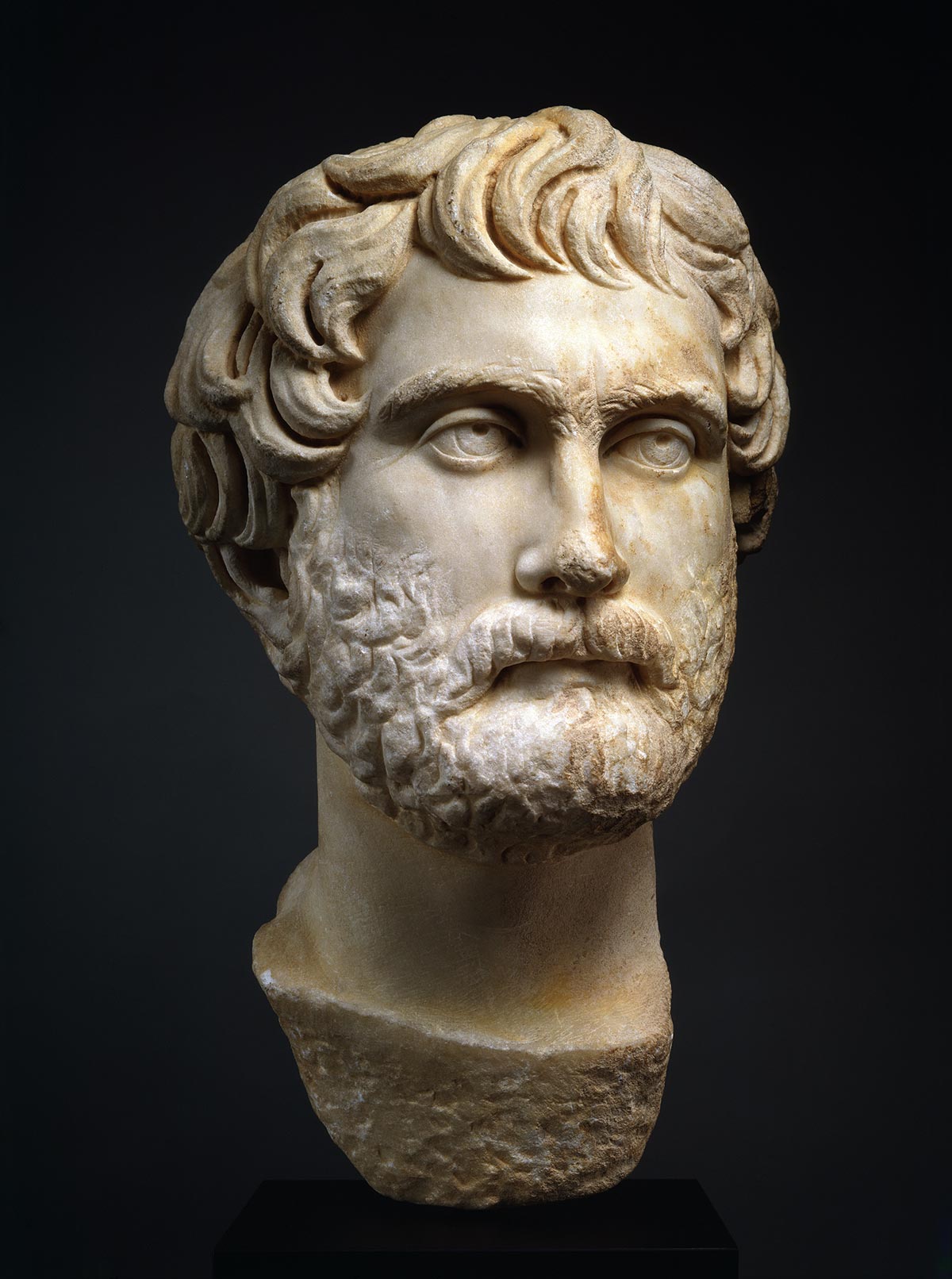
Marble bust of a man with a beard and short curly hair
Roman, Late Hadrianic (AD 117–138) or Antonine (AD 138–193) Period. Portrait of a Man, 2nd century AD. Marble. height: 16 1/2 in. (41.91 cm). Milwaukee Art Museum, Gift of Suzanne and Richard Pieper M2004.582.
Marble bust of a man with a beard and short curly hair
Roman, Late Hadrianic (AD 117–138) or Antonine (AD 138–193) Period. Portrait of a Man, 2nd century AD. Marble. height: 16 1/2 in. (41.91 cm). Milwaukee Art Museum, Gift of Suzanne and Richard Pieper M2004.582.

Walk into any home today and you’re likely to see photographs of people.  Carefully posed family portraits, snapshots from vacation, and, of course, selfies surround us in our homes.  People have an almost innate desire to capture the faces of their friends and family, not to mention themselves.

Two thousand years ago, Ancient Romans didn’t have photography, but they did have the same desire to capture and remember the faces of those they loved.  Wealthy Roman homes were filled with portraits of family members both past and present, most often in the form of busts and full-length statues.  One such portrait, The Milwaukee Art Museum’s Portrait of a Man, was sculpted during the late Hadrianic (117-138 CE) or Antonine Period (138-193 CE).  Based on the size and detail of this marble portrait, it would have likely been placed in a prominent position in a house or garden.  Just like today, all portraits weren’t created equal, and sculptures like this one are akin to an expensive portrait you might commission from a professional photographer, rather than a snapshot developed at a convenience store.

Categories
Art Collection Curatorial European Modern

From the Collection: Wassily Kandinsky’s Fragment I for Composition VII

Wassily Kandinsky (Russian, 1866–1944), Fragment I for Composition VII (Center), 1913. Oil on canvas. Milwaukee Art Museum, Gift of Mrs. Harry Lynde Bradley M1958.12. Photo credit by Larry Sanders.
Wassily Kandinsky (Russian, 1866–1944), Fragment I for Composition VII (Center), 1913 (detail). Oil on canvas. Milwaukee Art Museum, Gift of Mrs. Harry Lynde Bradley M1958.12. Photo credit by Larry Sanders.

Many of the artists featured in the special exhibition Van Gogh to Pollock: Modern Rebels, Masterworks from the Albright-Knox Art Gallery are also represented in the collection of the Milwaukee Art Museum. This is the second in a series of blog posts that will highlight Milwaukee’s artworks during the run of the exhibition.

Only one artwork from the Milwaukee Art Museum’s own collection is displayed as part of the newly-opened Modern Rebels exhibition: Wassily Kandinsky’s Fragment I for Composition VII. When one reads the title of the equally vibrant artwork from the Albright-Knox Gallery hung next to it, the reason for its inclusion becomes instantly clear.

Categories
Art Collection Curatorial European

From the Collection–Meissen Porcelain Manufactory, Two-Handled Urn

Meissen Porcelain Manufactory (Dresden, Germany, established 1710), Two-Handled Urn, 1814-60. Porcelain with hand-painted overglaze decoration and gilding. Milwaukee Art Museum, Gift of the René von Schleinitz Foundation, M1962.248. Photo credit: John R. Glembin

Last week, we looked an amazing example of large-scale Meissen porcelain sculpture.  This time, we’ll look at another beautiful work of Meissen, this two-handled urn.

This sizable object has a great presence (it’s about a foot tall).  What immediately draws attention is the beautifully painted decoration.  The base and rim are painted in a Renaissance revival-style panel with purple-pink and light olive green tones highlighted with the white of the porcelain and shiny gilding. And then there is the main frieze, which shows an ancient Greek myth called the Calydonian Boar Hunt.

Categories
Art Collection Curatorial European

From the Collection–G. H. van Hengel, Jr., Chandelier

G.H. van, Jr. Hengel (Rotterdam, Holland, active 18th century). Chandelier, 1710-30. Brass, cast iron, 42 1/2 × 36 3/4 in. (107.95 × 93.35 cm). Milwaukee Art Museum, Gift of Friends of Art, M1974.232 Photo credit: P. Richard Eells

This fantastic chandelier is currently on view in the Milwaukee Art Museum’s east galleria.  It hangs there to represent the European collections in our reinstallation display–and I think that is does a great job!

Dating to the early 18th century, the chandelier is typically Dutch in form. The design is a perfect example of baroque restraint, from its curved arms, a baluster-shaped shaft, and the balancing ball with finial. Overall, it is graceful and well-proportioned—it was clearly made by a master metalworker. The glossy dark patina is also well-done and in great condition.

Categories
Art Collection Curatorial European

From the Collection–Meissen Porcelain Manufactory, Augustus III, King of Poland

Meissen Porcelain Manufactory (Dresden, Germany, established 1710). Augustus III, King of Poland, 18th century. Glazed porcelain, with polychrome overglaze decoration, and gilding, 30 × 16 1/2 × 13 1/4 in. (76.2 × 41.91 × 33.66 cm). Milwaukee Art Museum, Gift of the René von Schleinitz Foundation, M1962.364. Photo credit: John R. Glembin

Believe it or not, this imposing sculpture is made out of a material that we usually associate with teacups and figurines for our end tables.  That’s right–this two-and-a-half feet tall man is made out of porcelain!

But it’s not just any porcelain.  It’s porcelain made at the factory in Meissen, Germany.  You may remember Meissen as one of the most important names in European porcelain production from my series on German drinking vessels.

Just to recap, Augustus the Strong, Elector of Saxony and King of Poland, was obsessed with porcelain and purchased huge amounts of Chinese and Japanese examples for his palaces in Dresden. But he, like so many rulers in Europe, wanted to be able to make what was dubbed as “white gold” for himself.

Categories
Art Collection Curatorial European

German Tankards and Steins: Part 8–Character Steins

VEB Porzellanmanufactur Plaue (Plaue, Germany, established 1816). "Singing Pig" Stein, ca. 1900. Glazed hard paste porcelain, colored underglaze decoration, and pewter. Milwaukee Art Museum, Gift of the René von Schleinitz Foundation M1962.984. Photo by Melissa Hartly Omholt.
VEB Porzellanmanufactur Plaue (Plaue, Germany, established 1816). “Singing Pig” Stein, ca. 1900. Glazed hard paste porcelain, colored underglaze decoration, and pewter. Milwaukee Art Museum, Gift of the René von Schleinitz Foundation M1962.984. Photo by Melissa Hartly Omholt.

Ready for some more laughs? In this post, we’ll be looking at more German steins meant to be amusing.

The industrial revolution of the nineteenth century meant that more goods could be produced quickly and more people could afford those goods. Developments in the technique for shaping ceramics meant that steins didn’t have to be a standard shape—they could be molded in all sorts of ways. And, in a never-ending quest for novelty, they were!

Categories
Art Collection Curatorial European

German Tankards and Steins: Part 7–Humorous Mettlach

Villeroy & Boch (Mettlach, Saarland, Germany, established 1836), design attributed to Franz von Stuck (German, 1863–1928). "2106" Stein, 1894. Stoneware, with colored slip and glaze decoration, platinum luster, and pewter. Gift of the René von Schleinitz Foundation M1962.890. Photo credit: John R. Glembin.
Villeroy & Boch (Mettlach, Saarland, Germany, established 1836), design attributed to Franz von Stuck (German, 1863–1928). “2106” Stein, 1894. Stoneware, with colored slip and glaze decoration, platinum luster, and pewter. Gift of the René von Schleinitz Foundation M1962.890. Photo credit: John R. Glembin.

Drinking games have long been a source of entertainment.  One only has to look at the proliferation of puzzle jugs dating back to the sixteenth century to see this.

Categories
Art Collection Curatorial European

German Tankards and Steins: Part 5–Introduction to Late 19th Century Germany

Villeroy & Boch (Mettlach, Saarland, Germany, established 1836), designed by Christian Warth (German, active 1854–1892). "1395" Stein, 1885. Stoneware with colored slip and glaze decoration, gilding and pewter. Milwaukee Art Museum, Bequest of Dorothy Trommel in memory of her parents, Eunice and Howard Wertenberg M2013.43.  Photo credit: John Glembin.
Villeroy & Boch (Mettlach, Saarland, Germany, established 1836), designed by Christian Warth (German, active 1854–1892). “1395” Stein, 1885. Stoneware with colored slip and glaze decoration, gilding and pewter. Milwaukee Art Museum, Bequest of Dorothy Trommel in memory of her parents, Eunice and Howard Wertenberg M2013.43. Photo credit: John Glembin.

Over the past year, we’ve taken a look at some of the German drinking vessels in the Milwaukee Art Museum’s collection.  The subjects have ranged from luxurious silver tankards to early stoneware vessels, and from high-quality Meissen porcelain to the prized tin-glazed earthenware that was developed to mimic it.

Now we’ve come to the end of the 19th century, the time of the most dramatic changes for the German drinking vessels.  This was due to a powerful combination of events.