Kornelius Erb (German, Augsburg, ca. 1560-1618). The Erb Tankard, 1580/85. Silver. Milwaukee Art Museum, Gift of Richard and Erna Flagg, M1991.85. Photo credit John Nienhuis
For the past few months, I’ve been lucky enough to be able to research the Milwaukee Art Museum’s collection of German drinking vessels. With over 200 steins, tankards, and jugs, we have examples that range in date from the mid-16th century to the early 20th century. So, over the next few months, I’ll be doing a series of blog posts to highlight this important—and interesting—area of the collection.
Chipstone House in Fox Point, WI. Photo by Chelsea Kelly
In late March, this semester’s group of Satellite teens took a field trip to the Chipstone Foundation in Fox Point, WI. You probably knew that Chipstone has a great decorative arts collection and produces progressive exhibitions in the Lower Level of the Milwaukee Art Museum. What you might not know is that they also have a site in Fox Point, where they host college-level age groups.
Tea bowl, John Bartlam, 1765-1769. Chipstone Foundation. Photo by Gavin Ashworth.
Temple Burling, professor of physics, astronomy, biology and great ideas at Carthage College, has been part of the Object Lab team since 2009. He first connected with Chipstone staff through a shared interest in cabinets of curiosities, an example of which is our Rooms of Wonder exhibition at the Milwaukee Art Museum.
Since we first got to know him, Temple has been bringing his museum studies class up to Milwaukee every year (yes, he is a biophysicist that teaches a course on museums), as well as discussing possible collaborative projects with us. The opportunity came up when Temple was awarded a sabbatical, and he asked if he could spend this year’s fall semester in Milwaukee studying the Chipstone Foundation’s collection.
We jumped at the chance to have a scientist interpret our collection. Since his sabbatical is almost over, I asked Temple to write about his experience these past few months. View an object in the Chipstone collection through the eyes of a brilliant scientist, in part one of two posts, below.
Face Jug, 1860-1880. Chipstone Foundation. Photo by Jim Wildeman.
Last month I wrote about the Chipstone Foundation’s new acquisition, an early Edgefield face jug with writing on the back. Since then, our curatorial team has uncovered the meaning behind the elusive inscription. Before revealing this discovery, I’ll catch you up on new research for Face Jugs: Art and Ritual in 19th-Century South Carolina, on view until August 5 at the Milwaukee Art Museum.
“Face jugs” is a term created by art historians, historians and archeologists to refer to turned stoneware vessels with applied faces. The eyes and the teeth are made of kaolin, a white river clay that is one of the primary components of porcelain. You will notice when you visit the exhibition that there are also face cups and face pitchers.
Many different cultures have created pottery with faces or human elements, but the Edgefield face jugs are unique.
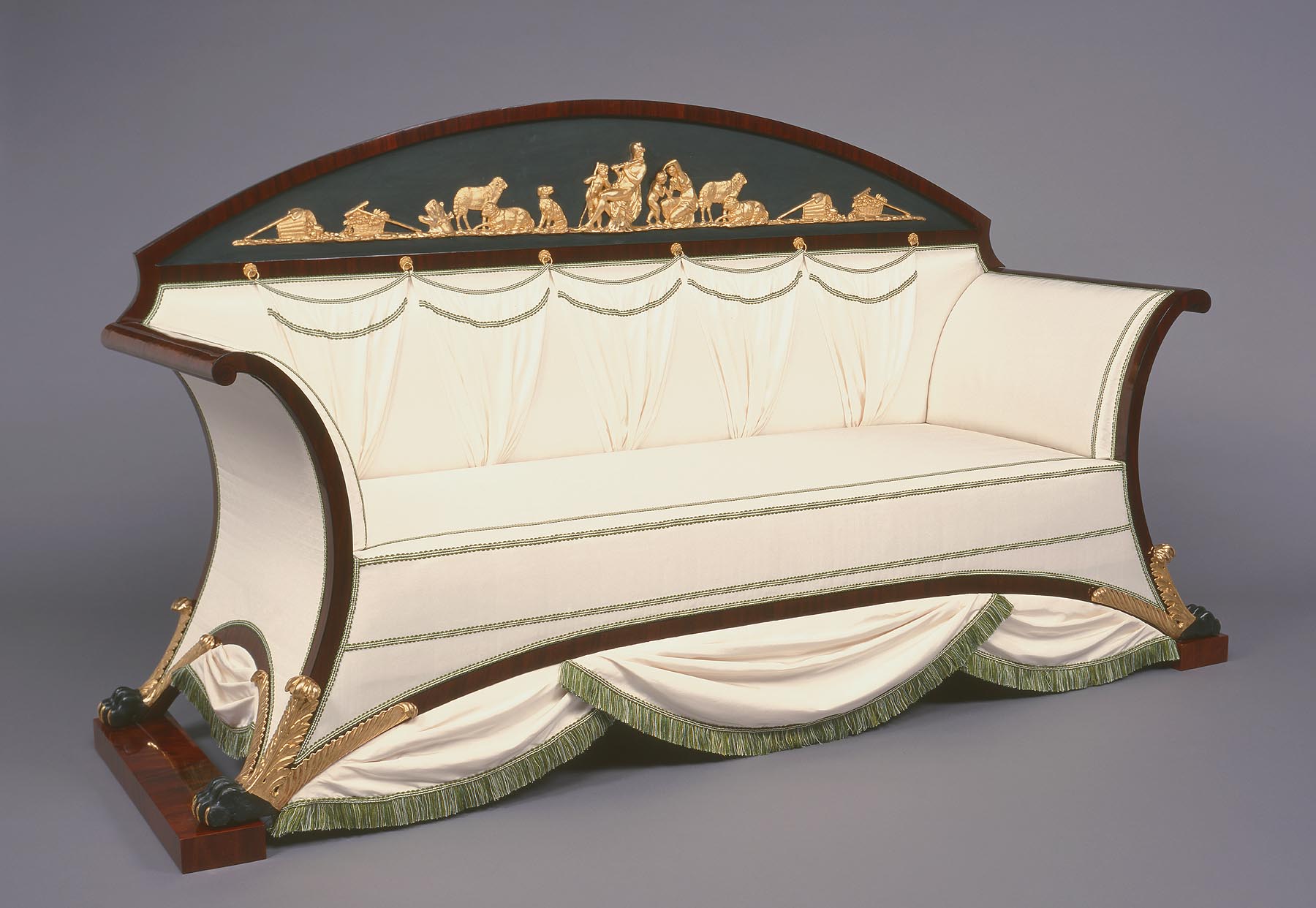
In 2006, when the Milwaukee Art Museum organized the exhibition Biedermeier: The Invention of Simplicity, it established itself as a center of study for the Beidermeier style that was popular in Central and Northern Europe from about 1815 to 1835.
Building upon the Museum’s strength in German and Austrian art—partly due to the ethnic background of Milwaukee—the exhibition brought to the spotlight to Biedermeier art. This period of art and design history was not only little-known in the United States, but the exhibition also proposed a whole new interpretation of the style that changed scholarship in Europe as well. You can read more about Biedermeier here in this review from the New York Times.
The year 2012 is considered the 50th anniversary of the American Studio Glass movement. The anniversary is being celebrated with exhibitions and events across the country, organized in large part by the Art Alliance for Contemporary Glass.
The Milwaukee Art Museum has a terrific collection of studio glass, and we were thrilled to be part of the celebration. Along one wall of the newly-designed Kohl’s Art Generation Studio is a new installation that celebrates using glass as a medium of creative impulse.
The glass sparkles, tells an important art history story, and I hope that its visual beauty inspires young artists as they create their own artwork nearby.
What is the American Studio Glass movement, and what is this anniversary?
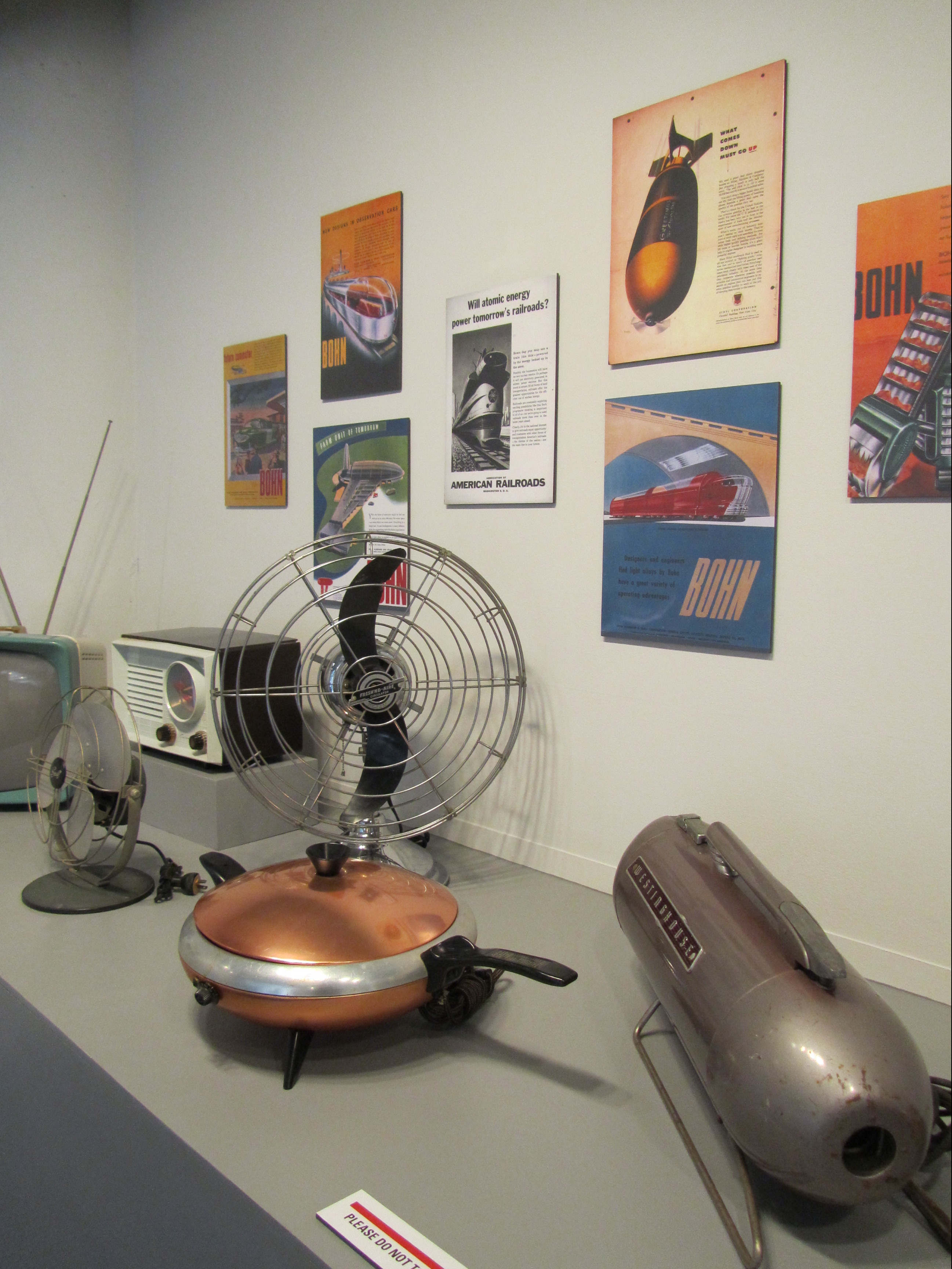
Installation shot, MIAD’s “Style, Innovation, & Vision” exhibition. Photo by the author.
Don’t answer that. Most jokes beginning that way aren’t very nice to the subject. My answer, in this case, is: six.
This fall, the Milwaukee Institute of Art & Design (MIAD) Director of Galleries Mark Lawson asked six design-lovers to curate an exhibition in the college’s Brooks Stevens Gallery.
MIAD has a significant collection of industrial design objects–ranging wildly from a Betty Crocker mixer to wheelchairs to a Motorola Razr cell phone. In 2010 MIAD’s webmaster Dave O’Meara and MIAD alumnus Dave Hinkle created a new digital catalog of these objects and illustrations.
To celebrate and advertise the possibilities of this new resource, Mark Lawson used it at the center of an exhibition. He called in a variety of voices to help, and I was thrilled to be one of the six involved.
One of my favorite decorative art objects in the Museum’s permanent collection is actually a rather bewildering piece.
It’s an enormous Parlor Cabinet, designed and produced sometime between 1860-1870 by Alexandre Roux (1813-1866), a French-born cabinetmaker who moved to New York to open a successful furniture business.
At first glance, this is a monumental and pretty confusing object.
It has columns and pilasters, just like a building. Its top is a stepped pagoda, which gives it the effect of an Asian temple. And it’s big: five feet tall, over six feet wide and nearly two feet deep. The cabinet part, in the central portion is actually pretty small in comparison to the rest of the piece (look for the key hole in the door to find it).
So is it architecture or furniture? The answer is: both.
I’ve just learned that Hilda Jesser could design anything.
Correction: I’ve just learned who Hilda Jesser was.
To back up, I should explain that I often use this blog as an excuse to explore something in the Museum’s collection that I should know more about. This colorful ceramic vase is charming, but I’ve never selected it to go on view in the galleries because I wasn’t quite certain how to explain it.
Thanks to the markings on its base and the curatorial cataloging records here at the Museum, I knew that the vase was designed by Hilda Jesser while at the Wiener Werkstätte sometime around 1921.
But it doesn’t look anything like my preconceived notion of what Wiener Werkstätte ceramic designs would look like, so how could I select it to represent that influential moment in modern design history?
This week we lose one of our valued co-workers here at Chipstone. Kate Smith, whom I introduced to you in my blog post last fall, is returning to England where she will be working at the University of Warwick as a research fellow. Her new project is titled The East India Company at Home: 1757-1857. As one of her parting gestures she has agreed to blog about what she has been researching while in Milwaukee. –Claudia Mooney
My name is Kate Smith and this year I have worked as the Charles Hummel Fellow at the Chipstone Foundation. As a historian, I focus on eighteenth-century Britain, and while a Fellow at Chipstone, I have researched such things as the idea of design, female hands and the Chinoiserie style. I have also been working on another project concerned with fossil teapots, asking why these objects were made in eighteenth-century Britain and what they meant to the people who owned and used them.