
Categories
Art Collection Curatorial European

Questions of Provenance—Doubting Thomas by Adriaen van der Werff, Part 2

Adriaen van der Werff (Dutch, 1659–1722). Self-portrait with the Portrait of his Wife, Margaretha van Rees, and their Daughter Maria, 1699. Oil on canvas. Rijksmuseum, Amsterdam, SK-A-465.

In the first part of this post, using the Milwaukee Art Museum’s painting Doubting Thomas, we explored the biography and style of Dutch artist Adriaen van der Werff (a self-portrait of him from the Rijksmuseum is to the left).  This week, we’re going to trace the provenance of Doubting Thomas and see what it tells us about the history of taste in art and trends in collecting.

Van der Werff was one of the most famous painters of his day and was known internationally throughout his career. He was in demand in his earlier career for his rich portraits in the popular “Fine School” style. One example of his early work is the 1685 painting in the National Gallery, London called Portrait of a Man in a Quilted Gown.

Then in the 1690’s van der Werff’s paintings became more and more influenced by the classical style admired in France. He already had a tendency to use richer detail and elegant lines in his Fine School paintings. An important reason for this transition is the fact that the new style was preferred by patrons in the late Baroque period. If you want to make a living, you paint want people want to buy!
Categories
Art Collection Curatorial European

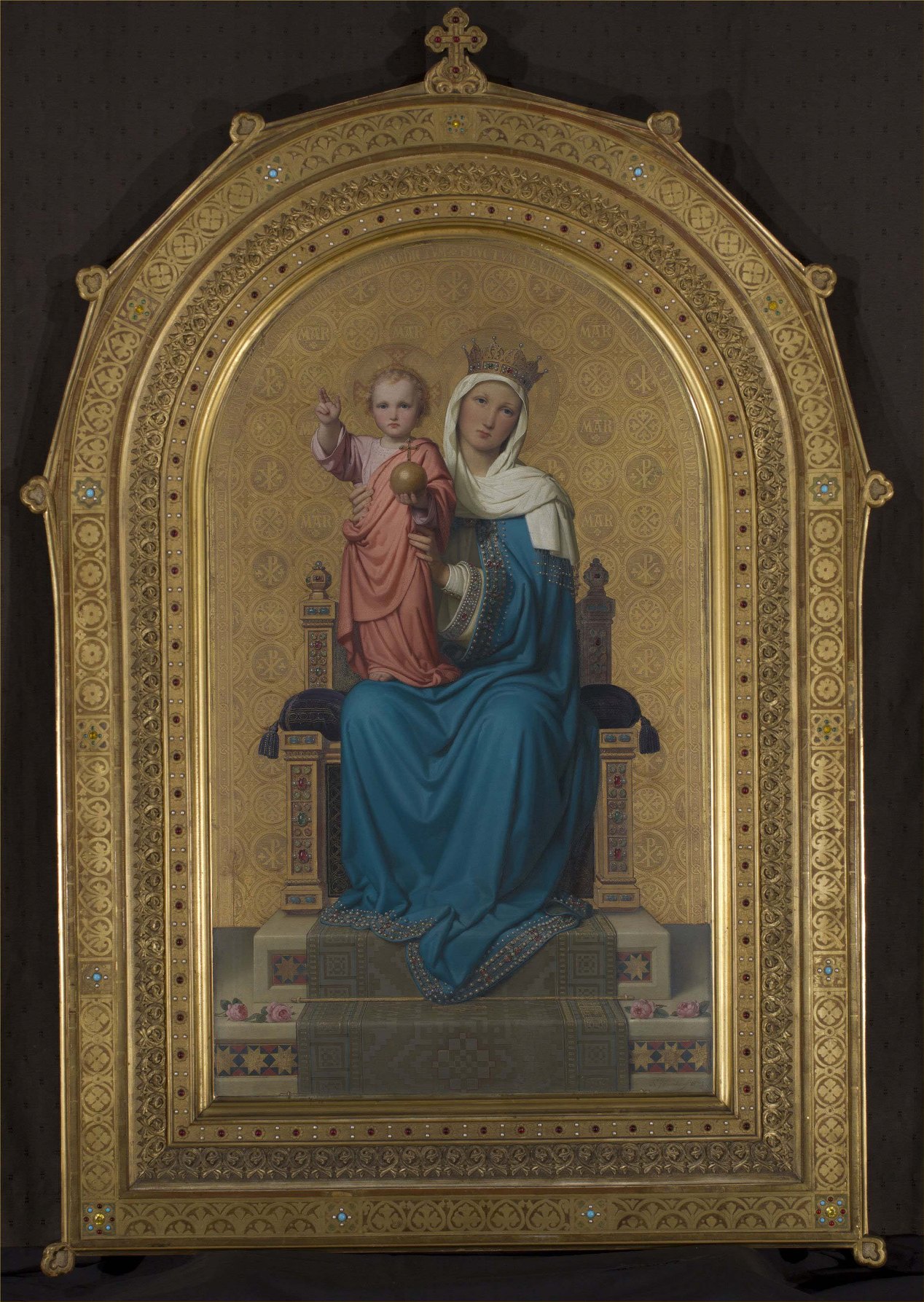
From the Collection—Mother of the World by Franz Ittenbach

Franz Ittenbach (German, 1813–1879), Mother of the World, 1872. Oil on panel. Milwaukee Art Museum, Purchase, René von Schleinitz Memorial Fund and with funds in memory of Betty Croasdaile and John E. Julien.

From the glittery gold background to the touching depiction of the Madonna and child, the Milwaukee Art Museum’s new acquisition Mother of the World by Franz Ittenbach (German, 1813–1879) is a perfect subject for our blog post during the weeks leading up to Christmas.

At first glance, Mother of the World probably reminds you of the painting that I highlighted two years ago during the holidays: Nardo di Cione’s Madonna and Child. But Ittenbach is a German artist of the 19th century, not an Italian artist of the 14th century! Clearly, Ittenbach is looking back at paintings like the Nardo. This is because he is part of a German art group called the Nazarenes.

Categories
Art Collection Curatorial European

Questions of Provenance—Doubting Thomas by Adriaen van der Werff, Part 1

Adriaen van der Werff (Dutch, 1659–1722). Doubting Thomas (The Incredulity of St. Thomas), 1710. Oil on wood panel. 24 15/16 × 18 15/16 in. (63.34 × 48.1 cm). Milwaukee Art Museum, Gift of Mr. and Mrs. R. V. Krikorian M1971.60. Photo credit: P. Richard Eells.

Remember in an earlier post when I said that the study of provenance can tell us a lot about the history of taste? We’ll see how by taking a closer look at one of the paintings in the collection of the Milwaukee Art Museum.

The painting is Doubting Thomas—sometimes called The Incredulity of St. Thomas—by Dutch artist Adriaen van der Werff (1659–1722).

Adriaen van der Werff started his career by painting in the style called Fijnschilder, which literally means “Fine School”. In Fine School painting, the goal was to create a painting that is so smooth and pristine that individual brushstrokes could not be seen. Often the artworks were small and filled with details that required close looking and layers of symbolism. A perfect example is our A Young Woman at a Window with a Parrot and a Birdcage, which you can see bellow (and which will be discussed in a future blog post!).

By the late 17th century, van der Werff began to change his style, painting in a classical style that was popular in France. Doubting Thomas is a perfect example of this classical style. You can see it in the long, elegant proportions of his figures and in his rich depiction of costume.

Categories
Art Behind the Scenes Collection Curatorial European

Questions of Provenance—The Marriage Trap by Jan Victors, Part 4

Jan Victors (Dutch, 1619–after 1676), The Marriage Trap, ca. 1640–60. Oil on canvas. Milwaukee Art Museum, Gift of Richard and Erna Flagg M1974.233. Photo credit: John Nienhuis, Dedra Walls.

With The Marriage Trap as an example, we have seen that it is an immense task to do provenance research for all paintings that were probably in Europe from 1933 through 1945! Museums, however, have accepted this ongoing project as an important part of the stewardship of their collections.

In this particular instance, at least we know that our painting was processed through the appropriate channels after World War II. It was returned to Austria for restitution to its owner; we do not know who ended up with the painting. All we can do is be transparent about the provenance and hope more information comes to light in the future.

So, now that we’re done as much as we can about the provenance with the resources easily available to us, all of the documentation goes into the file for the object.  Then, it’s time to write up the information for our collection database.  Like most museums, the Milwaukee Art Museum uses a database for keeping track of all things related to the collection.  We use one called The Museum System, or TMS, You can see a screen shot of it at the bottom of this post.

Categories
Art Behind the Scenes Collection Curatorial European

Questions of Provenance—The Marriage Trap by Jan Victors, Part 3

Jan Victors (Dutch, 1619–after 1676), The Marriage Trap, ca. 1640–60. Oil on canvas. Milwaukee Art Museum, Gift of Richard and Erna Flagg M1974.233. Photo credit: John Nienhuis, Dedra Walls.

In the last two posts we’ve looked at the earliest known and most recent provenance of our painting The Marriage Trap.

We also know that in 1947 the painting was processed at the Munich Central Collecting Point, or MCCP.

This means that the painting was looted by the Nazis during World War II.

The MCCP was one of the offices set up by the Allied forces at the end of World War II to process the repositories of Nazi-confiscated works of art. These stashes were hidden in Germany and Austria. Managed by the Monuments, Fine Arts and Archives Service (MFA&A) of the military, they were staffed by soldiers and art historians that became known as the Monuments Men. Collecting points were also set up in Marburg, Wiesbaden, and Offenbach. The one in Munich, however, was the largest. The offices there handled a wide variety of material such as painting, sculpture, textiles, and metalwork.

Categories
Art Behind the Scenes Collection Curatorial European

Questions of Provenance—The Marriage Trap by Jan Victors, Part 2

This post is part of a series that that will highlight some of the interesting provenance cases in the Milwaukee Art Museum’s Collection. 

Jan Victors (Dutch, 1619–after 1676), The Marriage Trap, ca. 1640–60. Oil on canvas. Milwaukee Art Museum, Gift of Richard and Erna Flagg M1974.233. Photo credit: John Nienhuis, Dedra Walls.

Last time we looked at The Marriage Trap’s provenance and attribution just before and since its acquisition by the Milwaukee Art Museum. That’s usually the easiest part.

In this post, we’ll see how piecing together the ownership of a painting requires pulling information from a number of sources, thinking critically about what we find, and then sometimes making an educated guess (noted as such, of course).

Categories
Art Behind the Scenes Collection Curatorial European

Questions of Provenance—The Marriage Trap by Jan Victors, Part 1

Jan Victors (Dutch, 1619–after 1676), The Marriage Trap, ca. 1640–60. Oil on canvas. Milwaukee Art Museum, Gift of Richard and Erna Flagg M1974.233. Photo credit: John Nienhuis, Dedra Walls.

Jan Victors (Dutch, 1619–after 1676) was probably a student of the famous Dutch Golden Age artist Rembrandt (Dutch, 1606–1669). Just like his contemporaries, Victors created works with various popular subjects, including religious scenes, portraits, and genre paintings.

The Milwaukee Art Museum has a market scene in its collection which falls into this last category. The Marriage Trap is set along the familiar canals of Holland. A peasant wedding party is purchasing a fish for the ensuing celebration.

But the Dutch loved layering painting with many layers of symbolism–often for a humorous result.  Victor’s ability in combining realism with humor is illustrated by the context and placement of the fish.  It is most likely intended as a sexual metaphor!

Recently, The Marriage Trap was on our list for submission to the Art Loss Register. A quick look at the thick object file—where we keep records and correspondence related to one artwork—showed me that there was some untangling to do! So, I carefully read through everything, looked for more resources, and double checked it all before organizing it in a clearly stated entry for our collection database.

Categories
Art Collection Curatorial Modern

From the Collection: Pablo Picasso’s The Cock of the Liberation

Colorful rooster made of different shapes
Pablo Picasso (Spanish, 1881–1973), The Cock of the Liberation (Le Coq de la Liberation), 1944 (detail). Oil on canvas. 39 1/2 × 31 3/4 in. (100.33 × 80.65 cm). Gift of Mrs. Harry Lynde Bradley M1959.372. Photo credit: Larry Sanders. © 2019 Estate of Pablo Picasso / Artists Rights Society (ARS), New York
Colorful rooster made of different shapes
Pablo Picasso (Spanish, 1881–1973), The Cock of the Liberation (Le Coq de la Liberation), 1944. Oil on canvas. 39 1/2 × 31 3/4 in. (100.33 × 80.65 cm). Gift of Mrs. Harry Lynde Bradley M1959.372. Photo credit: Larry Sanders. © 2019 Estate of Pablo Picasso / Artists Rights Society (ARS), New York

Many of the artists featured in the special exhibition Van Gogh to Pollock: Modern Rebels, Masterworks from the Albright-Knox Art Gallery are also represented in the collection of the Milwaukee Art Museum. This is the fifth in a series of blog posts that will highlight Milwaukee’s artworks during the run of the exhibition.

Pablo Picasso (Spanish, 1881–1973) is not usually considered a political artist.  His favorite artistic subjects were still-lifes, portraits, harlequins, and other seemingly uncontroversial images.

But in some key instances, world events were an important influence on him.  We don’t have to look far to find an example: the Milwaukee Art Museum’s The Cock of the Liberation (Le Coq de la Liberation), painted by Picasso in 1944.

Categories
Art Collection Curatorial European Prints and Drawings

From the Collection–Vegetable Market at Pontoise by Camille Pissarro

Many of the artists featured in the special exhibition Van Gogh to Pollock: Modern Rebels, Masterworks from the Albright-Knox Art Gallery are also represented in the collection of the Milwaukee Art Museum. This is the fourth in a series of blog posts that will highlight Milwaukee’s artworks during the run of the exhibition.

Camille Pissarro (French, 1830–1903), Vegetable Market at Pontoise, 1891. Etching, drypoint, and aquatint. Milwaukee Art Museum, Maurice and Esther Leah Ritz Collection M2004.283. Photo credit: Efraim Lev-er.

A bustling market welcomes the viewer of Impressionist artist Camille Pissarro’s Vegetable Market at Pontoise. We can almost hear the commotion of the rural village where he lived for some time.

Playing the part of both voyeur and companion, we stand behind a woman selling her vegetables. A young woman stops in front of us, deliberating whether or not she would like to buy what is gently offered to her. We can nearly hear their more quiet conversation in the midst of the lively square where all individuals congregate without segregation of rank. There are men with top hats conversing and women in fine dresses strolling, while others are clearly from a more modest upbringing.

Categories
Art Curatorial

Matisse versus Picasso

Matisse's colorful "La Musique" is featured in the exhibition Van Gogh to Pollock: Modern Rebels. Come check it out! Photo by the author.
Matisse’s colorful “La Musique” is featured in the exhibition Van Gogh to Pollock: Modern Rebels. Come check it out! Photo by the author.

“If I were not making the paintings I make, I would paint like Matisse,” Pablo Picasso once said of his rival and dear friend, Henri Matisse. Both artists are featured in the Milwaukee Art Museum’s latest exhibition, Van Gogh to Pollock: Modern Rebels.

In the early twentieth century, the relationship between Picasso and Matisse had developed out of a nature of competitiveness and grew to be one of mutual admiration—at times. When Picasso came onto the European modern art scene, Matisse, being eleven years older, had already established himself as a rebel in that world. After meeting in 1906 at the Parisian salon of famous writer Gertrude Stein, the two artists would continuously look to one another’s work to both pose criticism and find inspiration.