Categories
Art Collection Curatorial Modern

From the Collection: Chaïm Soutine’s Children and Geese

Two young children walking in a field
Chaïm Soutine (Russian, 1893–1943, active in France), Children and Geese, 1934 (detail). Oil on canvas. Milwaukee Art Museum, Gift of Mrs. Harry Lynde Bradley M1959.375. Photo credit: Efraim Lev-er. ©2010 Artists Rights Society (ARS), New York / ADAGP, Paris.
Two young children walking in a field
Chaïm Soutine (Russian, 1893–1943, active in France), Children and Geese, 1934. Oil on canvas. Milwaukee Art Museum, Gift of Mrs. Harry Lynde Bradley M1959.375. Photo credit: Efraim Lev-er. ©2010 Artists Rights Society (ARS), New York / ADAGP, Paris.

Many of the artists featured in the special exhibition Van Gogh to Pollock: Modern Rebels, Masterworks from the Albright-Knox Art Gallery are also represented in the collection of the Milwaukee Art Museum. This is the third in a series of blog posts that will highlight Milwaukee’s artworks during the run of the exhibition.

Comparing the painting by Chaïm Soutine (Russian, 1893–1943, active in France) in the Modern Rebels show (Carcass of Beef) with the one in the Milwaukee Art Museum’s collection (Children and Geese), it is almost difficult to believe that the two works are by the same artist. The former depicts the body of a cow, flayed open from neck to tail, its scarlet inner organs glistening vividly against the shadowed blue background. In contrast, the artwork within Milwaukee’s own collection is a simple rural scene: a young boy and girl walking down a country path, with abstract brushstrokes suggesting a flock of white geese beside them.

A shockingly graphic image of blood and death versus an innocent, bucolic portrayal of childhood. How could these two works have been painted by the same artist?
Categories
Ancient Mediterranean Art Art Collection Curatorial

From the Collection: Roman Portrait of a Man

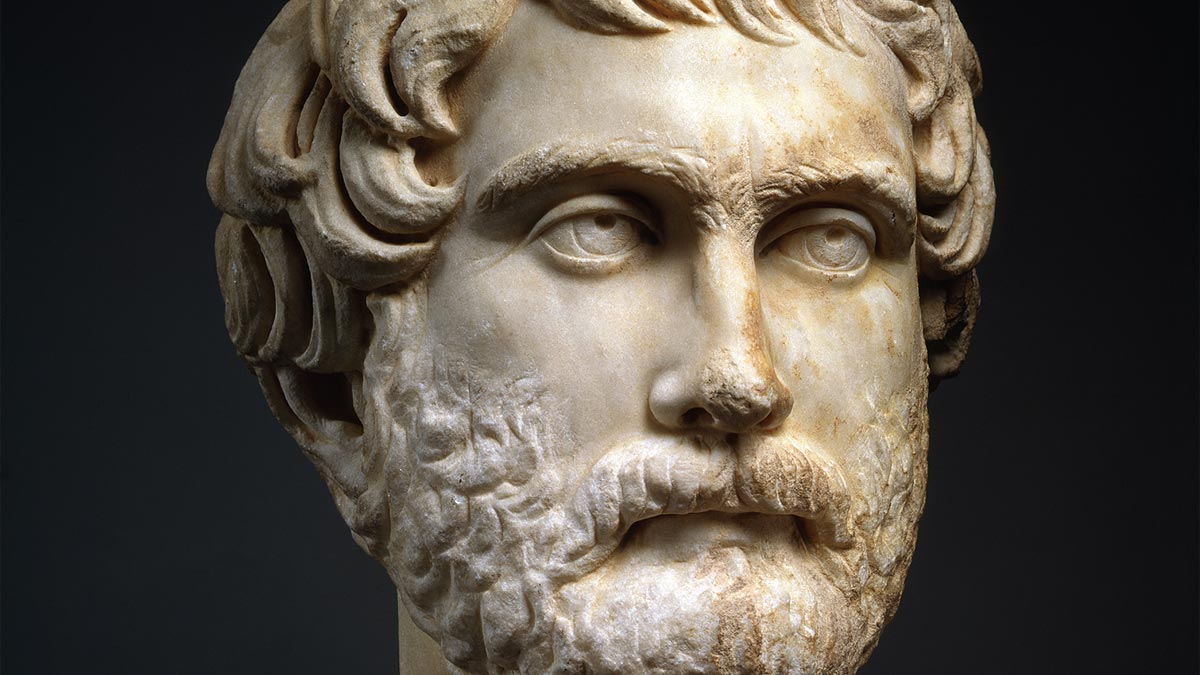
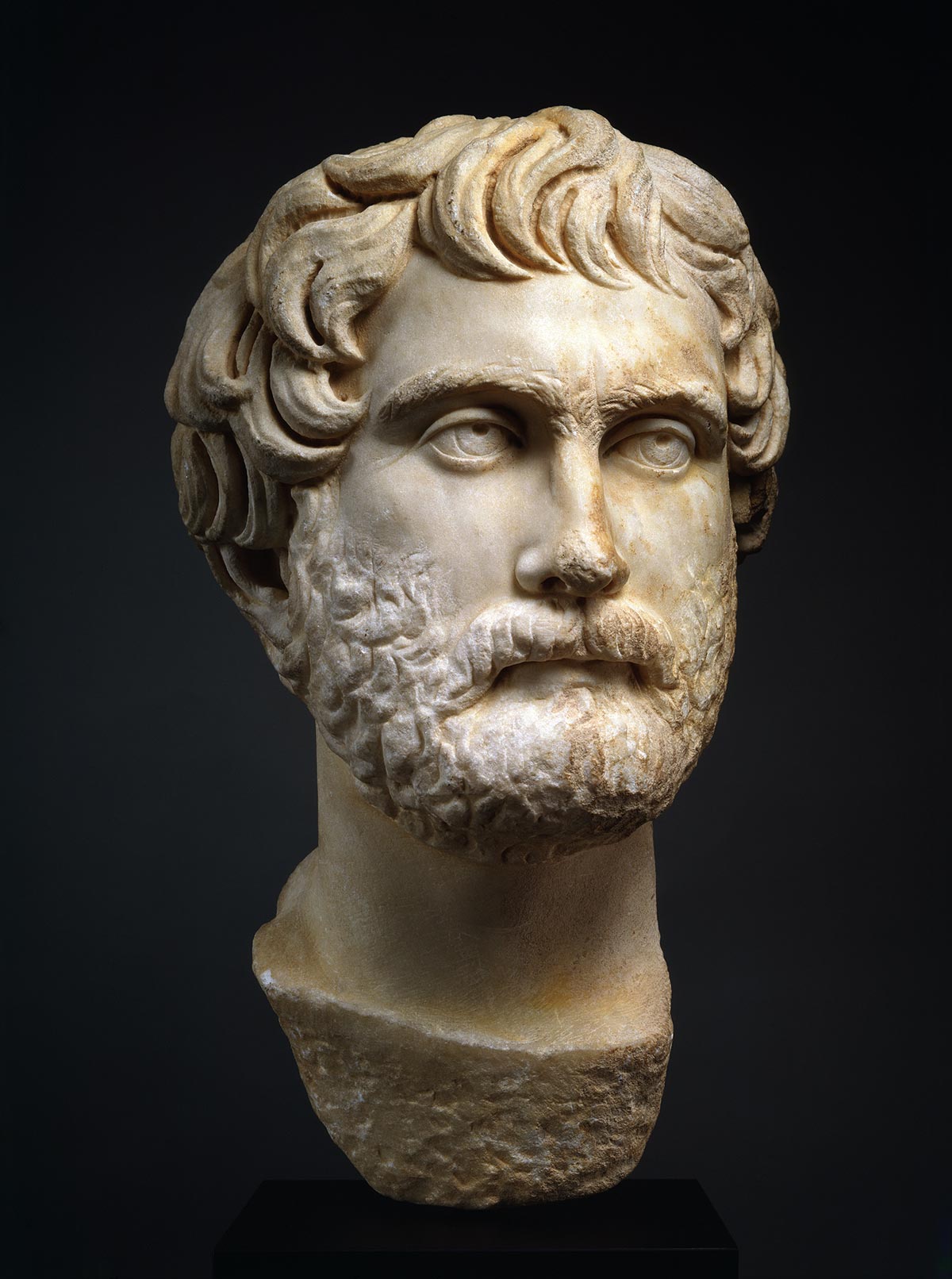
Marble bust of a man with a beard and short curly hair
Roman, Late Hadrianic (AD 117–138) or Antonine (AD 138–193) Period. Portrait of a Man, 2nd century AD. Marble. height: 16 1/2 in. (41.91 cm). Milwaukee Art Museum, Gift of Suzanne and Richard Pieper M2004.582.
Marble bust of a man with a beard and short curly hair
Roman, Late Hadrianic (AD 117–138) or Antonine (AD 138–193) Period. Portrait of a Man, 2nd century AD. Marble. height: 16 1/2 in. (41.91 cm). Milwaukee Art Museum, Gift of Suzanne and Richard Pieper M2004.582.

Walk into any home today and you’re likely to see photographs of people.  Carefully posed family portraits, snapshots from vacation, and, of course, selfies surround us in our homes.  People have an almost innate desire to capture the faces of their friends and family, not to mention themselves.

Two thousand years ago, Ancient Romans didn’t have photography, but they did have the same desire to capture and remember the faces of those they loved.  Wealthy Roman homes were filled with portraits of family members both past and present, most often in the form of busts and full-length statues.  One such portrait, The Milwaukee Art Museum’s Portrait of a Man, was sculpted during the late Hadrianic (117-138 CE) or Antonine Period (138-193 CE).  Based on the size and detail of this marble portrait, it would have likely been placed in a prominent position in a house or garden.  Just like today, all portraits weren’t created equal, and sculptures like this one are akin to an expensive portrait you might commission from a professional photographer, rather than a snapshot developed at a convenience store.

Categories
Art Collection Curatorial European Modern

From the Collection: Wassily Kandinsky’s Fragment I for Composition VII

Wassily Kandinsky (Russian, 1866–1944), Fragment I for Composition VII (Center), 1913. Oil on canvas. Milwaukee Art Museum, Gift of Mrs. Harry Lynde Bradley M1958.12. Photo credit by Larry Sanders.
Wassily Kandinsky (Russian, 1866–1944), Fragment I for Composition VII (Center), 1913 (detail). Oil on canvas. Milwaukee Art Museum, Gift of Mrs. Harry Lynde Bradley M1958.12. Photo credit by Larry Sanders.

Many of the artists featured in the special exhibition Van Gogh to Pollock: Modern Rebels, Masterworks from the Albright-Knox Art Gallery are also represented in the collection of the Milwaukee Art Museum. This is the second in a series of blog posts that will highlight Milwaukee’s artworks during the run of the exhibition.

Only one artwork from the Milwaukee Art Museum’s own collection is displayed as part of the newly-opened Modern Rebels exhibition: Wassily Kandinsky’s Fragment I for Composition VII. When one reads the title of the equally vibrant artwork from the Albright-Knox Gallery hung next to it, the reason for its inclusion becomes instantly clear.

Categories
Art Collection Curatorial Modern

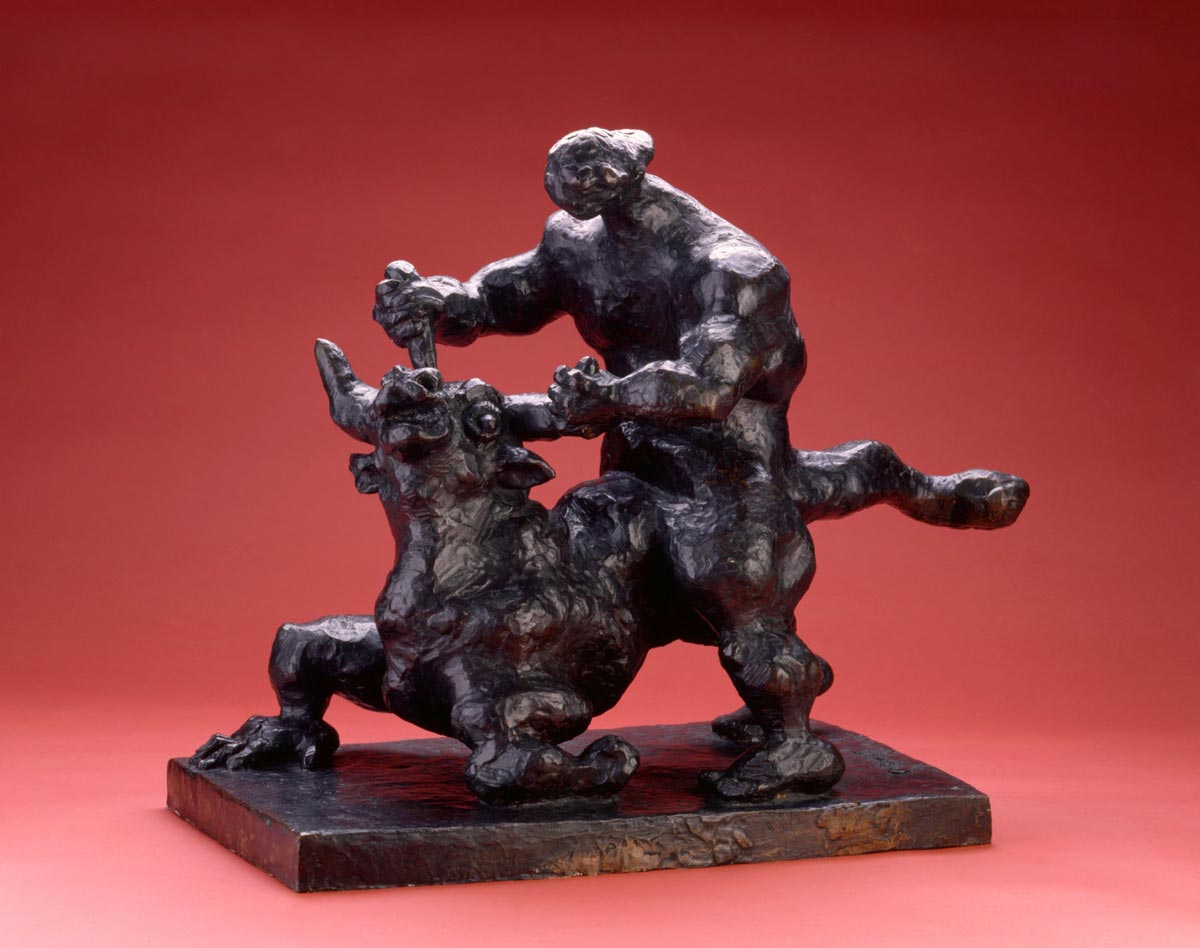
From the Collection: Theseus by Jacques Lipchitz

Black sculpture of a man grabbing a minotaur by the horns
Jacques Lipchitz (French, b. Lithuania, 1891–1973, active in the United States), Theseus, 1942 (detail). Hollow bronze cast. height: 23 3/4 in. (60.33 cm). Milwaukee Art Museum, Gift of Mrs. William D. Vogel M1956.80. Photo credit by Larry Sanders. © Estate of Jacques Lipchitz, all rights reserved.
Black sculpture of a man grabbing a minotaur by the horns
Jacques Lipchitz (French, b. Lithuania, 1891–1973, active in the United States), Theseus, 1942. Hollow bronze cast. height: 23 3/4 in. (60.33 cm). Milwaukee Art Museum, Gift of Mrs. William D. Vogel M1956.80. Photo credit by Larry Sanders. © Estate of Jacques Lipchitz, all rights reserved.

Many of the artists featured in the special exhibition Van Gogh to Pollock: Modern Rebels, Masterworks from the Albright-Knox Art Gallery are also represented in the collection of the Milwaukee Art Museum. This is the first in a series of blog posts that will highlight Milwaukee’s artworks during the run of the exhibition.

Knowledge of classical mythology is one of those subjects that will always help the student of art history, no matter what period you study. Over the last few years, I have explored mythological subjects in the Milwaukee Art Museum’s collection represented in ancient Greek hydriae; Baroque decorative arts and painting; and nineteenth century German ceramics.

Modern art is no exception. We have to look no further than the sculptures of Jacques Lipchitz (1891–1973).

Jacques Lipchitz was a Jewish artist from France who was born in Lithuania. He was classically trained in Paris, although he soon worked in a cubist style, such as Sailor with Guitar in the collection of the Albright-Knox Art Gallery.

Categories
Art Curatorial

Questions of Provenance—Nazi-era Germany

This post is the second to introduce a series that that will highlight some of the interesting provenance cases in the Milwaukee Art Museum’s Collection. 

Adolf HItler presents Hermann Goering with The Falconer, 1880, by 19th century Austrian painter Hans Makart. Library of Congress.

To fully understand how important provenance research is for museums, we will need to look more at the period of art looting that is most familiar to many: the Nazi period in Germany.

Categories
Art Collection Curatorial European

Questions of Provenance–An Introduction

Claude Monet (French, 1840–1926). Waterloo Bridge, Sunlight Effect, ca. 1900 (dated 1903). Oil on canvas. Milwaukee Art Museum, Bequest of Mrs. Albert T. Friedmann M1950.3. Photo credit: John R. Glembin.

One of the important areas of museum research is that of provenance, or the history of ownership.

Why is it important to know who owned an artwork? Well, for a number of reasons.

Categories
Art Collection Curatorial European

From the Collection–Christopher Dresser, Pitcher and Claret Jug

Christopher Dresser (English, 1834-1904) Manufactured by Watcombe Terracotta Clay Company (Torquay, Devon, England, established 1867) Pitcher, designed 1870-75; produced by Watcombe of Torquay. Terracotta or red stoneware, gilding 7 1/8 × 5 1/2 × 5 1/4 in. (18.1 × 13.97 × 13.34 cm) . Milwaukee Art Museum, Gift of Daniel Morris and Denis Gallion M1991.323

In 1898, the artists periodical The Studio called Christopher Dresser “perhaps the greatest of commercial designers imposing his fantasy and invention upon the ordinary output of British industry.” This seems an appropriate description for an Englishman who was interested in art but first trained in botany, and then found inspiration for his designs both in the ancient past and traditions of Japan.

Looking at two of Dresser’s designs in the collection of the Milwaukee Art Museum–a pitcher produced by the Watcombe Terracotta Clay Company and a claret jug produced by Hulkin & Heath–you can see how he applied his own personal motto to his work: truth, beauty, power. The sleek and angular vessels lack the decoration that most people associate with the Victorian period, which would have been at its height in the 1870’s.  They look like something from the 20th century!

It may surprise you then, that Dresser was also known for his interests in flat patterning.

Categories
Art Collection Curatorial European

From the Collection–Meissen Porcelain Manufactory, Two-Handled Urn

Meissen Porcelain Manufactory (Dresden, Germany, established 1710), Two-Handled Urn, 1814-60. Porcelain with hand-painted overglaze decoration and gilding. Milwaukee Art Museum, Gift of the René von Schleinitz Foundation, M1962.248. Photo credit: John R. Glembin

Last week, we looked an amazing example of large-scale Meissen porcelain sculpture.  This time, we’ll look at another beautiful work of Meissen, this two-handled urn.

This sizable object has a great presence (it’s about a foot tall).  What immediately draws attention is the beautifully painted decoration.  The base and rim are painted in a Renaissance revival-style panel with purple-pink and light olive green tones highlighted with the white of the porcelain and shiny gilding. And then there is the main frieze, which shows an ancient Greek myth called the Calydonian Boar Hunt.

Categories
Art Collection Curatorial European

From the Collection–G. H. van Hengel, Jr., Chandelier

G.H. van, Jr. Hengel (Rotterdam, Holland, active 18th century). Chandelier, 1710-30. Brass, cast iron, 42 1/2 × 36 3/4 in. (107.95 × 93.35 cm). Milwaukee Art Museum, Gift of Friends of Art, M1974.232 Photo credit: P. Richard Eells

This fantastic chandelier is currently on view in the Milwaukee Art Museum’s east galleria.  It hangs there to represent the European collections in our reinstallation display–and I think that is does a great job!

Dating to the early 18th century, the chandelier is typically Dutch in form. The design is a perfect example of baroque restraint, from its curved arms, a baluster-shaped shaft, and the balancing ball with finial. Overall, it is graceful and well-proportioned—it was clearly made by a master metalworker. The glossy dark patina is also well-done and in great condition.

Categories
Art Collection Curatorial European

From the Collection–Meissen Porcelain Manufactory, Augustus III, King of Poland

Meissen Porcelain Manufactory (Dresden, Germany, established 1710). Augustus III, King of Poland, 18th century. Glazed porcelain, with polychrome overglaze decoration, and gilding, 30 × 16 1/2 × 13 1/4 in. (76.2 × 41.91 × 33.66 cm). Milwaukee Art Museum, Gift of the René von Schleinitz Foundation, M1962.364. Photo credit: John R. Glembin

Believe it or not, this imposing sculpture is made out of a material that we usually associate with teacups and figurines for our end tables.  That’s right–this two-and-a-half feet tall man is made out of porcelain!

But it’s not just any porcelain.  It’s porcelain made at the factory in Meissen, Germany.  You may remember Meissen as one of the most important names in European porcelain production from my series on German drinking vessels.

Just to recap, Augustus the Strong, Elector of Saxony and King of Poland, was obsessed with porcelain and purchased huge amounts of Chinese and Japanese examples for his palaces in Dresden. But he, like so many rulers in Europe, wanted to be able to make what was dubbed as “white gold” for himself.