Categories
Art Collection Curatorial European Exhibitions Prints and Drawings

From the Collection: Anders Zorn Captures Modern Life

The current exhibition in the European works on paper rotation space (on view until July 31) is Anders Zorn: Sweden’s Painter-Etcher. Featuring all 18 prints in the Milwaukee Art Museum’s collection by Zorn, this is the first time ever that they have been on view at the same time. This is the third in a series of posts focusing on the exhibition.

Anders Leonard Zorn (Swedish, 1860–1920), Girl With A Cigarette II, 1891. Etching. Milwaukee Art Museum, Gertrude Nunnemacher Schuchardt Collection, presented by William H. Schuchardt M1924.131. Photo credit: John R. Glembin.

Paris in the 1880’s was like no other place.

Citizens from all over France joined with immigrants from all over the world.  Some flocked there to take advantage of new opportunities in industry, others to experience an avant-garde culture.  The population more than doubled in the second half of the nineteenth century.

New entertainment venues popped up to cater to the masses.  Circuses, dance halls, cabarets, theaters, operas, museums (including the first wax museum in Paris) added to the excitement of the city.

Meanwhile, Napoleon III, the Emperor of France, hired an urban planner who changed the entire look of the city.  A warren of medieval buildings was transformed into a modern city with wide boulevards.

Paris was experiencing the growth of a modern urban center–and all the problems and benefits of that growth.  It is probably not surprising that visual artists found inspiration with new subject matter and developed innovative ways to depict it.

Anders Zorn (Swedish, 1860–1920) made Paris his home between 1886 and 1896. Accordingly, his artistic output during this period shows the influence of the modern city around him.

Categories
Art Collection Curatorial European Exhibitions Prints and Drawings

From the Collection: Anders Zorn’s Portrait Prints

The current exhibition in the European works on paper rotation space (on view until July 31) is Anders Zorn: Sweden’s Painter-Etcher.  Featuring all 18 prints in the Milwaukee Art Museum’s collection by Zorn, the exhibition is the first time ever that they have been on view at the same time.  This is the second in a series of posts focusing on the exhibition.

Anders Leonard Zorn (Swedish, 1860–1920), King Oscar II (or Oscar II), 1898. Etching and aquatint. Milwaukee Art Museum, Gift of Mrs. Joseph Greene M1979.23. Photo credit: John R. Glembin.

Last time, we were introduced to career of Anders Zorn (Swedish, 1860–1920). In this post, we’ll consider a few more of his portrait prints.

In the Milwaukee Art Museum exhibition, there are portraits of two members of the Swedish royal family: the King of Sweden, Oscar II (left), and the Crown-Princess Margaret (below), who was married to Gustav Adolf, the grandson of King Oscar. Margaret herself was the granddaughter of Queen Victoria of England.

Oscar II was a fan of Zorn’s from the artist’s earliest days, when the king tried to purchase a watercolor from him at an exhibition at the Stockholm Academy. The king eventually commissioned some painted portraits from Zorn. Our portrait print is not based upon any of those paintings. It shows the king at leisure, enjoying his yacht—he is even wearing a captain’s hat. It seems appropriate to use the intimate scale of an etching to capture the head of state.

Categories
Art Collection Curatorial European Exhibitions Prints and Drawings

From the Collection: Anders Zorn and Etching

The current exhibition in the European works on paper rotation space (on view until July 31) is Anders Zorn: Sweden’s Painter-EtcherFeaturing all 18 prints in the Milwaukee Art Museum’s collection by Zorn, the exhibition is the first time ever that they have been on view at the same time.  This is the first in a series of posts focusing on the exhibition.

Anders Leonard Zorn (Swedish, 1860–1920), Zorn and his Wife, 1890. Etching, possibly drypoint, and graphite. Milwaukee Art Museum, Gertrude Nunnemacher Schuchardt Collection, presented by William H. Schuchardt M1924.141. Photo credit: John R. Glembin

Did you know that Anders Zorn might be the most famous artist you’ve never heard of?

During his career, which spanned about 20 years before and 20 years after 1900, Zorn was in high demand for painted portrait commissions in Europe and in the U.S.  In fact, he was in direct competition with John Singer Sargent (American, 1856–1925), one of the best known portrait painters at the turn of the twentieth century.

So, who was Anders Zorn?

Anders Zorn was born in 1860, the son of a German brewer and one of his Swedish employees.  His parents were not married, and Zorn’s father was not very involved in his son’s life, although he did leave Zorn a small inheritance when he died.

Categories
American Art Collection Curatorial Exhibitions

From the Collection: In the Catskills by Asher Brown Durand

A number of the artists featured in the special exhibition Nature and the American Vision: The Hudson River School can also be found in the galleries of the Milwaukee Art Museum. This is the fourth and final in a series of blog posts that will highlight Milwaukee’s artworks during the run of the exhibition.

Asher Brown Durand (American, 1796–1886), In The Catskills, 1857. Oil on canvas. Milwaukee Art Museum, Layton Art Collection, Inc., Gift of Frederick Layton L105. Photo credit: Larry Sanders.

Although they depicted the American landscape, Hudson River School painters found inspiration in Europe.

Traveling to France or Italy to study Old Masters was a common tradition, even for American artists looking to assert their cultural identity, and they adapted European conventions to a uniquely American vision.

For this blog post, we will use the painting In the Catskills by Asher Brown Durand (American, 1796-1886) as a case study, showing the influence of European artistic traditions.

Categories
American Art Collection Curatorial Exhibitions

From the Collection: Frederick Edwin Church and Charles De Wolf Brownell

A number of the artists featured in the special exhibition Nature and the American Vision: The Hudson River School can also be found in the galleries of the Milwaukee Art Museum. This is the third in a series of blog posts that will highlight Milwaukee’s artworks during the run of the exhibition.

Frederic Edwin Church (American, 1826–1900), A Passing Shower, 1860. Oil on canvas. Milwaukee Art Museum, Layton Art Collection, Inc. L107. Photo credit: Larry Sanders.

The first post in this series focused on Thomas Cole, the founder of the Hudson River School. Today we will highlight Cole’s one and only pupil, Fredrick Edwin Church (American, 1826-1900), as well as Church’s very good friend, Charles De Wolf Brownell (American, 1822-1909).

Categories
American Art Collection Curatorial Exhibitions

From the Collection: Albert Bierstadt’s Wind River Mountains, Nebraska Territory

A number of the artists featured in the special exhibition Nature and the American Vision: The Hudson River School can also be found in the galleries of the Milwaukee Art Museum. This is the second in a series of blog posts that will highlight Milwaukee’s artworks during the run of the exhibition.

Albert Bierstadt (American, b. Germany, 1830–1902), Wind River Mountains, Nebraska Territory, 1862. Oil on board. Milwaukee Art Museum, Layton Art Collection, Inc., Purchase L1897.3. Photo credit: Larry Sanders.

The special exhibition Nature and the American Vision looks at the paintings of the Hudson River School. This week, let’s take a closer look at one of the paintings by this group of artists on view in the American galleries and see how it relates to scientific study.

Today we see science and art as two separate forms of study, but for much of history, they were intertwined. The painters of the Hudson River School worked during the nineteenth century, when science and the humanities had more fluidity.

Categories
Art Behind the Scenes Curatorial Exhibitions

Herzfeld Photography, Print, and Drawing Study Center

Herzfeld Photography, Print, and Drawing Study Center. Photo credit: John Glembin.

Did you know that nearly half of the Milwaukee Art Museum’s collection consists of works on paper? We have more than 15,000 rare prints, drawings, photographs, and book arts.

Works on paper cannot be shown indefinitely, because they are light-sensitive; light will cause them to fade.  Accordingly, in order to preserve them in the best condition possible, they are rotated.  A rotation is when one work is taken off view and replaced with another, usually every three to four months.

The Museum has a number of new spaces dedicated to works on paper.  The focus of these areas range from European prints and drawings (Gallery S202), to modern art from the Bradley Collection (Gallery K215), to Folk and Self-Taught art (Gallery K122). When not on view, those works on paper are stored safely in the dark.

Categories
Art Collection Curatorial European Prints and Drawings

From the Collection—Albrecht Dürer, Part 3

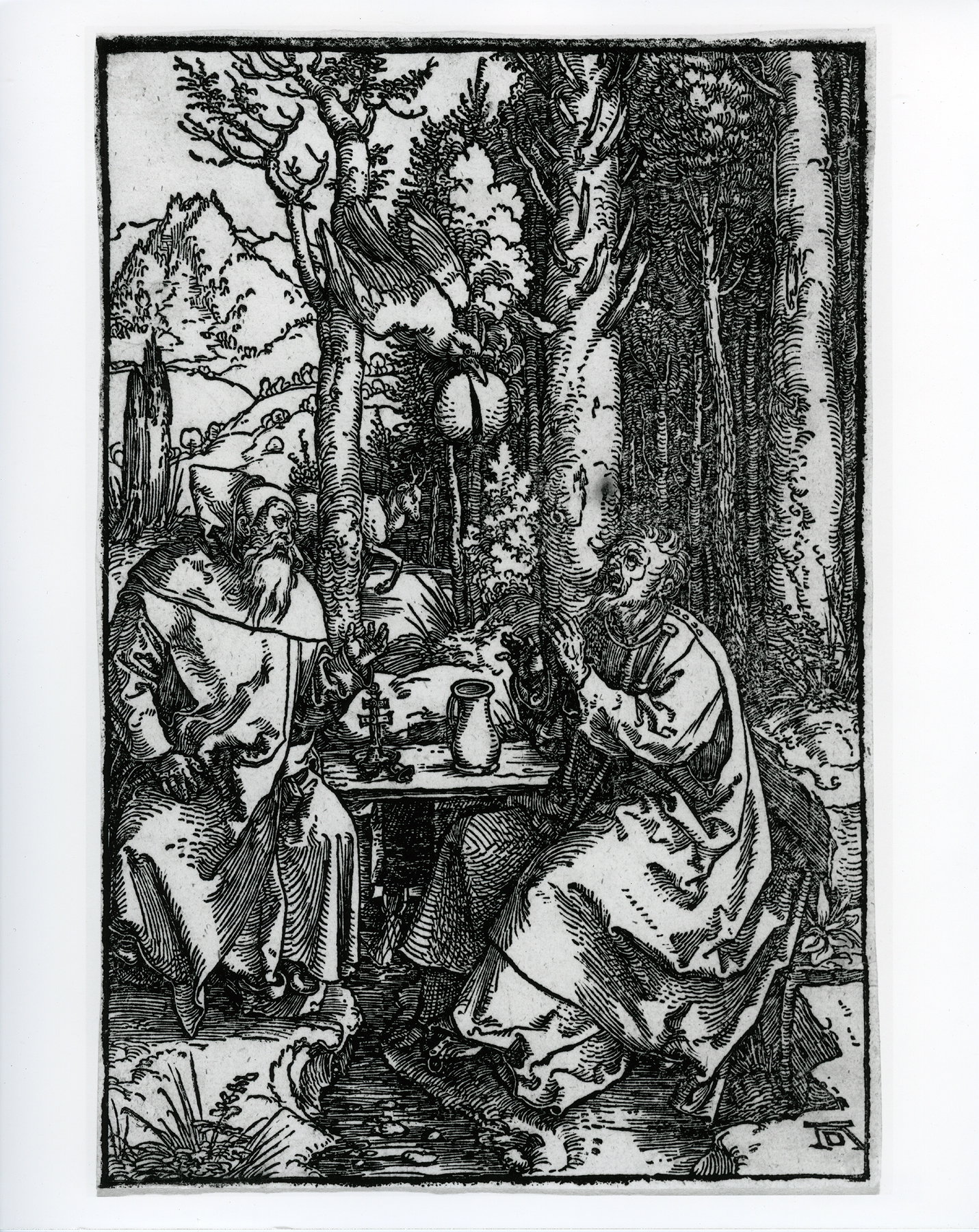
The inaugural exhibition in the European works on paper rotation space (on view until March 20) explores the Renaissance in Germany. Comprised completely of prints from the collection of the Milwaukee Art Museum, you can find engravings by Heinrich Aldegrever (1502–ca. 1561) and stipple engravings by Hans Sebald Beham (1500–1550). But you can’t study printmaking in the German Renaissance without a serious consideration of Albrecht Dürer (1471–1528). And we’re lucky enough to have 14 prints by the master! This is the third and final of a series of posts related to Dürer’s prints.

Albrecht Dürer (German, 1471–1528), The Hermits St. Anthony and St. Paul in the Desert, ca. 1504. Woodcut. Milwaukee Art Museum, Maurice and Esther Leah Ritz Collection M2004.179. Photo credit: Efraim Lev-er.

Sometimes the specialized terminology used in the study of art can be intimidating. This can particularly be a problem with works on paper! In this post I hope to explain the difference between two important printmaking techniques, using Albrecht Dürer as an example, so that they are no longer so daunting.

Categories
Art Collection Curatorial European Prints and Drawings

From the Collection—Albrecht Dürer, Part 2

The inaugural exhibition in the European works on paper rotation space (on view until March 20) explores the Renaissance in Germany. Comprised completely of prints from the collection of the Milwaukee Art Museum, you can find engravings by Heinrich Aldegrever (1502–ca. 1561) and stipple engravings by Hans Sebald Beham (1500–1550). But you can’t study printmaking in the German Renaissance without a serious consideration of Albrecht Dürer (1471–1528). And we’re lucky enough to have 14 prints by the master! This is the second of a series of posts related to Dürer’s prints.

Albrecht Dürer (German, 1471–1528), Madonna with the Monkey, ca. 1498. Engraving. Milwaukee Art Museum, Gertrude Nunnemacher Schuchardt Collection, presented by William H. Schuchardt M1924.169. Photo credit: P. Richard Eells.

Last time, we learned a little about Albrecht Dürer by looking at a woodcut from his series called The Apocalypse. In this post, we’ll look at a different type of print—an engraving—with religious subject matter.

Madonna with the Monkey is one of several Madonna and child compositions that Dürer produced throughout his career. His Catholic German patrons would be interested in the powerful woman that had become so central to the salvation of man by being the mother of Christ. This type of print would be popular and consequently sell well. In the current display at the Milwaukee Art Museum, there are two other depictions of the Madonna and child (Madonna and the Infant in Swaddling and the Madonna with the Pear) and two prints from the series The Life of the Virgin (The Death of Mary and The Circumcision of Jesus).

In Madonna with the Monkey, Dürer shows a young, loving mother holding her chubby baby. This display of emotion, combined with the well-modeled physicality of the figures, is a contrast to previous depictions of the Madonna and Child found in central Europe (compare this sculptural example at the Metropolitan Museum of Art). This is likely a result of Dürer’s first visit to Italy, from 1491 to 1495. While there, he studied artwork of the Italian Renaissance and the classical past. He brought back sketches and ideas which moved German art away from the frontal, stylized representations of the middle ages.

Categories
Art Collection Curatorial European Prints and Drawings

From the Collection—Albrecht Dürer, Part 1

The inaugural exhibition in the European works on paper rotation space (on view until March 20) explores the Renaissance in Germany. Comprised completely of prints from the collection of the Milwaukee Art Museum, you can find engravings by Heinrich Aldegrever (1502–ca. 1561) and stipple engravings by Hans Sebald Beham (1500–1550). But you can’t study printmaking in the German Renaissance without a serious consideration of Albrecht Dürer (1471–1528). And we’re lucky enough to have 14 prints by the master! This is the first of a series of posts related to Dürer’s prints.

Albrecht Dürer (German, 1471–1528), St. John's Vision of Christ and the Seven Candlesticks, from the series The Apocalypse, 1498; published 1511. Woodcut. Milwaukee Art Museum, Gift of Mrs. Albert O. Trostel M1972.41. Photo credit: P. Richard Eells.
Albrecht Dürer (German, 1471–1528), St. John’s Vision of Christ and the Seven Candlesticks, from the series The Apocalypse, 1498; published 1511. Woodcut. Milwaukee Art Museum, Gift of Mrs. Albert O. Trostel M1972.41. Photo credit: P. Richard Eells.

Albrecht Dürer is often considered the father of the northern Renaissance. He traveled to Italy twice, bringing the Italian Renaissance’s interests in art and culture back to Germany. Not only was he a well-respected visual artist, but he was also a widely published author on humanistic thought and scientific topics.  Also, he was engaged in debate on religious issues. Serving as the first court artist to Holy Roman Emperors Maximilian I and his successor Charles V, Dürer had access to some of the highest social circles of Europe.  Accordingly, he embraced the Renaissance idea of the artist as a creative genius whose gifts were bestowed by God rather than as a hard-working craftsman.

One way that Dürer influenced the artistic trajectory of the northern Renaissance is through his masterful approach to printmaking. His exploration of the unique way that prints can show light and dark, as well as how they can tell a powerful story, made printmaking an artwork in its own right rather than just a way to illustrate printed books. Today we begin a series that explores Dürer’s role in the history of printmaking by looking closely at some of his prints on view at the Milwaukee Art Museum.