Categories
Art Collection Curatorial European

From the Collection–Nautilus Cup

Flemish or South German Nautilus Cup, 1575/1625 Shell, gilt bronze, copper, silver, and semiprecious gems 12 1/2 x 7 1/2 x 3 3/4 in. (31.75 x 19.05 x 9.53 cm) Purchase, with funds from Donald and Donna Baumgartner M2002.170 Photo credit John Nienhuis
Flemish
or South German,
Nautilus Cup, 1575/1625.
Shell, gilt bronze, copper, silver, and semiprecious gems;
12 1/2 x 7 1/2 x 3 3/4 in. Purchase, with funds from Donald and Donna Baumgartner, M2002.170.
Photo credit John Nienhuis.

At first glance, the Museum’s stunning Nautilus Cup looks like an impractical way to drink.  Tankards and beakers, which are also on display in the Museum’s Gallery #2, make sensible drinking vessels. In comparison the nautilus cup, a chambered nautilus shell mounted with elaborate metal work, perhaps could function as a drinking vessel, but seems more convincing as an aesthetic object.

Because it is gorgeous.

Would anyone use this stunning object to serve beverages? If not, why would anyone have this kind of odd-shaped cup? What did it mean?

In directly combing man’s art with God’s nature, a nautilus cup was the type of treasure that would have been housed in a Renaissance Wunderkammer

Wunderkammer were privately-owned collections that are considered the predecessor of the modern museum. German for “room of wonder” or “cabinet of curiosities,” Wunderkammer developed in mid-16th-century Europe and celebrated man-made arts and also natural arts, with minerals, ivory, ostrich eggs, coconut shells, nautilus shells, and other exotic objects.

The Museum’s own American Galleries on the Lower Level are installed as a type of Wunderkammer.

Categories
Art Collection Curatorial European

From the Collection—The Rivals (Little Kittens) by Mihály Munkácsy

Mihály Munkácsy (Hungarian, 1844–1900) The Rivals (Little Kittens), 1885 Oil on wood panel 34 3/4 x 45 11/16 in. (88.27 x 116.05 cm) Layton Art Collection, Gift of Frederick Layton L139 Photo credit P. Richard Eells
Mihály Munkácsy (Hungarian, 1844–1900), The Rivals (Little Kittens), 1885. Oil on wood panel, 34 3/4 x 45 11/16 in. Milwaukee Art Museum, Layton Art Collection, Gift of Frederick Layton L139. Photo credit P. Richard Eells.

In honor of mother’s day this month, I thought that I would write about a painting that not only features one mother, but two!  You’ll find The Rivals (Little Kittens) by Mihály Munkácsy (Hungarian, 1844-1900) in the Museum’s Gallery #10 with 19th-century European paintings.

The painting shows a woman (mother #1) and her child on a sofa watching two kittens wrestling.  Meanwhile, a cat (mother #2) sits on the floor, watching the tussle from below.

Dated 1885, The Rivals shows us a comfortable French drawing room of what Americans recognized as the Victorian period. This family is clearly well-off financially, with up-to-date furnishings, opulent red decorations, and a fantastic potted plant.  Visible in the lower left, even the cat has her own fur-lined bed.  In fact, having housecats at all meant the family was of means.  In the late 19th century, it had become a popular trend for the upper middle class to own cats.

As can be deduced by the family-oriented subject, the painting was aimed at a bourgeois market interested in displaying ideals such as domesticity, prosperity, and refinement. These were known as salon pictures, which is the French word for living room.

Categories
Art Collection Curatorial European

From the Collection– “Head of a Noblewoman” tomb effigy

French, Head of a Noblewoman, 14th century. Marble; H: 11 3/4 in. Milwaukee Art Museum, Gift of The William Randolph Hearst Foundation through the Milwaukee Sentinel M1958.67. Photo by John Nienhuis.

Just as you walk into the Museum’s Gallery #3 (Northern Renaissance artworks), on your right is a display case that holds a marble sculpture.

It’s an unobtrusive work labeled Head of a Noblewoman, French, 14th century.   I’m sure many Museum visitors have walked right by it and not even thought twice.  The most interesting thing for those that look closer may be the way the artwork is positioned in the case–it is shown lying down, not upright.

This sculpture is more than just a portrait of a French noblewoman.  It’s a portrait of the noble French woman from her tomb!

Originally, the Museum’s head sculpture would have been part of a full body sculpture of the woman lying down, and it would have rested above her tomb. You can be certain of this orientation because the back of her head is unfinished.

Although funerary portraits were used as far back as the ancient Egyptians, medieval Europe saw an explosion of them.  Examples are known from the 11th century, and by the 13th century they were filling churches and abbeys.  Of course, only those who could afford to have an elaborate tomb could have such an elaborate sculpture, so most examples are of kings, queens, and other nobility, including knights, such as Jean d’Alluye, whose tomb effigy is now at the Metropolitan Museum of Art.

Categories
Art Collection Curatorial European Exhibitions

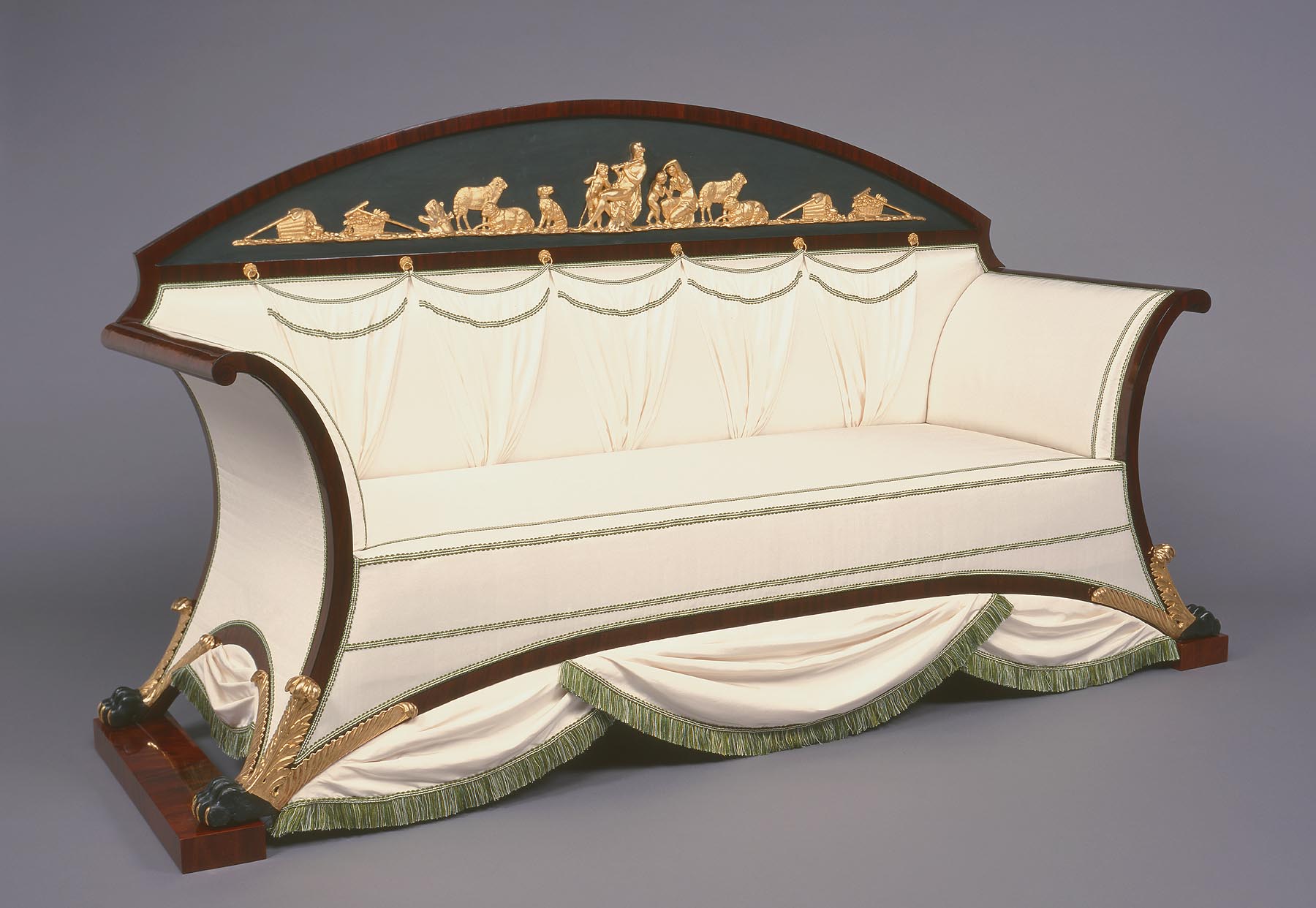
From the Collection–Biedermeier Settee

In 2006, when the Milwaukee Art Museum organized the exhibition Biedermeier: The Invention of Simplicity, it established itself as a center of study for the Beidermeier style that was popular in Central and Northern Europe from about 1815 to 1835.

Building upon the Museum’s strength in German and Austrian art—partly due to the ethnic background of Milwaukee—the exhibition brought to the spotlight to Biedermeier art.  This period of art and design history was not only little-known in the United States, but the exhibition also proposed a whole new interpretation of the style that changed scholarship in Europe as well.  You can read more about Biedermeier here in this review from the New York Times.

Or better yet, read the exhibition catalogue, available for purchase on the Museum Store site.

Categories
Art Collection Curatorial European

From the Collection— “A Roman Amateur” by Lawrence Alma-Tadema

Lawrence Alma-Tadema (English, b. Dutch, 1836–1912), A Roman Amateur (also known as A Roman Art Lover), 1870. Oil on wood panel, 29 x 39 1/2 in. Milwaukee Art Museum, Layton Art Collection, Gift of the following Layton Art Gallery Trustees, plus Layton funds, between 1892-96: George Dickens, Frederick Layton, William Plankinton, B.K. Miller, Samuel Marshall, J.H. Van Dyke, L149. Photo by John Neinhuis.
Lawrence Alma-Tadema (English, b. Dutch, 1836–1912), A Roman Amateur, 1870. Oil on wood panel, 29 x 39 1/2 in. Milwaukee Art Museum, Layton Art Collection, Gift of the following Layton Art Gallery Trustees, plus Layton funds, between 1892-96: George Dickens, Frederick Layton, William Plankinton, B.K. Miller, Samuel Marshall, J.H. Van Dyke, L149. Photo by John Neinhuis.

On December 14, 1894, Frederick Layton, the Milwaukee meat packer and philanthropist who founded the Layton Art Gallery (the predecessor of the Milwaukee Art Museum), wrote a letter to Julius Gugler of the Milwaukee Art Association.

Layton requested the organization to raise $10,000 by subscription to purchase a painting by Lawrence Alma-Tadema which was currently on display at Milwaukee’s Pfister Hotel as a loan from one of Layton’s art dealer friends.

The subscription must have been successful, because the Layton Art Collection at the Milwaukee Art Museum has a wonderful painting by Alma-Tadema!

This painting, called A Roman Amateur, can be found in Gallery #10 with other works of 19th-century European art.

Categories
Art Collection Curatorial European

From the Collection–Virgin and Child

Virgin and Child South German ca. 1550 Solnhofen stone 7 1/4 x 6 1/2 x 1 3/4 in. (18.42 x 16.51 x 4.45 cm) Gift of Anne H. and Frederick Vogel III in loving memory of his sister Grace Vogel Aldworth (1932-2002)
South German, Virgin and Child, ca. 1550. Solnhofen stone, 7 1/4 x 6 1/2 x 1 3/4 in. Milwaukee Art Museum, Gift of Anne H. and Frederick Vogel III in loving memory of his sister Grace Vogel Aldworth (1932-2002), M2003.67. Photo by John R. Glembin.

Sometimes with the rush of the holiday season, it is nice to take a deep breath and spend some time on your own.

In that spirit, I’d like to consider a small-scale stone relief Virgin and Child, ca. 1550.  You’ll find it at the Museum tucked in a case in Gallery #3, with works of the Northern Renaissance.

The artwork, carved in stone, is done in low relief and is set into a wood and silk case with a two-part hinged cover.   The small size allowed the owner to hold it in the palm of his or her hand for private contemplation and prayer.  The case is probably a later replacement, but it certainly would have had something similar to protect it when slipped into a drawer or carried for devotion during travel.

And what a beautiful image to inspire! 

Categories
Art Collection Curatorial European

From the Collection–Neapolitan crèche (Nativity scene)

Naples Italy, Nativity Scene (Crèche), mid 1700s. Milwaukee Art Museum, Gift of Loretta Howard Sturgis. Photo by John R. Glembin.
Naples Italy, Nativity Scene (Crèche), mid 1700s. Milwaukee Art Museum, Gift of Loretta Howard Sturgis, M2006.9.1-.20. Photo by John R. Glembin.

[Again for the 2011 holiday season, the Milwaukee Art Museum is thrilled to display the beloved Neopolitan crèche. Visit the Museum soon to enjoy this tradition with your family–the Nativity Scene will be on view through January 2012. Re-posted below is curator Catherine Sawinski’s 2010 blog post sharing the history of this artwork. ]

It’s that time of year again! The Museum’s Neapolitan crèche is on view in the galleries for the holiday season. You’ll find it in Gallery 4 of the Collection Galleries, with European art.

The origin of the popular Christmas tradition of re-staging the Nativity scene is usually credited to Saint Francis of Assisi in 1223. The custom reached its artistic height in eighteenth-century Naples, when the Museum’s version was made.

Categories
Art Collection Curatorial European

From the Collection–Girolamo Mengozzi’s “Architectural Fantasy with Figures”

M1982.37
Attributed Girolamo Mengozzi, Architectural Fantasy with Figures, ca. 1750. Oil on canvas34 3/8 x 28 in. Milwaukee Art Museum, Gift of Mr. and Mrs. Myron Laskin,M1982.37. Photo by P. Richard Eels.

I have always loved architecture. As a child, nothing excited me more than a big old Victorian farmhouse. Greek Revival, Carpenter Gothic, Second Empire, Queen Anne—I was probably one of the only Wisconsin middle-schoolers who knew the nuances of American house design and could read—and draw—a floor plan.

As an undergraduate, one of my majors was Classical Civilization, and my interest in architecture easily translated to ancient buildings. When I studied in Rome during my junior year and was able to see ruins that I had been studying in photographs, I was so excited.

I actually cried a little when I walked into the Pantheon for the first time!

Working in the European department at the Milwaukee Art Museum doesn’t allow me a lot of possibilities to directly study architecture, but I have found one way to explore it indirectly. Tucked away in the corner of the Italian Baroque gallery (Gallery #6) is a painting that most visitors probably miss. It is Architectural Fantasy with Figures attributed to Girolamo Mengozzi (Italian, ca. 1688–ca. 1766).

Categories
Art Library/Archives

Vive “Verve”

VERVE The French Review of Art Volume 2, Number 8 (September-November 1940) Printed in France Gift of Lillian Schultz
Matisse’s cover, VERVE The French Review of Art Volume 2, Number 8 (Sept-Nov 1940). Printed in France. Milwaukee Art Museum, Gift of Lillian Schultz. Photo by Beret Balestrieri Kohn.

Imagine having your favorite artists, authors, philosophers and others ready at your beck and call for any project you desire.

What would you have them do?

Published by E. Tériade, “Verve: The French Review of Art” was a legendary quarterly art journal with that kind of seemingly-limitless access to legendary artists.

From 1937 to 1975, Tériade (real name Stratis Eleftheriades, French 1889–1983) was an art critic, patron, and publisher that commissioned artists and philosophers, including Pablo Picasso, Henri Matisse, and André Derain to produce works for his prestigious journal.

This particular issue of “Verve” (Vol. 2, No. 8, Sept—Nov 1940), devoted to the “Nature of France”, features a luxurious dark dust jacket after Matisse’s paper cutouts.

Categories
Art Collection Curatorial European

From the Collection–Table Clock with Orpheus Frieze

Probably Nuremberg, Germany  Table Clock with Orpheus Frieze, 1560/80 with later movement Gilt brass, brass, steel, blued steel, silver and blue enamel 3 1/2 x 9 3/4 in. (8.89 x 24.77 cm) Gift of Richard and Erna Flagg M1991.84  Photo credit John Nienhuis
Probably Nuremberg, Germany, Table Clock with Orpheus Frieze, 1560-80 with later movement. Gilt brass, brass, steel, blued steel, silver and blue enamel, 3 1/2 h x 9 3/4 inch diameter. Milwaukee Art Museum, Gift of Richard and Erna Flagg, M1991.84. Photo by John Nienhuis.

When you visit the European galleries of the Milwaukee Art Museum, you may have noticed that in the “Renaissance Treasury” gallery (gallery #2) there are a lot of clocks!

These aren’t the wristwatches and battery-powered kitchen clocks that most of us have in our homes and offices.  With their highly decorative cases, these special clocks show highly-skilled and artful metalwork that celebrated a new way of time-keeping during the Renaissance.

Until the 14th century, time-keeping was not systematic at all.  The only way to tell time was to look at the sun, or to use a sun-dial, but that was tricky because the length of the day changed so much over the course of a year.  Another option was to use a water clock, which used flowing water to move gears, but they were large and cumbersome—and not always very accurate.