George Vicat Cole (English, 1833–1893), At Arundel, Sussex, 1887. Oil on canvas, 32 1/2 × 52 1/16 in. (82.55 × 132.24 cm). Milwaukee Art Museum, Layton Art Collection, Gift of J.M. Durand. L1888.17 Photo credit: John R. Glembin
For those you who where able to see the Milwaukee Art Museum’s Salon-style hang in Gallery 10 a couple of years ago, this painting may look familiar. This is because it is a Layton Art Collection painting that was brought out of storage for that display.
Happily, a number of paintings from that special installation will be included in the European galleries once we reopen, and we anticipate that this painting will be one of them!
Maria-Theresia van Thielen (Flemish, 1640–1706), Still Life with Parrot, 1661. Oil on canvas. 21 × 27 in. (53.34 × 68.58 cm). Milwaukee Art Museum, gift of Mr. and Mrs. John Schroeder in memory of their parents. M1967.41
This still life is probably one of the only signed paintings by Flemish flower painter Maria-Theresia van Thielen. It is truly a jewel of the collection!
Maria-Theresia van Thielen was one of three daughters of flower painter Jan Philips van Thielen. Her two sisters also became painters. The skillful and interesting composition of our painting sets it apart from most flower paintings by the van Thielen family; this may be why Maria-Theresia prominently signed it here on the pillar. There you can see “M.T. von Thielen” along with F. (for fecit, which is Latin for “made in”), Ano (short for Anno Domini, or A.D.) and the year, 1661.
VEB Porzellanmanufactur Plaue (Plaue, Germany, established 1816). “Singing Pig” Stein, ca. 1900. Glazed hard paste porcelain, colored underglaze decoration, and pewter. Milwaukee Art Museum, Gift of the René von Schleinitz Foundation M1962.984. Photo by Melissa Hartly Omholt.
Ready for some more laughs? In this post, we’ll be looking at more German steins meant to be amusing.
The industrial revolution of the nineteenth century meant that more goods could be produced quickly and more people could afford those goods. Developments in the technique for shaping ceramics meant that steins didn’t have to be a standard shape—they could be molded in all sorts of ways. And, in a never-ending quest for novelty, they were!
Villeroy & Boch (Mettlach, Saarland, Germany, established 1836), design attributed to Franz von Stuck (German, 1863–1928). “2106” Stein, 1894. Stoneware, with colored slip and glaze decoration, platinum luster, and pewter. Gift of the René von Schleinitz Foundation M1962.890. Photo credit: John R. Glembin.
Drinking games have long been a source of entertainment. One only has to look at the proliferation of puzzle jugs dating back to the sixteenth century to see this.
Villeroy & Boch (Mettlach, Saarland, Germany, established 1836), designed by Heinrich Schlitt (German, 1849–1923). “2765” Stein, 1902. Stoneware, with colored slip and glaze decoration, and pewter. Milwaukee Art Museum, Gift of the René von Schleinitz Foundation M1962.848. Photo credit: John R. Glembin.
Last time, we looked at the historical context for artwork in late nineteenth century Germany. In 1871, Germany officially became a unified country. This time, we’ll look at the cultural ramifications of the unification and how it impacted art.
Although German-speaking princes had been allied for centuries, the individual provinces needed to strengthen their commitment in order to counter military and economic competition from other countries such as Austria and France. But just because the people in the new country spoke German and shared much in the way of their cultural identity didn’t mean that they felt like a big happy family. And the disruptive forces of the industrial revolution did nothing to help the sense of confusion and frustration.
The people of the German Empire needed to ask themselves: what does it mean to be German? The imagery on Mettlach steins of the time offers some interesting answers to that question.
Villeroy & Boch (Mettlach, Saarland, Germany, established 1836), designed by Christian Warth (German, active 1854–1892). “1395” Stein, 1885. Stoneware with colored slip and glaze decoration, gilding and pewter. Milwaukee Art Museum, Bequest of Dorothy Trommel in memory of her parents, Eunice and Howard Wertenberg M2013.43. Photo credit: John Glembin.
Now we’ve come to the end of the 19th century, the time of the most dramatic changes for the German drinking vessels. This was due to a powerful combination of events.
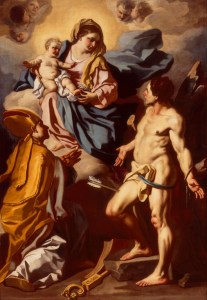
Francesco Solimena (Italian, 1657–1747), Madonna and Child with St. Januarius and St. Sebastian, ca. 1700. Oil on canvas. Milwaukee Art Museum, Gift of Friends of Art M1964.35. Photo credit: Larry Sanders.A number of artists featured in the special exhibition Of Heaven and Earth: 500 Years of Italian Painting from Glasgow Museums are also represented in the collection of the Milwaukee Art Museum. This is the fifth and final in a series of blog posts that will highlight Milwaukee’s paintings during the run of the exhibition.
A number of artists featured in the special exhibition Of Heaven and Earth: 500 Years of Italian Painting from Glasgow Museumsare represented in the collection of the Milwaukee Art Museum. This is the fourth in a series of blog posts that will highlight Milwaukee’s paintings during the run of the exhibition.
Italian baroque painting can be bold, dramatic—and downright gruesome. Artememsia Gentileschi’s Judith Slaying Holofernes or Caravaggio’s David with the Head of Goliath are two great examples. The theatricality is in part a result of the demands of the Catholic Church, which was reacting to the Protestant movements spreading throughout Europe. Their response was called the Counter-Reformation. In order to encourage a return to Catholicism, the Church commissioned art that would capture the viewer’s attention with drama and emotion.
But not all Italian Baroque paintings are blood and guts. Some can draw in the viewer with a quiet, contemplative air. One such painting is the Milwaukee Art Museum’s St. Dorothy by Antiveduto Gramatica (Italian, 1571-1626).
Back in September, the Milwaukee Art Museum participated in International Ask a Curator Day, an online initiative started in 2010 in the UK. The idea? Use social media to open up conversations between visitors and museum staff. This year’s Ask a Curator Day saw an astounding 721 museums from 43 different countries answering visitor questions pretty much around the clock.
Of course, we museum staff do this every day on site and online, but we love that Ask a Curator Day gives us the chance to reach a huge virtual audience from all around the world. After the jump, you’ll find some highlights from our Twitter feed on Ask a Curator Day. Thanks to everyone who tweeted us!
A number of artists featured in the special exhibitionOf Heaven and Earth: 500 Years of Italian Painting from Glasgow Museums are represented in the collection of the Milwaukee Art Museum. This is the third in a series of blog posts that will highlight Milwaukee’s paintings during the run of the exhibition.
Antonio Mancini (Italian, 1852–1930), On the Eve of Her Wedding, ca. 1882. Oil on canvas. Milwaukee Art Museum, Gift of Mrs. S. S. Merrill M1919.33. Photo by John Glembin.
In researching a museum’s collection, the story behind the acquisition of an artwork can sometimes be just as interesting as the artwork itself. The Milwaukee Art Museum’s On the Eve of Her Wedding by Antonio Mancini (Italian, 1852-1930) is a great example.
Mancini began his artistic studies at the age of 12. In 1875 and again in 1877, he visited Paris—then the center of the avant-garde world—where he met French Impressioninists Edgar Degas (French, 1834-1917) and Edouard Manet (French, 1832-1883). Mancini’s loose, expressive brushstroke and dark color choices were clearly influenced by Manet. At one point, John Singer Sargent (American, 1856-1925) declared Mancini to be the greatest living painter.