

Author: Catherine Sawinski

For the past few months, I’ve been lucky enough to be able to research the Milwaukee Art Museum’s collection of German drinking vessels. With over 200 steins, tankards, and jugs, we have examples that range in date from the mid-16th century to the early 20th century. So, over the next few months, I’ll be doing a series of blog posts to highlight this important—and interesting—area of the collection.


As Christmas approaches, it seems appropriate to take a closer look at one of the highlights of the European galleries: Virgin and Child by Nardo di Cione (Italian, ca. 1320–1365 or 1366) in Gallery #4.
Nardo was one of three artist brothers with a workshop in Florence in the mid 14th century. They were well-known not only for church frescos, such as those in the Santa Maria novella, but also their free-standing panel paintings.

Until February 9, the mezzanine will display works on paper that celebrate the natural world. You will not only have the opportunity to see a selection of our fantastic Rembrandt etchings and landscapes by other Dutch artists, but you’ll also be able to see how prints from 400 years ago influence contemporary artists.
In one of the two cases in the installation are three prints designed by the Flemish artist Joris Hoefnagel (1542-1601) and engraved by his son Jacob (1575-ca. 1630). They give us an amazing way to understand art and science in 16th century Europe.

These prints all came from a book called Archetypa studiaque patris Georgii Hoefnagelii. Published in 1592, the engravings illustrate an important transition in art production.
Joris Hoefnagel was one of the last important Flemish manuscript illuminators. This means that he would decorate books by hand for the extremely wealthy. By the late 16th century, the technique of printmaking had established itself as a way to spread images quickly and less expensively. When Joris’s son Jacob engraved his designs and published them as a book, it was a perfect example of this transitional period in the art market.

Joris Hoefnagel was more than just a talented illuminator. He was also a highly intelligent, well-educated man who was fascinated with the natural world. Perfectly at home in the Renaissance’s scientific inquiry, Hoefnagel carefully studied plants, animals, and insects, and then rendered them in detail. Many of them were rendered here for the first time. Other artists used his book as a source for designs in their own paintings and decorative arts.
A closer look shows that Hoefnagel has offered inspiration in another way. Each page includes an epigram that invites the viewer to reflect upon the image and contemplate his or her place in the universe. For instance, Plate 3 reads in Latin “Virum improbum vel mures mordeant” which translates to “May a Wicked Man at Least Be Bitten by Mice”.

The Renaissance’s interest in the natural world gives rise to centuries of artists who explore the subject. Still life painting in northern Europe flourished in the early 17th century. Botanical illustrators sought to discover, categorize, and document plants and animals worldwide in the quest of knowledge. The best-known wildlife illustrator, John James Audubon (American, b. Santo Domingo [now Haiti], 1785-1851), traveled for years to document the birds and mammals of the United States.
Contemporary artists are also interested in depicting and honoring nature. The display on the mezzanine includes works by Milwaukee artist JoAnna Poehlmann.

The tradition set forth by Joris Hoefnagel is alive and well in Poehlmann’s artwork. She draws her amazingly detailed images from an extensive collection of specimens. Her meticulous technique is obvious when looking at works such as Going Dutch I and Going Dutch IV.

But Poehlmann does not just celebrated the natural world in her artwork. Her playful works display her droll sense of humor, combing her knowledge of art history and literature. The Stamp Collection, a set of cards in a beautifully constructed envelope, juxtaposes illustrations postage stamps featuring art in order to create clever statements: a stamp of a crab with a lovingly rendered petit four makes a “crab cake” and a stamp with a tree above a perky little frog results in “tree frog.”

JoAnna Poehlmann’s creations are always best seen in person, so make sure you stop by the Mezzanine soon! (And stop by the Museum store to take home a little of her art.)

Catherine Sawinski is the Assistant Curator of European Art. When not handling the day-to-day running of the European art department and the Museum’s Fine Arts Society, she researches the collection of Ancient and European artwork before 1900.

A young boy kneels at the beach, drawing a sailboat into the wet sand with a stick. The sun beats on his bare skin and makes him almost glow with warmth and light. Behind him, water licks at his feet, cool and tempting. Although he is intent on his project, we know that once he has gotten too hot, he will lose interest and go back into the water.
Now that’s it September, I thought we’d have one more taste of summer by exploring Drawing in the Sand by Joaquin Sorolla y Bastida (Spanish, 1863-1923), which is on view in Gallery 11.

tureen. Bequest of Mrs. Arthur J. Riebs given in memory of her father C.W. George Everhart, and her mother Lillian Boynton Everhart. Photo credit John R. Glembin
What do you know about chestnuts? You might think of the opening lines of The Christmas Song (“chestnuts roasting on an open fire…”). The song is a sure sign that Christmas is coming, but how many of us have actually eaten a chestnut?
For thousands of years, chestnuts have been a nourishing food around the world. They can be eaten raw, dried, boiled, baked, and roasted, or even ground into flour. The ancient Greeks and Romans ate chestnuts. Roasted ones could be found for sale on the streets of Rome in the 1500’s and in America in the early 20th century; you can still find them offered by street vendors in countries such as China, the Philippines, Japan, and Turkey, and in Europe during the winter. (They are less familiar in the United States today because of chestnut blight, a fungus that killed off the chestnut trees in America during the early 20th century.)
But our subject today is the chestnut in France–18th century France, to be specific.

Last month we explored the history of the salon-hang style used in Gallery 10, which has been reopened as Mr. Layton’s Gallery. A glance around tells a lot about what kind of art was popular in the late 19th century in America: sculpture is clean, white marble; paintings by European and American artists fit into easily described categories (landscape, genre, still-life), or they are inspired by the classical past.
There is nothing truly avant-garde here. No Courbet, no Manet, no Monet, no Gauguin. Most of this artwork stands firmly in the tradition of art as it was understood for centuries. In fact, Homer and His Guide may even have been a direct rebuttal to the type of artwork shown at the First Impressionist Exhibition of 1874. Bougereau’s powerful painting reflects the survival of the classical, in both poetry and art, while facing adversity.
Although most of the beautiful objects from the early history of the Layton Art Collection are not ground-breaking, they are important to the time. And many of them still show the influence of the artists leading the attack on the art establishment.
So let’s take a look at some of the paintings that have come “out of the vault!”
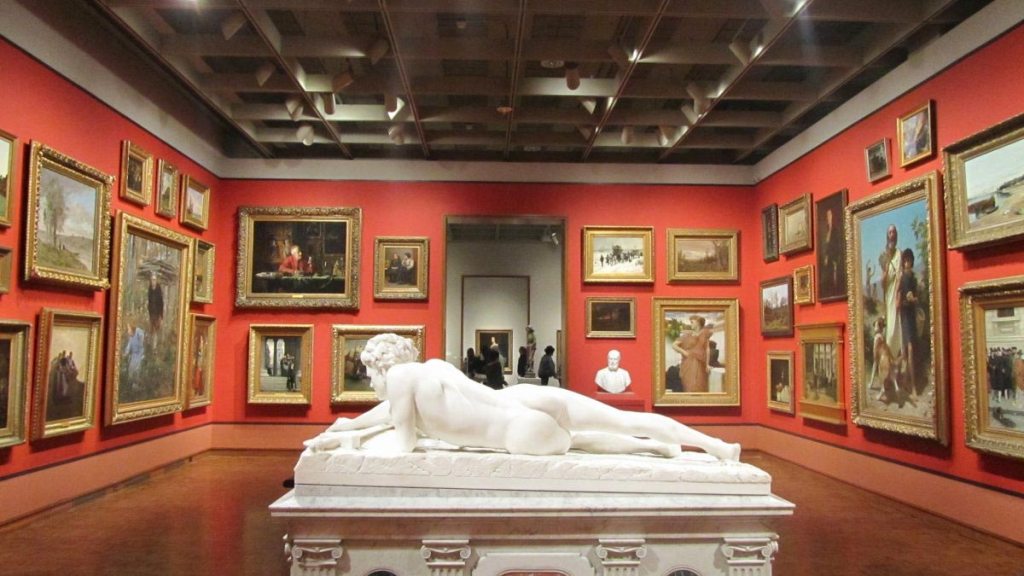
If you’ve been in the European galleries in the last few weeks, you’ve probably noticed a dramatic transformation in Gallery 10!
The gallery has been reinstalled as part of the celebrations of the 125th anniversary of the founding of the Layton Art Gallery, which laid the foundation for what would become the Milwaukee Art Museum. We’ve decided to call it Mr. Layton’s Gallery, after Milwaukee philanthropist Frederick Layton, who started it all.


Part of what drew me to studying Roman portraiture in college was my fascination with fashion. When growing up, if I wasn’t pouring over floorplans of Victorian houses, I was pouring over Victorian photographs and fashion plates.
So of course, when I found out that hairstyles were so important in portraits of women in ancient Rome, I was thrilled! Sabina, the wife of Hadrian, wore lovely waves similar to sculptures of Greek goddesses. Meanwhile, Septimius Severus’s wife, Julia Domna, is known for her helmet-like rolls of hair. The timeline of the Roman world unfolds before the fashion-conscious.
But what makes this topic even more fascinating is that, in true Roman-style, hairstyles are not just about beauty. Read on for a closer look at the political importance of Roman hairstyles (yes, you read that right), as well as a video how-to so you can give the hairdo a try yourself.