Categories
Art Curatorial

From the Collection— Neapolitan Crèche (Nativity Scene)

It’s that time of year again!  The Museum’s Neapolitan crèche is on view in the galleries for the holiday season. You’ll find it in Gallery 4 of the Collection Galleries, with European art.

The origin of the popular Christmas tradition of re-staging the Nativity scene is usually credited to Saint Francis of Assisi in 1223. The custom reached its artistic height in eighteenth-century Naples.  Nobles and aristocrats vied to outdo each other in presenting theatrical crèche (or presepio) displays with elaborate figures clothed in luxurious costumes.  In addition to the Holy Family, the scenes would include angels, putti, shepherds, the Magi, and a host of barnyard animals.  The most elaborate scenes would include daily life in Naples, such as the market, resulting in a lively scene mixing the sacred and the secular that could fill entire rooms. 

Categories
Art Curatorial

From the Collection—Elderkin Great Chair

A treasure you’ll find at the Milwaukee Art Museum: One of the oldest known pieces of American furniture to survive. Let me say that again: At the Museum is one of the oldest known pieces of American furniture.

This dramatic chair was made sometime in the mid-1600s in Connecticut or Massachusetts. Of course, at the time of its construction, its maker would have identified himself and the style of this chair as English. And yes, three-legged chairs of this type were not uncommon in England, but on the faraway shores of New England, this Great Chair was a great novelty.

Categories
Art Collection

From the Collection: ’Tis the Season

Gathering of people dancing underneath a large tree
Ludwig Knaus (German, 1829–1910), Dance under the Linden Tree, 1881 (detail). Oil on canvas. Gift of the René von Schleinitz Foundation M1962.31. Photo credit: John R. Glembin.
Gathering of people dancing underneath a large tree
Ludwig Knaus (German, 1829–1910), Dance under the Linden Tree, 1881. Oil on canvas. Gift of the René von Schleinitz Foundation M1962.31. Photo credit: John R. Glembin.

Earlier this week, as I walked to work, seeing my breath in front of me with my hands stuffed in my pockets, noticing that the trees were mostly bare, I had to admit to myself: winter just might be here. But part of me doesn’t want to dig out the winter coat and put away the flip-flops. I’m channeling my split-season-personality in this post by featuring two works in our Von Schleinitz collection of German art, which live right next to each other in Gallery 9.

Categories
Art Curatorial

From the Collection—George Mann Niedecken

George Niedecken’s reputation is that of a masterful Prairie School interior architect. However, because he worked as a collaborator to the master Prairie School architect, Frank Lloyd Wright, Niedecken’s legacy is often diminished. In addition to his famous collaborations on Wright’s Robie House (Chicago, Illinois) and Bogk House (Milwaukee, Wisconsin), Niedecken was committed to new American styles for the twentieth century right here in Milwaukee. He studied the European Art Nouveau, Secessionist, and Arts and Crafts movements in Paris and Berlin, and applied these ideas to inspired designs for the living rooms of his Midwestern clients.

Categories
Art

From the Collection: Francisco de Zurbarán’s “St. Francis”

Man in brown hooded robe looking down at a skull in his hands
Francisco de Zurbarán, Saint Francis of Assisi in His Tomb, ca. 1630/34 (detail). Purchase M1958.70. Photo credit John Nienhuis, Dedra Walls
Francisco de Zurbarán, Saint Francis of Assisi in His Tomb, ca. 1630/34. Purchase M1958.70. Photo credit John Nienhuis, Dedra Walls

Ever wondered what it’s like to experience a religious epiphany? Just walk into Gallery 6 and look to Francisco de Zurbarán’s St. Francis of Assisi in His Tomb, one of the great masterpieces in the Museum’s Collection. St. Francis towers above us in a massive, stark painting, lit only by unseen torchlight, his face hidden and a skull cradled in his palms. The space is unclear, the colors muted. He is monumental, and walks towards us: his foot pokes out of his robes, entering into our space. When I stand in front of this painting, I always feel like I should take a step back and get out of his way.

Categories
Art Exhibitions

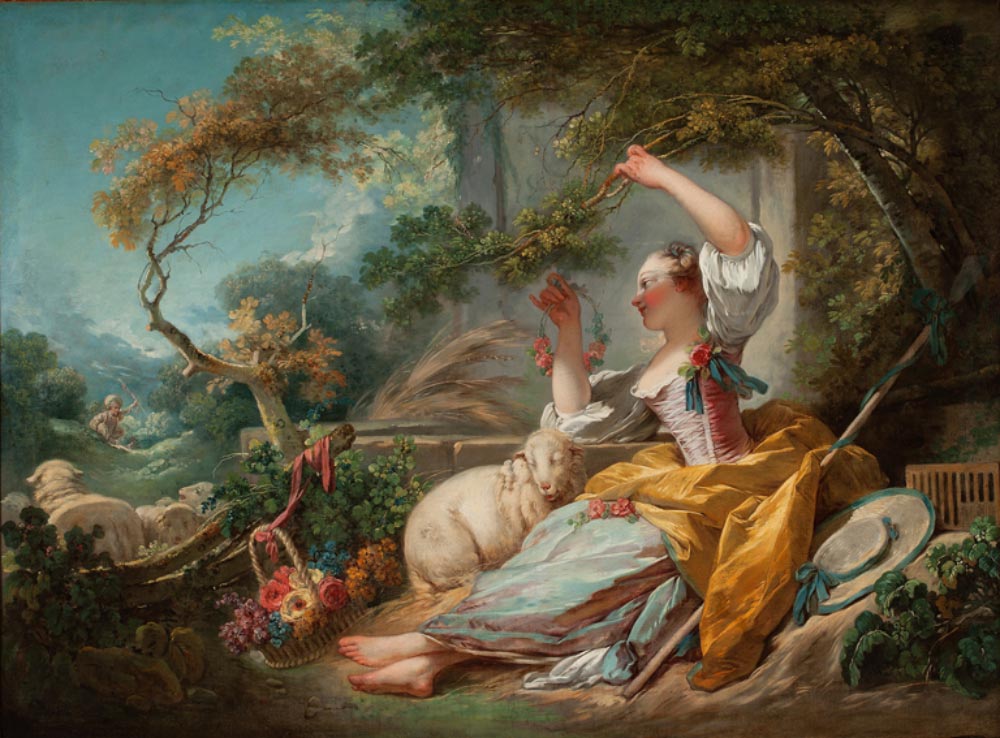
From the Collection: Jean-Honoré Fragonard’s “The Shepherdess”

Jean-Honoré Fragonard, The Shepherdess, ca. 1750/52 (detail). Bequest of Leon and Marion Kaumheimer. Photo credit John Nienhuis, Dedra Walls
Jean-Honoré Fragonard, The Shepherdess, ca. 1750/52. Bequest of Leon and Marion Kaumheimer. Photo credit John Nienhuis, Dedra Walls

In my high school art history class, my teacher, having covered with reverence the high-contrast drama of the Baroque, flipped the slide machine to show Jean-Honoré Fragonard’s The Swing and paused, glaring at the slide in the darkened room. Then she pronounced: “The Rococo. I loathe the Rococo! The Rococo is art history’s porn!”

Categories
Art

From the Collection: Gustave Courbet’s “Clement Laurier”

Portrait of a man in a black suit
Gustave Courbet, Clément Laurier, 1855 (detail). Gift of Friends of Art. Photo by John Nienhuis, Dedra Walls.
Portrait of a man in a black suit
Gustave Courbet, Clément Laurier, 1855. Gift of Friends of Art. Photo by John Nienhuis, Dedra Walls.

Speaking of curious museum coincidences, here’s yet one more. I knew the identity of the man in the Museum’s Courbet painting (Clement Laurier), but what I didn’t know was that Courbet also painted a portrait of Laurier’s wife. After popping onto the Metropolitan Museum of Art’s Timeline of Art History for some entirely unrelated research, I came across Courbet’s rendering of Madame Laurier, which lives in the Met! And then I immediately sat down to write this blog post instead of doing my original research. Always nice when your procrastination relates to your job, right?

Categories
Art

From the Collection: Edwin Landseer’s “Portrait of a Terrier”

Edwin Landseer (English, 1802–1873), Portrait of a Terrier, The Property of Owen Williams, ESQ., M.P. (Jocko with a Hedgehog), 1828 (detail). Oil on canvas
39 15/16 × 49 3/16 in. (101.44 × 124.94 cm). Gift of Erwin C. Uihlein M1967.79. Photo by Larry Sanders
Edwin Landseer (English, 1802–1873), Portrait of a Terrier, The Property of Owen Williams, ESQ., M.P. (Jocko with a Hedgehog), 1828. Oil on canvas
39 15/16 × 49 3/16 in. (101.44 × 124.94 cm). Gift of Erwin C. Uihlein M1967.79. Photo by Larry Sanders

This week is National Dog Week—and what better Museum dweller to highlight than brave Jocko (and his unfortunate companion, the hedgehog) in honor of this important holiday?

Categories
Art Curatorial

From the Collection— Tiffany gold Tea Service

In any museum gallery, you will encounter rare and valuable pieces of art. We value well-designed objects for many reasons, including for their materials and craft, their aesthetic design, and sometimes the people associated with them. This luxurious Tiffany & Co. Tea Service from 1905 is a rare object with incredible value in all three categories.

Categories
Art

From the Collection—English Posset Pot

This unusual form with an even odder name begs the question: what is a posset pot?

Posset pots were specially designed for the consumption of a warm, spiced drink popular from the Medieval period into the 19th century. The nourishing beverage, posset, was used to strengthen new mothers, the sick, or the elderly. Though it turns my stomach slightly to think of it, a good posset recipe should result in several layers caused by curdling.  The drink is made from milk beaten with eggs, sugar, and spices and curdled with ale or wine, but bread could be added to thicken it. The curdled milk rises to the top, the eggs create a custard mid-layer, and at the bottom is a warm spicy alcoholic drink, accessible only through the straw-like spout of a posset pot’s distinctive shape.