Categories
Art Collection Curatorial European Exhibitions Prints and Drawings

From the Collection: Anders Zorn’s Portrait Prints

The current exhibition in the European works on paper rotation space (on view until July 31) is Anders Zorn: Sweden’s Painter-Etcher.  Featuring all 18 prints in the Milwaukee Art Museum’s collection by Zorn, the exhibition is the first time ever that they have been on view at the same time.  This is the second in a series of posts focusing on the exhibition.

Anders Leonard Zorn (Swedish, 1860–1920), King Oscar II (or Oscar II), 1898. Etching and aquatint. Milwaukee Art Museum, Gift of Mrs. Joseph Greene M1979.23. Photo credit: John R. Glembin.

Last time, we were introduced to career of Anders Zorn (Swedish, 1860–1920). In this post, we’ll consider a few more of his portrait prints.

In the Milwaukee Art Museum exhibition, there are portraits of two members of the Swedish royal family: the King of Sweden, Oscar II (left), and the Crown-Princess Margaret (below), who was married to Gustav Adolf, the grandson of King Oscar. Margaret herself was the granddaughter of Queen Victoria of England.

Oscar II was a fan of Zorn’s from the artist’s earliest days, when the king tried to purchase a watercolor from him at an exhibition at the Stockholm Academy. The king eventually commissioned some painted portraits from Zorn. Our portrait print is not based upon any of those paintings. It shows the king at leisure, enjoying his yacht—he is even wearing a captain’s hat. It seems appropriate to use the intimate scale of an etching to capture the head of state.

Categories
Art Collection Curatorial European Exhibitions Prints and Drawings

From the Collection: Anders Zorn and Etching

The current exhibition in the European works on paper rotation space (on view until July 31) is Anders Zorn: Sweden’s Painter-EtcherFeaturing all 18 prints in the Milwaukee Art Museum’s collection by Zorn, the exhibition is the first time ever that they have been on view at the same time.  This is the first in a series of posts focusing on the exhibition.

Anders Leonard Zorn (Swedish, 1860–1920), Zorn and his Wife, 1890. Etching, possibly drypoint, and graphite. Milwaukee Art Museum, Gertrude Nunnemacher Schuchardt Collection, presented by William H. Schuchardt M1924.141. Photo credit: John R. Glembin

Did you know that Anders Zorn might be the most famous artist you’ve never heard of?

During his career, which spanned about 20 years before and 20 years after 1900, Zorn was in high demand for painted portrait commissions in Europe and in the U.S.  In fact, he was in direct competition with John Singer Sargent (American, 1856–1925), one of the best known portrait painters at the turn of the twentieth century.

So, who was Anders Zorn?

Anders Zorn was born in 1860, the son of a German brewer and one of his Swedish employees.  His parents were not married, and Zorn’s father was not very involved in his son’s life, although he did leave Zorn a small inheritance when he died.

Categories
American Art Collection Curatorial Exhibitions

From the Collection: In the Catskills by Asher Brown Durand

A number of the artists featured in the special exhibition Nature and the American Vision: The Hudson River School can also be found in the galleries of the Milwaukee Art Museum. This is the fourth and final in a series of blog posts that will highlight Milwaukee’s artworks during the run of the exhibition.

Asher Brown Durand (American, 1796–1886), In The Catskills, 1857. Oil on canvas. Milwaukee Art Museum, Layton Art Collection, Inc., Gift of Frederick Layton L105. Photo credit: Larry Sanders.

Although they depicted the American landscape, Hudson River School painters found inspiration in Europe.

Traveling to France or Italy to study Old Masters was a common tradition, even for American artists looking to assert their cultural identity, and they adapted European conventions to a uniquely American vision.

For this blog post, we will use the painting In the Catskills by Asher Brown Durand (American, 1796-1886) as a case study, showing the influence of European artistic traditions.

Categories
American Art Collection Curatorial Exhibitions

From the Collection: Frederick Edwin Church and Charles De Wolf Brownell

A number of the artists featured in the special exhibition Nature and the American Vision: The Hudson River School can also be found in the galleries of the Milwaukee Art Museum. This is the third in a series of blog posts that will highlight Milwaukee’s artworks during the run of the exhibition.

Frederic Edwin Church (American, 1826–1900), A Passing Shower, 1860. Oil on canvas. Milwaukee Art Museum, Layton Art Collection, Inc. L107. Photo credit: Larry Sanders.

The first post in this series focused on Thomas Cole, the founder of the Hudson River School. Today we will highlight Cole’s one and only pupil, Fredrick Edwin Church (American, 1826-1900), as well as Church’s very good friend, Charles De Wolf Brownell (American, 1822-1909).

Categories
American Art Collection Curatorial Exhibitions

From the Collection: Albert Bierstadt’s Wind River Mountains, Nebraska Territory

A number of the artists featured in the special exhibition Nature and the American Vision: The Hudson River School can also be found in the galleries of the Milwaukee Art Museum. This is the second in a series of blog posts that will highlight Milwaukee’s artworks during the run of the exhibition.

Albert Bierstadt (American, b. Germany, 1830–1902), Wind River Mountains, Nebraska Territory, 1862. Oil on board. Milwaukee Art Museum, Layton Art Collection, Inc., Purchase L1897.3. Photo credit: Larry Sanders.

The special exhibition Nature and the American Vision looks at the paintings of the Hudson River School. This week, let’s take a closer look at one of the paintings by this group of artists on view in the American galleries and see how it relates to scientific study.

Today we see science and art as two separate forms of study, but for much of history, they were intertwined. The painters of the Hudson River School worked during the nineteenth century, when science and the humanities had more fluidity.

Categories
Art Behind the Scenes Curatorial Exhibitions

Herzfeld Photography, Print, and Drawing Study Center

Herzfeld Photography, Print, and Drawing Study Center. Photo credit: John Glembin.

Did you know that nearly half of the Milwaukee Art Museum’s collection consists of works on paper? We have more than 15,000 rare prints, drawings, photographs, and book arts.

Works on paper cannot be shown indefinitely, because they are light-sensitive; light will cause them to fade.  Accordingly, in order to preserve them in the best condition possible, they are rotated.  A rotation is when one work is taken off view and replaced with another, usually every three to four months.

The Museum has a number of new spaces dedicated to works on paper.  The focus of these areas range from European prints and drawings (Gallery S202), to modern art from the Bradley Collection (Gallery K215), to Folk and Self-Taught art (Gallery K122). When not on view, those works on paper are stored safely in the dark.

Categories
Art Exhibitions

Happy Birthday, Andy Warhol!

Andy Warhol's 100 Cans in the exhibition Van Gogh to Pollock: Modern Rebels, Masterworks from the Albright-Knox Art Gallery. Photo by the author.
Andy Warhol’s 100 Cans in the exhibition Van Gogh to Pollock: Modern Rebels, Masterworks from the Albright-Knox Art Gallery. Photo by the author.

Today we celebrate the birthday of famous American pop artist Andy Warhol. The Milwaukee Art Museum’s permanent collection boasts a number of works by Warhol, but one of his most iconic pieces is featured in the Museum’s current temporary exhibition, Van Gogh to Pollock: Modern Rebels. The piece, titled 100 Cans, was completed in 1962.

Categories
Art Exhibitions

Happy Birthday, Frida Kahlo!

 Frida Kahlo's "Self-Portrait with Monkey" can be seen displayed in "Van Gogh to Pollock: Modern Rebels," at MAM through September 20th
Frida Kahlo’s “Self-Portrait with Monkey” can be seen displayed in “Van Gogh to Pollock: Modern Rebels,” at MAM through September 20th

From June 18 to September 20, the Milwaukee Art Museum is proud to temporarily house works by some of the most famous artists in history in an exhibition titled Van Gogh to Pollock: Modern Rebels. One such rebel artist, whose painting Self-Portrait with Monkey is displayed in this extraordinary exhibition, is Frida Kahlo. In honor of her 108th birthday on July 6, we celebrate the life and mind of this strong woman and creative artist.

Categories
Art Collection Curatorial European Exhibitions

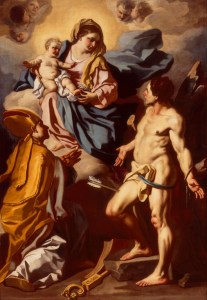
From the Collection–Francesco Solimena’s Madonna and Child with St. Januarius and St. Sebastian

Francesco Solimena (Italian, 1657–1747), Madonna and Child with St. Januarius and St. Sebastian, ca. 1700. Oil on canvas. Milwaukee Art Museum, Gift of Friends of Art M1964.35. Photo credit: Larry Sanders.
A number of artists featured in the special exhibition Of Heaven and Earth: 500 Years of Italian Painting from Glasgow Museums are also represented in the collection of the Milwaukee Art Museum. This is the fifth and final in a series of blog posts that will highlight Milwaukee’s paintings during the run of the exhibition.

The black death. It terrorized Europe for centuries. Although the knowledge of modern medicine means that plagues are not widespread today, the power of disease and its strain on society is still evident.

Categories
Art Collection Curatorial European Exhibitions

From the Collection: St. Dorothy by Antiveduto Gramatica

Antiveduto Gramatica (Italian, 1571–1626), St. Dorothy, late 16th–early 17th century. Oil on canvas. Milwaukee Art Museum, Gift of Dr. and Mrs. Alfred Bader M1971.23. Photo credit: John R. Glembin

A number of artists featured in the special exhibition Of Heaven and Earth: 500 Years of Italian Painting from Glasgow Museums are represented in the collection of the Milwaukee Art Museum. This is the fourth in a series of blog posts that will highlight Milwaukee’s paintings during the run of the exhibition.

Italian baroque painting can be bold, dramatic—and downright gruesome.  Artememsia Gentileschi’s Judith Slaying Holofernes or Caravaggio’s David with the Head of Goliath are two great examples. The theatricality is in part a result of the demands of the Catholic Church, which was reacting to the Protestant movements spreading throughout Europe.  Their response was called the Counter-Reformation.  In order to encourage a return to Catholicism, the Church commissioned art that would capture the viewer’s attention with drama and emotion.

But not all Italian Baroque paintings are blood and guts.  Some can draw in the viewer with a quiet, contemplative air.  One such painting is the Milwaukee Art Museum’s St. Dorothy by Antiveduto Gramatica (Italian, 1571-1626).