

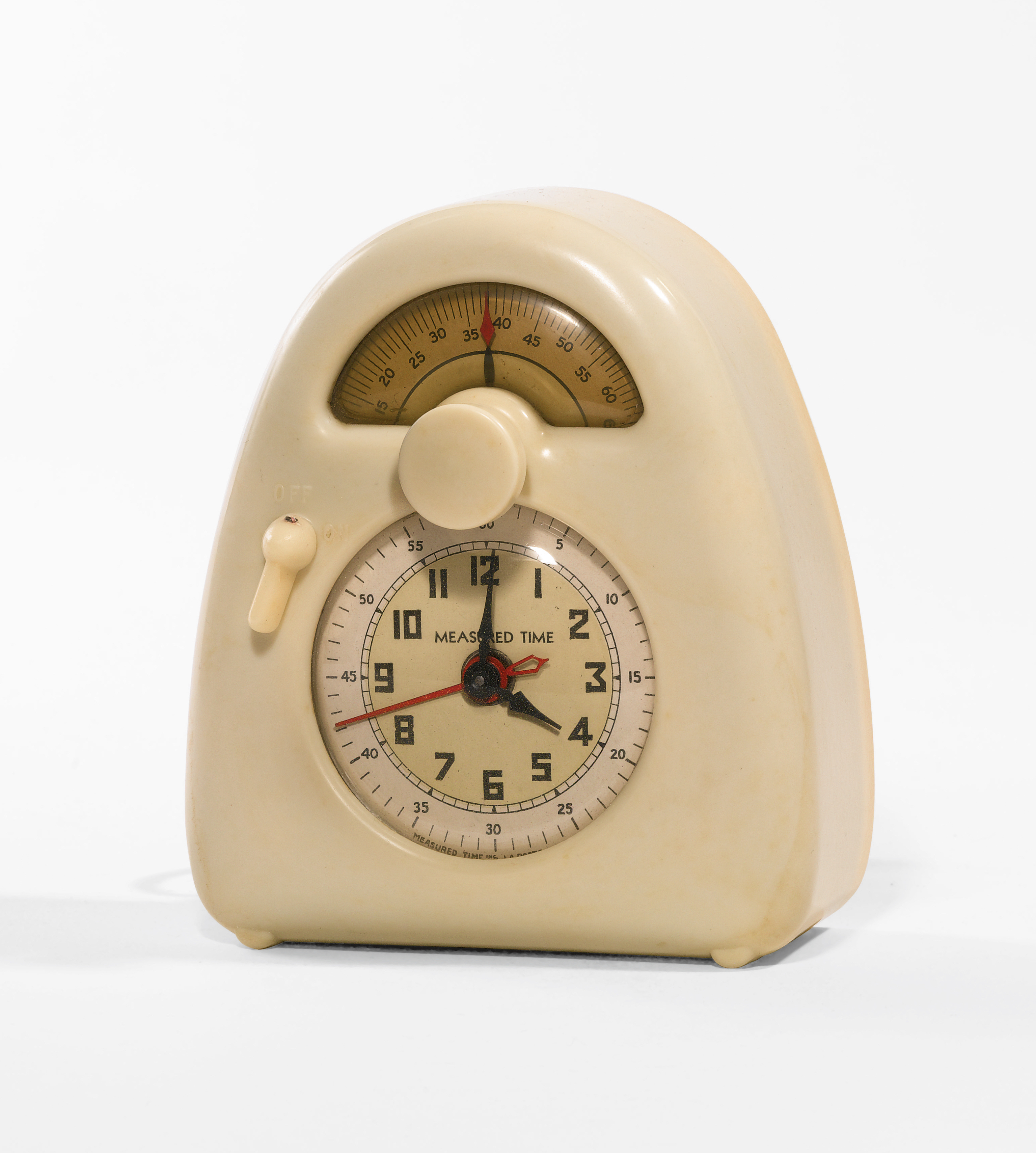
Clocks, calculators, measuring tapes, and scales—tools for measurement and calculation have long been important for people to accomplish tasks at work, school, and home. A new display in the 20th- and 21st-Century Design Galleries considers the role designers played in shaping such devices in the twentieth century, with examples from the 1920s-1980s. On one hand, these objects demonstrate how many designers aimed to make tools that are simple to use and easy to read, such as the streamlined kitchen clock and timer that Isamu Noguchi designed for Measured Time, Inc. in the early 1930s. At the same time, these designs bring to light how measurement and calculation have been closely linked to the human body in the twentieth century, as this post explores.
Category: Collection

Since its opening in 2015, the Herzfeld Center for Photography and Media Arts has proudly featured many world-renowned female artists working in photography, film, video, and digital media, specifically through solo exhibitions and special programming. These initiatives contribute to an institution-wide effort to highlight more women artists, challenging the art world’s male-dominated past.
As Women’s History Month comes to a close, we are looking back at some of the most recent Herzfeld Center exhibitions that have focused on women artists. Read below to learn more.

In 2016, the Milwaukee Art Museum partnered with Milwaukee Public Library to present Wisconsin Women Artists, an exhibition of paintings on view through September 2019 in the Central Library Art Gallery.
From cultural leaders to art educators, women have played a pivotal role in the development of the arts in the city of Milwaukee and the state of Wisconsin. This selection of paintings by Wisconsin women artists spans more than one hundred years and highlights the breadth of their artistic contributions and output, from early realist landscapes and portraits, to abstract and modernist canvases.
Below are just a few of the works featured in the exhibition—stop by the library to see them all!
Categories
Women in Design

Female designers: shattering the glass ceiling, while creating glass masterpieces (among other innovative objects)
Though not often recognized as prominently as their male counterparts, female designers have had a significant impact on the world of design, using their creativity and inventiveness to push boundaries and marry the concepts of beauty and practicality. Read below to learn about some of the inspiring female designers featured in the Museum’s Design Galleries.
Categories
Can You Name Five Women Artists?

In honor of Women’s History Month, the Milwaukee Art Museum is joining the National Museum of Women in the Arts in their effort to address the persisting gender imbalance in the art world and highlight more women artists. Though kicking off in March, these efforts will extend far beyond a single month, with special programming focused on female artists all year.
Categories
Celebrate Women Artists at the Museum

Who run the [art] world? Historically, men. But, despite an enduring lack of public recognition and acclaim, our Collection shows that women artists have helped shape the art world throughout time, using their talents to not only reflect the world around them, but also challenge conventions, make bold statements, and speak to the female experience.
Below are just a few of the works by women artists currently on view. Stop by the Museum to see them in person, in celebration of Women’s History Month.

In the early 1950s, designers Charles and Ray Eames painstakingly arranged penny cars, pencils, pills, and papers to photograph for their House of Cards construction set. They probably never imagined that decades later, thousands of children and adults in the Milwaukee region would meticulously decorate their own House of Cards, let alone that these cards would be installed together in a towering spiral at the Milwaukee Art Museum in conjunction with the exhibition Serious Play: Design in Midcentury America.


Ho-Chunk presence and their arts contributed to the development of Wisconsin Dells tourism—and to the material and aesthetic culture of the state. While Ho-Chunk representation is not always considered by tourists beyond stereotypical art for the trade, there is still a long and well-documented history of Ho-Chunk material life in the Wisconsin Dells area. The Ho-Chunk objects currently on exhibition in Mrs. M—’s Cabinet, are not the expected souvenirs of the Wisconsin Dells trade, but give a glimpse into the unfamiliar Ho-Chunk objects made and used in the Dells in the late 19th century.

Spring cleaning isn’t just for attics—the Museum’s Design Galleries were recently refreshed with a new coat of paint and numerous recent acquisitions. From turn-of-the-century silver to twenty-first-century furniture, these objects demonstrate the wide range of what we mean by “design” at the Milwaukee Art Museum.


It’s always exciting when new research comes to light! Just last month, while preparing for a lecture on Meissen in the Milwaukee Art museum collection, I discovered new information related to an object from an earlier post, the Meissen urn.
When last researching the urn in 2015, I was pretty sure that it was made by Meissen Porcelain Manufactory, the important German company, because it was marked on the bottom with crossed swords in blue. It has the snake handles popular on these types of vessels, particularly in the nineteenth century. The scene on the vase is the Greek myth of the Calydonian boar hunt.