


English history can appear to be a long list of kings and queens with the same names. The queen that most of us are familiar with today is Queen Elizabeth II. The first and only other Queen Elizabeth ruled from 1558 to 1603.
Category: Collection


When you look at the painting below, what do you see? American artist Helen Frankenthaler (1928–2011) was an Abstract Expressionist; these artists used line, shape, and color to express themselves.
Frankenthaler invented her own painting technique, which she called “soak staining.” First, she added turpentine to her oil paints to make them thinner (and very runny!). Then, she laid a cotton canvas flat on the floor, and poured, dripped, and brushed the paint onto its surface. Since her canvases were unprimed, or raw, the paint soaked into the fabric.


We commonly refer to dogs as everyone’s best friend, and for me, that’s true. But I have many other best friends, too, including my cat, my rabbit, and some nice people. Each has their own unique personality. Artworks can also have unique “personalities,” or styles. Artistic styles help us explain how artworks look and how they were made. There are many different styles of art.
Alex Katz’s Sunny #4, a larger-than-life portrait of the artist’s dog, is painted in the Pop Art style. Pop artists often used bold lines, flat shapes, and vivid colors in their artworks. Here, Katz used long, straight brushstrokes to paint Sunny’s hair, and for Sunny’s tongue, he painted a flat, pink rectangle.
Let’s make our own drawings inspired by Sunny!

JULY 25–26, 2020
This weekend, take to your sidewalks, driveways, and parking lots to create bright, joyful chalk art! We’re joining with the Museum of Wisconsin Art (MOWA) and many other arts organizations throughout the state to encourage a weekend of outdoor art making. Spread positive messages to family, friends, and neighbors—or create your own masterpiece, inspired by works in the Museum’s collection!
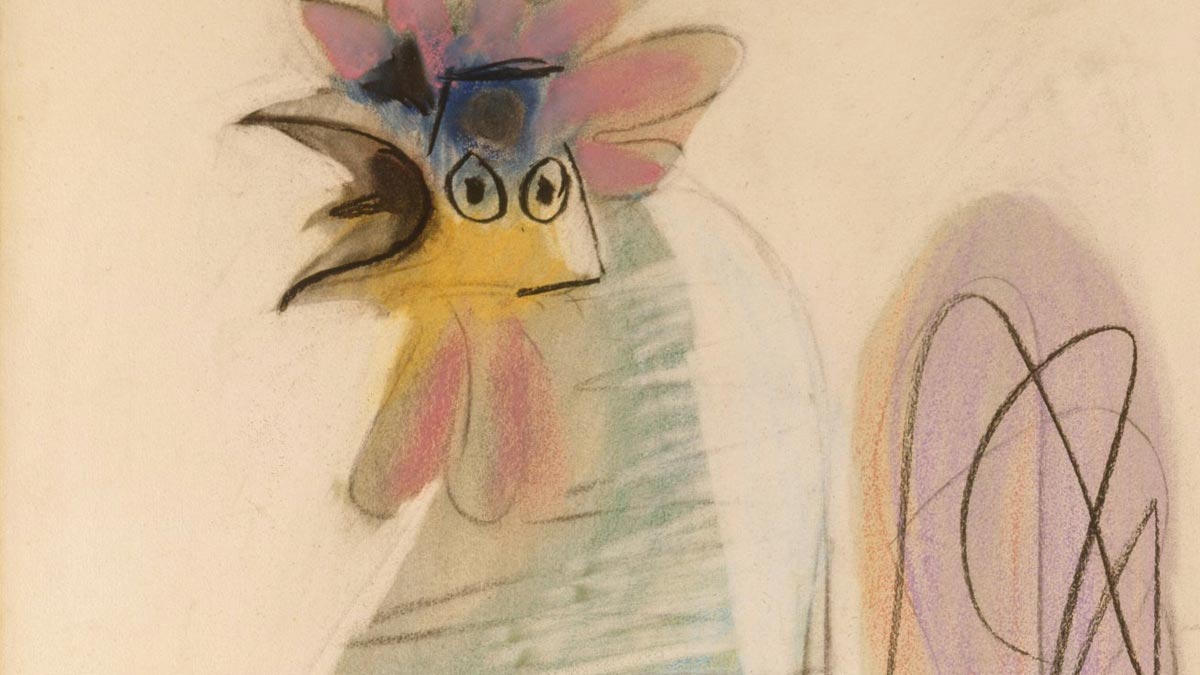
Many famous artists have used chalk to make both sketches and finished works of art. To create the drawing below, Pablo Picasso (1881–1973) used pastels. Pastels are made from pigment, or color, and chalk; the two are blended and held together with a binder. Picasso’s pastel drawing of a rooster shows many of the special things you can do with this material. Use sidewalk chalk to make a drawing outdoors. Save pastels for drawing on paper!
Here are some tips and tricks for working with chalk and pastels:
Categories
Letters to Sunny
Sunny #4 by Alex Katz is one of the most beloved pieces in the Milwaukee Art Museum’s collection. Many visitors make sure to visit Sunny every time they come into the galleries.

Who wouldn’t love this sweet face?
While the Museum was closed, our artworks felt very lonely—and Sunny was no exception! When we heard how much he missed his regular visitors, we knew we had to do something. For the entire month of June, we opened the Museum’s mailbox to messages and drawings for Milwaukee’s most popular pup.


The artistic talent of Lois Mailou Jones (1905–1998) was recognized at an early age. She received a wide range of encouragement, including scholarships to the School of the Museum of Fine Arts, in her native Boston, and after graduating with honors, she assumed teaching was a likely next step. But, in what was the first of several rejections in an openly racist society, she was told to go south and help “her people.”


Make moving art inspired by the kinetic sculpture of Harry Bertoia.
Time changes everyone—or almost everyone. Through the years, the Janitor has remained a constant in the galleries of the Milwaukee Art Museum.


Markets are great places to discover new things to buy and eat. In his work Crowded Market, Laurent Casimir captured a very busy outdoor market in Haiti. The artist filled every inch of his painting with people who are buying and selling goods, helping us imagine what it felt like to be there. Can you spot some of the different things people are buying and selling in the painting?
This week, we are going to make our own paint, using items that you may find at a market. With a grown-up’s permission, look for colorful spices and foods in your home. Flower petals are also a great source of color. Not everything you choose will make a good paint, so you’ll want to try them out before starting your artwork. Avoid foods that are sticky or very thick. Here are some of the things I collected:

We invite you to join us as each curator focuses on a single work of art, exploring both that object and how the object speaks to the collection as a whole, as well as to the chosen theme in particular.