


Artist Philomé Obin and his son, Antoine, worked together to complete this painting. In the work, you can see Philomé on the left, Antoine on the right, and Philomé’s brother, Sénéque, who was also an artist, in the center. They are sitting in front of the Centre d’Art in their hometown of Cap-Haïtien. Philomé opened this school and gallery as a branch of the Centre d’Art in Port Au Prince, Haiti.
Category: Collection


When it comes to materials, many artists are resourceful. To create his sculptures, Haitian blacksmith Georges Liautaud (1899–1991) used discarded steel drums that were left on the island. Liautaud cut and flattened the round drums, used fire to clean off the oil and dirt, and drew designs on the metal in preparation for sculpting. He then cut, punched holes in, and embossed (or pushed into the metal to create raised marks) the material. He was the first artist to create sculptures in this way. Liautaud taught this technique to many other blacksmiths and artists in Haiti. Today, it is still one of the country’s most popular art forms.


“Have you ever walked past Sunny #4 and not smiled?” That was the question Mrs. Kari Hahm, a teacher at Zion Lutheran School, posed to the Museum when she recently shared the chalk drawings her students made, at home, of Alex Katz’s Sunny #4.


We invite you to join us as each curator focuses on a single work of art, exploring both that object and how the object speaks to the collection as a whole, as well as to the chosen theme in particular.


American artist Al Held (1928–2005) was an abstract painter, most famous for his large-scale, geometric works. His paintings are full of circles, squares, cubes, and other geometric shapes and forms that overlap. In the painting below, he used a masking technique to create lines with sharp edges. He masked (covered) the white sections with tape and painted the remaining sections black.
Here’s how you can make your own geometric painting using materials you may already have at home:

We invite you to join us as each curator focuses on a single work of art, exploring both that object and how the object speaks to the collection as a whole, as well as to the chosen theme in particular.
In this first iteration, we examine the notion of still life as it has been treated in artwork across time.


It’s almost Mother’s Day! Give your mom, grandma, or any other special person in your life a flower bouquet that will last forever. This week, we’re making paper flowers inspired by the gorgeous blooms you can find in artworks throughout the Museum’s galleries. This is one of my favorite floral still lifes.
Let’s get started! Here are instructions for making two different kinds of paper flowers.
A museum’s collection is, by its very nature, carefully organized, its objects categorized by geographic origin, medium, chronology, and other defining characteristics. However, works of art have many qualities that defy these traditional institutional divisions. Through a series of videos, we will examine these broader elements, seeking commonalities and new ways of connecting the works in the Museum’s collection. We invite you to join us as each curator focuses on a single work of art, exploring both that object and how the object speaks to the collection as a whole, as well as to the chosen theme in particular.


Upon first glance, The Shepherdess by Jean-François Millet seems to represent a purely bucolic scene in rural France. Millet completed the etching in 1862, and in it, we see a woman knitting while her sheep graze in a field in the distance. She wears a cape, a bonnet, and sabots—wooden shoes associated with the lower classes in France. Her face is obscured by the shade of the trees growing behind the boulder where she rests. On her right, a dog keeps watch over the sheep. A sense of purposeful stillness pervades the scene. Despite the tranquility of the image, however, the setting and activities it depicts are closely related to ecological debates that took place in French society between the 1830s and 1870s. One such debate centered on Fontainebleau Forest.
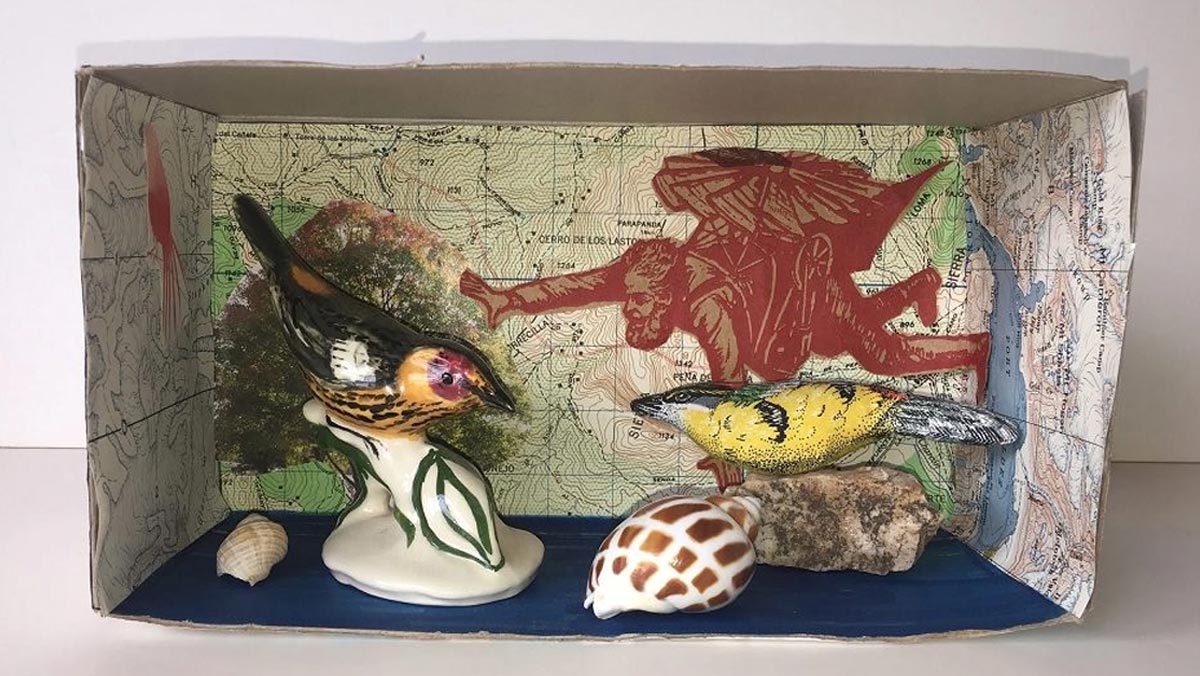

American artist Joseph Cornell (1903–1972) was famous for his imaginative, mixed-media shadow boxes. A shadow box is an enclosed box, with glass on the front, that contains artistic or personal objects. Cornell purchased trinkets from secondhand stores and cut out images from magazines to use as art supplies. He then arranged these objects to create dreamlike, mysterious, and whimsical scenes. Many of his shadow boxes had themes, like outer space or birds. Cornell spent a lot of time by himself; each shadow box offers a glimpse into his private world.
Here’s how you can create your own shadow box, using objects you find at home!