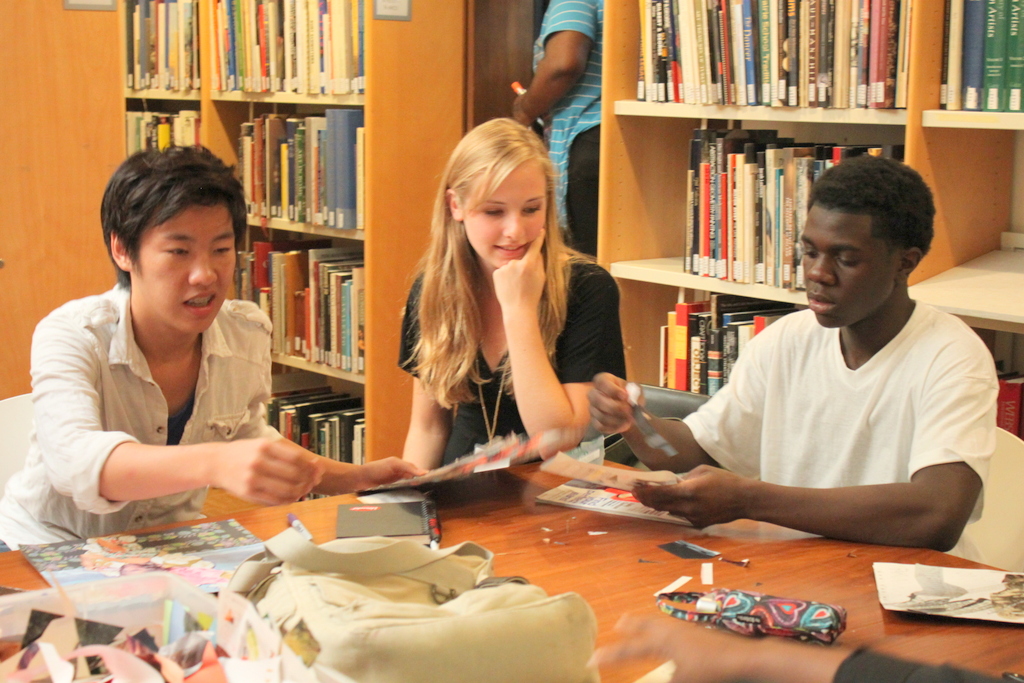
Steven, Sensei, and Dre’Shawn working on their projects. Photo by Chelsea KellyEditor’s Note: I’m thrilled to share another post from my intern, Jessica Janzer, whose previous piece focused on the Fall 2011 session of Satellite, one of our teen programs. In this post, Jessica reflects on her teaching practice, which is informed by her art education degree program as well as her work as an intern here at the Museum. Jessica’s thoughtful comparison of two different ways of teaching is great food for thought for all of us who are interested in education and the arts. –Chelsea Kelly, Manager of Digital Learning
A close-up of the Kohl’s Color Wheels Chihuly project.As the Kohl’s Color Wheels Team Coordinator, I have the chance to bridge the gap between the Collection and the world outside the Museum walls. I am given the awesome task of working with area schools and art teachers to bring part of the Collection to them. I wanted to share this process through photos of a past event with Shady Lane Elementary.
Mark Newell and Claudia Mooney collecting empirical data on the face jugs. Photo courtesy of Mark Newell.
The exhibition Face Jugs: Art and Ritual in 19th Century South Carolina, on view this past summer at the Milwaukee Art Museum (and currently on tour through South Carolina, Alabama and Georgia), provided us at Chipstone with a rare hands-on research opportunity.
As you may have read in one of my previous blog posts on Face Jugs, the objects in the exhibition were made by slaves, and later free African Americans, in the Edgefield County of South Carolina from about 1860 to about 1880. Previous scholars posited arguments that connected the face jugs back to Africa, but there was still research to be done in terms of the face jugs’ origin and function.
In addition to conducting our own research, we teamed up with anthropologists, archeologists and historians in order to gain a fuller understanding of the face jugs’ story–and got up close and personal with the objects in the process.
Installation shot “Grete Marks: When Modern Was Degenerate.” Photo by the author.
Well, that was a whirl! For any of you that follow these blog posts in a timely manner, you’ll know (and one of you even pointed out to me in a gallery talk!) that I ambitiously scheduled two “Making an Exhibition” blog posts for myself on the week of and week after the Grete Marks: When Modern Was Degenerate exhibition opened.
Mistake. So, here I am, three weeks tardy to my original plans, finding an afternoon to recap the excitement of putting together the exhibition in its final week, celebrating the opening of the exhibition, and then sharing it with tours and reporters.
I am thrilled with how the beautiful artwork and tremendous story unfold in our exhibition. I am happy to report that we had a great crowd at our opening night. And I have been honored to share this story with more than one reporter, who had very lovely things to say about our exhibition in the press.
This summer, fourteen teens from 12 Milwaukee-area high schools came together to impact the present and future of museums. Funded by the MPS Arts Internship Program through the Milwaukee Public Schools Recreation Department, these teens were paid museum studies interns for five weeks, going behind-the-scenes at the Museum, developing career skills, and helping the Museum in its day-to-day functions.
A “visual checklist” pinboard at my desk. Photo by the author.
Picking paint colors. Stepping under ladders in closed off galleries. Artfully arranging teacups. All are things I’ve done in the past few weeks, and all are entirely fun perks to a curator’s job. Beyond the fun, what I aim to do in this post is go a little deeper into the process of installing, painting, and arranging an exhibition.
In the first three posts of this series, I’ve addressed steps to developing the Milwaukee Art Museum’s Grete Marks: When Modern Was Degenerate exhibition (on view September 6, 2012 – January 1, 2013), from idea to loan paperwork to marketing.
The next step of bringing this incredible story and artwork physically to the public were the conversations we had about the design of the gallery, because there are as many ways to display artwork as there are paint colors in the Sherwin-Williams sample book.
William J. Anderson and Julius Bleyer. Milwaukee’s great industries: a compilation of facts concerning Milwaukee’s commercial and manufacturing enterprises, its trade and commerce, and the advantages it offers to manufacturers seeking desirable locations for new or established industries. Milwaukee: Association for the Advancement of Milwaukee, 1892. Gift to the Milwaukee Art Museum Library by Don M. Kaminsky (1941-2009).
Recently, I had the opportunity to open an interesting book in the Museum’s Library entitled Milwaukee’s Great Industries (1892). This 352-page tome features a history of Milwaukee, articles on its various industries, schools, churches, trades, a variety of advertisements, and a list of city facts entitled “Milwaukee in a Nutshell.”
Did you know that in 1892, Milwaukee produced $135 million in goods; had the biggest iron foundry in the world; or produced fully one-third of all the tin-ware used in the United States? And yes, Milwaukee officially had the largest brewery and tannery in the world!
Last but certainly not least–did you know that, in 1892, Milwaukee also had “one of the finest art galleries in the land, and several of the best private art collections in the world”?
“Grete Marks” exhibition committee formal proposal, front page.
In the first two posts of this series, I’ve addressed the origins of the Milwaukee Art Museum’s Grete Marks: When Modern Was Degenerate exhibition (on view September 6, 2012 – January 1, 2013). The exhibition went from my admiration of a certain artwork I didn’t know well, to years of background research to learn the context and nuance of the artist’s story.
In those steps, I looked at artwork, read about Bauhausian ideas, and traveled to Berlin and London to meet with curators and examine stunning teapots. For the next part of the task of making the exhibition, I mostly sat at a computer in Milwaukee generating forms and writing emails.
An exhibition goes from a curator’s idea to a museum reality through a series of approvals up the chain-of-command. To bring my personal research on Grete Marks into a real Museum exhibition, I first spoke with my curatorial colleagues and the Museum’s Chief Curator about the idea.
“Grete Marks” display at the Jewish Museum Berlin. Photo by the author.
As I moved through the stages of putting together the Milwaukee Art Museum’s Grete Marks: When Modern Was Degenerate exhibition (on view September 6, 2012 – January 1, 2013), I began by researching the designer through secondary literature and compiled a list of 417 Grete Marks ceramics and watercolors in institutional collections.
Those tasks I could do mostly from my office in Milwaukee, thanks to great library services and generous colleagues at other institutions.
However, to build relationships with curators for borrowing artwork, to meet with Grete Marks’ daughter Frances Marks, and to personally examine objects so that I could make informed decisions about which of the ceramic vessels we might want to request for loan to our exhibition, I needed to take a research trip to London and Berlin.
It was a tough job, but someone had to do it…
While researching in England, I made visits to “store” (Brit speak for “storage”) to see artworks at the Victoria & Albert Museum, The British Museum, and the National Museum in Wales. Those institutions have in their collections gifts from the artist herself, as well as from her husband, Harold Marks, and her daughter, Dr. Frances Marks (as do the Potteries Museum and the Museum at Wales’ Prifysgol Aberystwyth University, which I did not visit).
Milwaukee Art Institute Bulletin. January 1, 1931. Vol. 4, No. 5, Page 9While browsing the Museum’s 120+ year history and its more than 3,500 exhibitions, patterns reflecting shifts in cultural taste, local craft, and major world events, are apparent.
History also reveals patterns that sidestep the obvious cultural or historical narrative to stand on their own. One such pattern appears in the series of soap sculpture competitions held at the Museum (known then as the Milwaukee Art Institute) from 1927-1940. At least fifteen national and local soap-sculpture competitions and exhibitions were held over a tirteen-year period.
How did soap sculpting become such a popular part of local and national practice so quickly? The answer, it turns out, was no further away than my own grocery list.