Categories
Art Events Exhibitions

What’s Happening at the Museum: Oct. 25–Oct. 31

Kohl's Art Generation Family Sunday: Dia de los Muertos

This is a busy time of year at the Museum. On view is European Design Since 1985 and On Site: Chakaia Booker, and Portrait Miniatures closes on October 31. That means there’s plenty to do here, and lots of reasons to visit.

On Tuesday, October 26, the Museum will start its “Soup for Soup” food drive to benefit Hunger Task Force of Milwaukee. Every visitor who makes a donation at the Museum will receive a voucher for a complimentary cup of soup at the Museum’s own Cafe Calatrava. “Soup for Soup” runs through Sunday, November 14. Stop by the admissions desks to learn more.

Categories
Art

From the Collection: Francisco de Zurbarán’s “St. Francis”

Man in brown hooded robe looking down at a skull in his hands
Francisco de Zurbarán, Saint Francis of Assisi in His Tomb, ca. 1630/34 (detail). Purchase M1958.70. Photo credit John Nienhuis, Dedra Walls
Francisco de Zurbarán, Saint Francis of Assisi in His Tomb, ca. 1630/34. Purchase M1958.70. Photo credit John Nienhuis, Dedra Walls

Ever wondered what it’s like to experience a religious epiphany? Just walk into Gallery 6 and look to Francisco de Zurbarán’s St. Francis of Assisi in His Tomb, one of the great masterpieces in the Museum’s Collection. St. Francis towers above us in a massive, stark painting, lit only by unseen torchlight, his face hidden and a skull cradled in his palms. The space is unclear, the colors muted. He is monumental, and walks towards us: his foot pokes out of his robes, entering into our space. When I stand in front of this painting, I always feel like I should take a step back and get out of his way.

Categories
Art Exhibitions

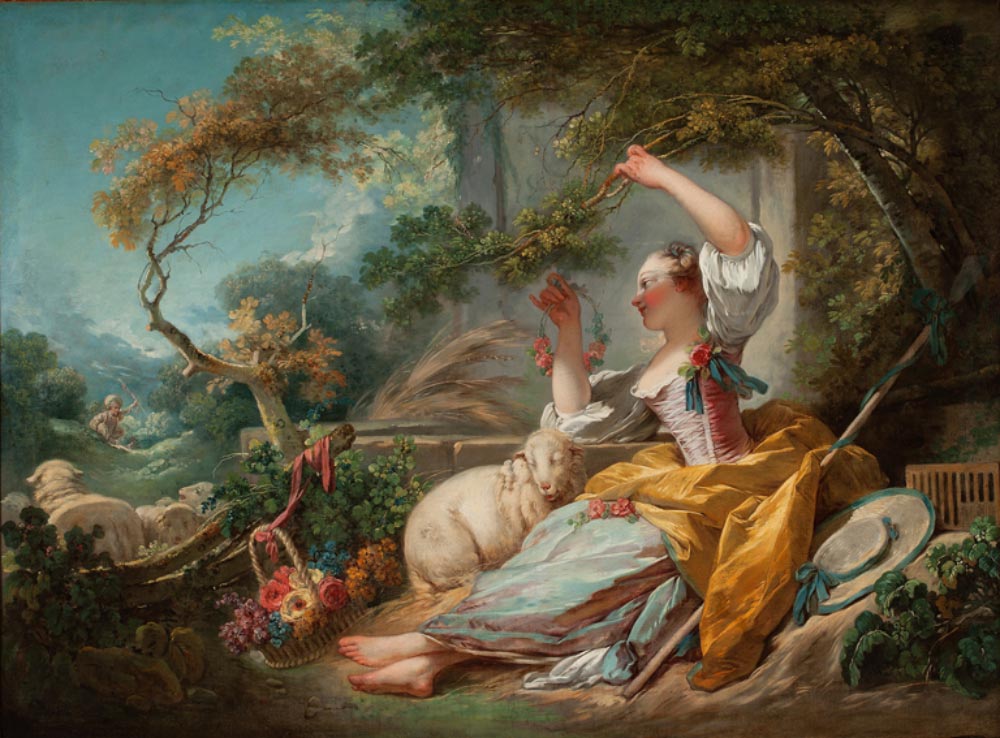
From the Collection: Jean-Honoré Fragonard’s “The Shepherdess”

Jean-Honoré Fragonard, The Shepherdess, ca. 1750/52 (detail). Bequest of Leon and Marion Kaumheimer. Photo credit John Nienhuis, Dedra Walls
Jean-Honoré Fragonard, The Shepherdess, ca. 1750/52. Bequest of Leon and Marion Kaumheimer. Photo credit John Nienhuis, Dedra Walls

In my high school art history class, my teacher, having covered with reverence the high-contrast drama of the Baroque, flipped the slide machine to show Jean-Honoré Fragonard’s The Swing and paused, glaring at the slide in the darkened room. Then she pronounced: “The Rococo. I loathe the Rococo! The Rococo is art history’s porn!”

Categories
Art Curatorial

From the Collection—Bengtsson’s Slice Chair

Mathias Bengtsson (Danish, b. 1971) Slice Chair, 1999 Aluminum 29 1/2 x 35 x 29 in. (74.93 x 88.9 x 73.66 cm) Gift of Friends of Art M2011.11 Photo credit John R. Glembin © Mathias Bengtsson, Courtesy of Industry Gallery
Mathias Bengtsson (Danish, b. 1971), Slice Chair, 1999. Aluminum; 29 1/2 x 35 x 29 in. Milwaukee Art Museum, Gift of Friends of Art M2011.11. Photo credit John R. Glembin. © Mathias Bengtsson, Courtesy of Industry Gallery.

In honor of last week’s opening of European Design Since 1985: Shaping the New Century, I thought I’d share a bit about why the Museum has used this striking aluminum chair so heavily in the exhibition’s marketing.

You saw this chair’s curves on banners and the cover of the MAM Insider (the Museum’s Member magazine), all over the Museum’s exhibition website, and even on little details like admission vouchers.

As a lover of beautiful things, I’m drawn to the dazzling shimmer of the aluminum surface and the undulating form of this design.

As a curator who loves to talk about art, I’m also drawn to the ideas behind the chair. I feel like you could talk about this chair all day.

Categories
Art

From the Collection: Gustave Courbet’s “Clement Laurier”

Portrait of a man in a black suit
Gustave Courbet, Clément Laurier, 1855 (detail). Gift of Friends of Art. Photo by John Nienhuis, Dedra Walls.
Portrait of a man in a black suit
Gustave Courbet, Clément Laurier, 1855. Gift of Friends of Art. Photo by John Nienhuis, Dedra Walls.

Speaking of curious museum coincidences, here’s yet one more. I knew the identity of the man in the Museum’s Courbet painting (Clement Laurier), but what I didn’t know was that Courbet also painted a portrait of Laurier’s wife. After popping onto the Metropolitan Museum of Art’s Timeline of Art History for some entirely unrelated research, I came across Courbet’s rendering of Madame Laurier, which lives in the Met! And then I immediately sat down to write this blog post instead of doing my original research. Always nice when your procrastination relates to your job, right?

Categories
Art Events Exhibitions

What’s happening at the Milwaukee Art Museum Sept. 30-Oct. 9

It is a busy week at the Museum, with two exhibitions opening and one closing, plus free admission on Thursday, October 7. The time to visit is now!

On Thursday, September 30, experience the opening of the newest on site installation by featured artist Chakaia Booker. Manhattan-based Booker uses cut tires to create relief, free standing, pedestal, and outdoor sculpture. Over a dozen works will be on display in Baumgartner Galleria through February, 2011, for On Site: Chakaia Booker.

Categories
Art

From the Collection: Edwin Landseer’s “Portrait of a Terrier”

Edwin Landseer (English, 1802–1873), Portrait of a Terrier, The Property of Owen Williams, ESQ., M.P. (Jocko with a Hedgehog), 1828 (detail). Oil on canvas
39 15/16 × 49 3/16 in. (101.44 × 124.94 cm). Gift of Erwin C. Uihlein M1967.79. Photo by Larry Sanders
Edwin Landseer (English, 1802–1873), Portrait of a Terrier, The Property of Owen Williams, ESQ., M.P. (Jocko with a Hedgehog), 1828. Oil on canvas
39 15/16 × 49 3/16 in. (101.44 × 124.94 cm). Gift of Erwin C. Uihlein M1967.79. Photo by Larry Sanders

This week is National Dog Week—and what better Museum dweller to highlight than brave Jocko (and his unfortunate companion, the hedgehog) in honor of this important holiday?

Categories
Art Curatorial

From the Collection— Tiffany gold Tea Service

In any museum gallery, you will encounter rare and valuable pieces of art. We value well-designed objects for many reasons, including for their materials and craft, their aesthetic design, and sometimes the people associated with them. This luxurious Tiffany & Co. Tea Service from 1905 is a rare object with incredible value in all three categories.

Categories
Art

From the Collection—English Posset Pot

This unusual form with an even odder name begs the question: what is a posset pot?

Posset pots were specially designed for the consumption of a warm, spiced drink popular from the Medieval period into the 19th century. The nourishing beverage, posset, was used to strengthen new mothers, the sick, or the elderly. Though it turns my stomach slightly to think of it, a good posset recipe should result in several layers caused by curdling.  The drink is made from milk beaten with eggs, sugar, and spices and curdled with ale or wine, but bread could be added to thicken it. The curdled milk rises to the top, the eggs create a custard mid-layer, and at the bottom is a warm spicy alcoholic drink, accessible only through the straw-like spout of a posset pot’s distinctive shape.

Categories
Art

From the Collection: Sofonisba Anguissola’s “The Artist’s Sister”

Sofonisba Anguissola, The Artist’s Sister Minerva Anguissola, ca. 1564 (detail). Layton Art Collection, Gift of the Family of Mrs. Frederick Vogel, Jr. Photo by P. Richard Eells
Sofonisba Anguissola, The Artist’s Sister Minerva Anguissola, ca. 1564. Layton Art Collection, Gift of the Family of Mrs. Frederick Vogel, Jr. Photo by P. Richard Eells

The work of an art historian or curator can sometimes be like that of a master investigator or CIA agent. For example, a trail of clues led to the probable identification of the woman in this painting by Sofonisba Anguissola. Anguissola is one of the earliest identified female artists, working in Italy in the late 1500s. Rare for the Renaissance, Anguissola was famous in her own time and worked as the court painter for the King of Spain, a job she secured thanks to the portraits of her family that she’d painted as she grew up and honed her skills. The girl in this image is the spitting image of many of Anguissola’s family members, with her round face, large hooded eyes, and long nose. But Anguissola had five sisters and two brothers, so who is this?