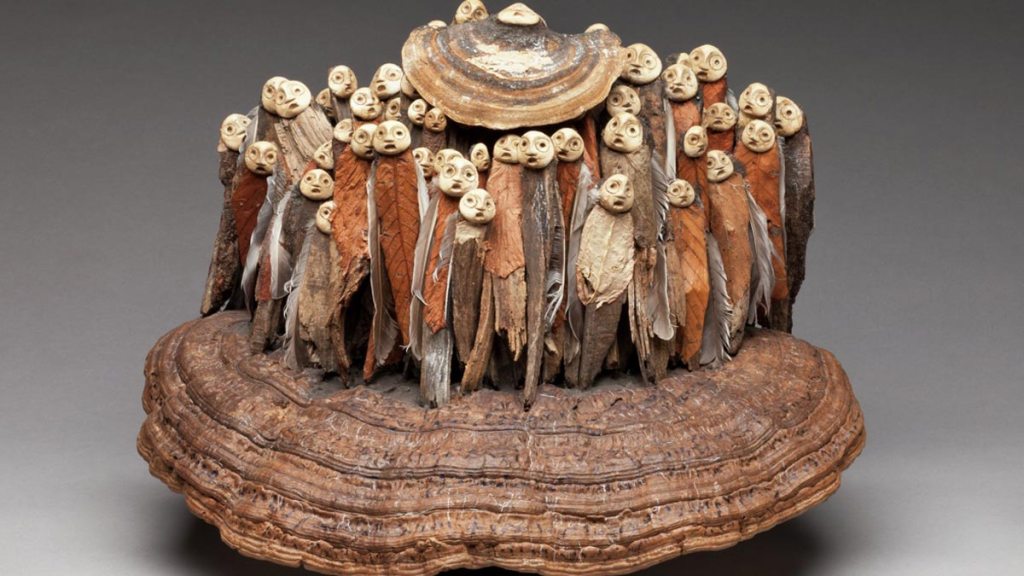
Now that it is officially spring, I love going outdoors to enjoy fresh air, sunshine, and exercise—and to explore nature. The artist Jephan de Villiers (HEFF-an duh vil-ee-AY) was inspired by the things he found in nature. As a child, de Villiers was often sick, which forced him to spend a lot of time in his bedroom. Being inside so much made him appreciate the outdoors even more. Leaves, branches, nuts, feathers, and fungi became his art supplies.
Alice H. Klein, Calculation, 1984 (detail). Acrylic, cubic zirconia, peridot, amethyst, cultured pearls, gold filled wire, mother-of-pearl polyester resin, 5 × 8 3/4 × 1 1/2 in. (12.7 × 22.23 × 3.81 cm). Gift of TKO Designs Incorporated M1991.52. Photo by John R. Glembin.
In our Play Date with Art program this month, we imagined what we’d be wearing in the future, and then we used found materials to bring our vision to life. You can do the same at home, using materials from around your house! Your designs can be anything you want. Think of future styles, or think of a special occasion you’d like to dress up for.
Marion Mahony Griffin (American, 1871-1962), Window, 1907 (detail). Glass and zinc came, 24 × 29 1/2 in. (60.96 × 74.93 cm). Gift of family and friends in memory of Pamela Jacobs Keegan, architect M1984.14.
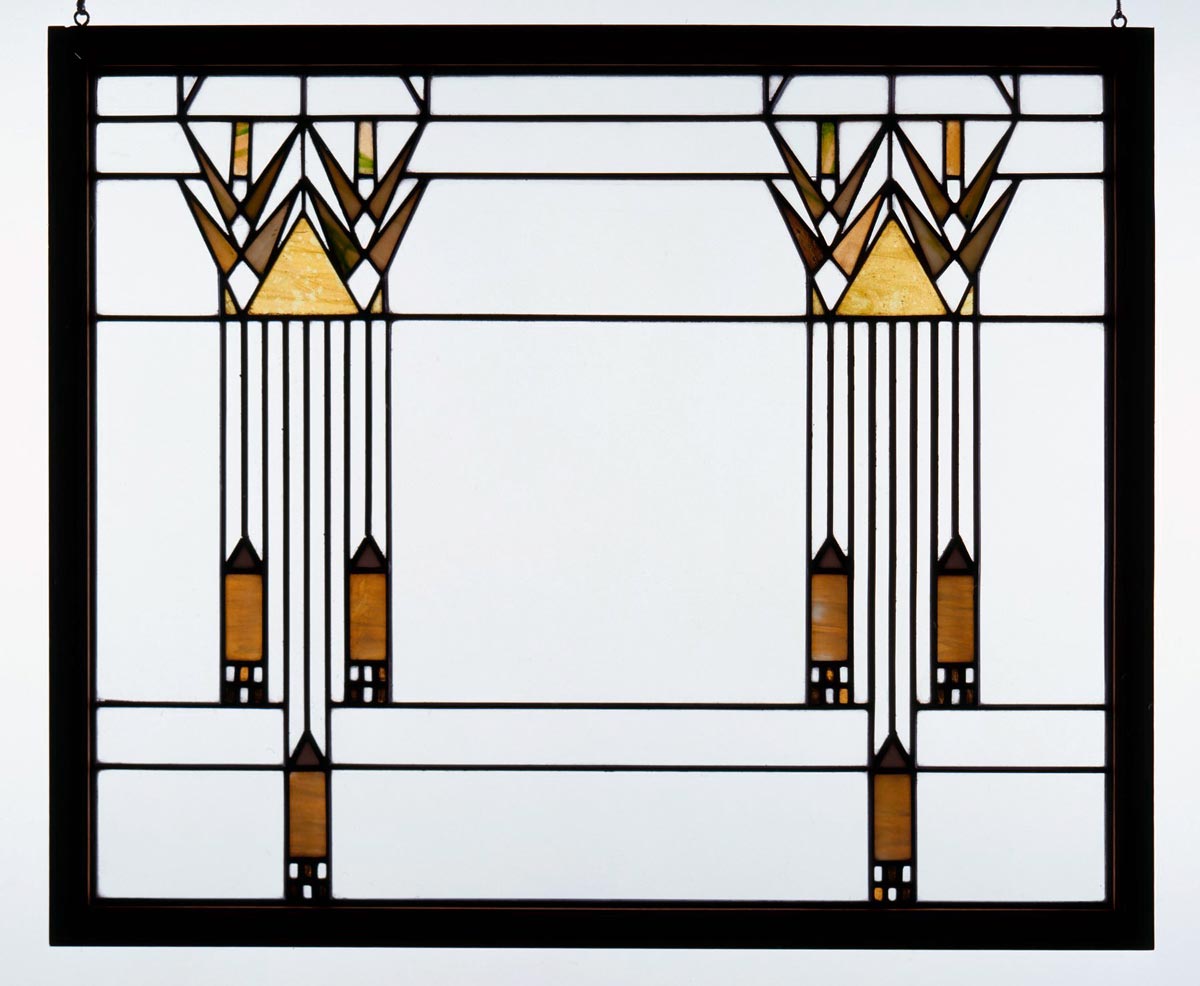
Marion Mahony Griffin (American, 1871-1962), Window, 1907. Glass and zinc came, 24 × 29 1/2 in. (60.96 × 74.93 cm). Gift of family and friends in memory of Pamela Jacobs Keegan, architect M1984.14.
Having to stay inside can get dull—especially if it’s too cold, too windy, or too rainy to play outside. I find myself staring out my window quite a lot these days. It got me thinking: what could make my window more fun? How could I make my indoors more colorful while also sharing some fun with my neighbors, who may be looking out their windows? For our first at-home art activity, I drew inspiration from leaded stained glass windows!
A tangram is a puzzle made of seven shapes that together form a large square. The shapes can be arranged in many different ways to resemble things in the world around us—or create interesting patterns. Here’s how you can create your own set of tangrams to use at home!
Paul Cézanne, Ginger Pot with Pomegranate and Pears, 1893 (detail). Oil on canvas. 18 1/4 × 21 7/8 in. The Phillips Collection, Washington, DC. Gift of Gifford Phillips in memory of his father, James Laughlin Phillips, 1939.
Paul Cézanne, Ginger Pot with Pomegranate and Pears, 1893. Oil on canvas. 18 1/4 × 21 7/8 in. The Phillips Collection, Washington, DC. Gift of Gifford Phillips in memory of his father, James Laughlin Phillips, 1939.
The works by Degas, van Gogh, Bonnard, Modigliani, and others on view in the Modern Visionexhibition are from The Phillips Collection and reflect the lifelong collecting efforts of Duncan Phillips, who developed an interest in art at an early age. A five-part podcast on collectors and collecting produced in conjunction with the exhibition reveals that Phillips worked in concert with his wife, Marjorie, herself an artist, whom he met shortly before he opened his museum. She became the deputy director of the museum and, after Duncan’s death, went on to become its director.
Robert S. Duncanson, Minneopa Falls, 1862 (detail). Oil on canvas. Purchase, Andrew A. Ziegler Fund M2007.37. Photo by John R. Glembin.
Where can you find it? Gallery K220
In celebration of Black History Month, we are highlighting one of the tours offered to school groups year-round: “Art by Artists of the African Diaspora.” On this tour, students explore the ways in which artists of African descent, including African Americans, use their work to document their lives, tell the stories of their communities, and fight for social change.
Here are some of the extraordinary works by African American artists featured on each tour. Find them in the Collection Galleries during your next Museum visit!
Murdoch & Company, View West of Wisconsin Avenue, Milwaukee, from Pabst Building, 1923/25 (detail). Gelatin silver print. Gift of Friends of Art, M1989.410. Copy photo by John R. Glembin.
Discover how the photographs in Portrait of Milwaukee continue to reflect Milwaukee and its community. On December 5, 2019, local residents created a living library inside the exhibition and shared personal stories that relate to specific works on view.
Entering a darkened fort to make fluorescent paintings glow under a black light, twirling ribbons so they dance through the air, and making snow angels and jumping into piles of packing peanut “snow”—these are just a few of the fun-filled experiences our youngest visitors have had at Play Date with Art. Once a month, from September through May, the Milwaukee Art Museum’s Windhover Hall is transformed into a dynamic, interactive space where children ages 5 and under can enjoy hands-on projects and a joyful romp in the light-filled prow that overlooks Lake Michigan.
This is your art museum. And I am delighted and proud to share with you today that we have set course on a direction that allows us to respond to our changing times and makes it possible for you, your friends, family—all people—to see yourselves at the Museum and better understand your world through the art we hold in public trust for you.