Categories
Art Collection Curatorial European Prints and Drawings

From the Collection—Albrecht Dürer, Part 2

The inaugural exhibition in the European works on paper rotation space (on view until March 20) explores the Renaissance in Germany. Comprised completely of prints from the collection of the Milwaukee Art Museum, you can find engravings by Heinrich Aldegrever (1502–ca. 1561) and stipple engravings by Hans Sebald Beham (1500–1550). But you can’t study printmaking in the German Renaissance without a serious consideration of Albrecht Dürer (1471–1528). And we’re lucky enough to have 14 prints by the master! This is the second of a series of posts related to Dürer’s prints.

Albrecht Dürer (German, 1471–1528), Madonna with the Monkey, ca. 1498. Engraving. Milwaukee Art Museum, Gertrude Nunnemacher Schuchardt Collection, presented by William H. Schuchardt M1924.169. Photo credit: P. Richard Eells.

Last time, we learned a little about Albrecht Dürer by looking at a woodcut from his series called The Apocalypse. In this post, we’ll look at a different type of print—an engraving—with religious subject matter.

Madonna with the Monkey is one of several Madonna and child compositions that Dürer produced throughout his career. His Catholic German patrons would be interested in the powerful woman that had become so central to the salvation of man by being the mother of Christ. This type of print would be popular and consequently sell well. In the current display at the Milwaukee Art Museum, there are two other depictions of the Madonna and child (Madonna and the Infant in Swaddling and the Madonna with the Pear) and two prints from the series The Life of the Virgin (The Death of Mary and The Circumcision of Jesus).

In Madonna with the Monkey, Dürer shows a young, loving mother holding her chubby baby. This display of emotion, combined with the well-modeled physicality of the figures, is a contrast to previous depictions of the Madonna and Child found in central Europe (compare this sculptural example at the Metropolitan Museum of Art). This is likely a result of Dürer’s first visit to Italy, from 1491 to 1495. While there, he studied artwork of the Italian Renaissance and the classical past. He brought back sketches and ideas which moved German art away from the frontal, stylized representations of the middle ages.

Categories
Art Collection Curatorial European Prints and Drawings

From the Collection—Albrecht Dürer, Part 1

The inaugural exhibition in the European works on paper rotation space (on view until March 20) explores the Renaissance in Germany. Comprised completely of prints from the collection of the Milwaukee Art Museum, you can find engravings by Heinrich Aldegrever (1502–ca. 1561) and stipple engravings by Hans Sebald Beham (1500–1550). But you can’t study printmaking in the German Renaissance without a serious consideration of Albrecht Dürer (1471–1528). And we’re lucky enough to have 14 prints by the master! This is the first of a series of posts related to Dürer’s prints.

Albrecht Dürer (German, 1471–1528), St. John's Vision of Christ and the Seven Candlesticks, from the series The Apocalypse, 1498; published 1511. Woodcut. Milwaukee Art Museum, Gift of Mrs. Albert O. Trostel M1972.41. Photo credit: P. Richard Eells.
Albrecht Dürer (German, 1471–1528), St. John’s Vision of Christ and the Seven Candlesticks, from the series The Apocalypse, 1498; published 1511. Woodcut. Milwaukee Art Museum, Gift of Mrs. Albert O. Trostel M1972.41. Photo credit: P. Richard Eells.

Albrecht Dürer is often considered the father of the northern Renaissance. He traveled to Italy twice, bringing the Italian Renaissance’s interests in art and culture back to Germany. Not only was he a well-respected visual artist, but he was also a widely published author on humanistic thought and scientific topics.  Also, he was engaged in debate on religious issues. Serving as the first court artist to Holy Roman Emperors Maximilian I and his successor Charles V, Dürer had access to some of the highest social circles of Europe.  Accordingly, he embraced the Renaissance idea of the artist as a creative genius whose gifts were bestowed by God rather than as a hard-working craftsman.

One way that Dürer influenced the artistic trajectory of the northern Renaissance is through his masterful approach to printmaking. His exploration of the unique way that prints can show light and dark, as well as how they can tell a powerful story, made printmaking an artwork in its own right rather than just a way to illustrate printed books. Today we begin a series that explores Dürer’s role in the history of printmaking by looking closely at some of his prints on view at the Milwaukee Art Museum.

Categories
Art Collection Curatorial European

Questions of Provenance—Doubting Thomas by Adriaen van der Werff, Part 2

Adriaen van der Werff (Dutch, 1659–1722). Self-portrait with the Portrait of his Wife, Margaretha van Rees, and their Daughter Maria, 1699. Oil on canvas. Rijksmuseum, Amsterdam, SK-A-465.

In the first part of this post, using the Milwaukee Art Museum’s painting Doubting Thomas, we explored the biography and style of Dutch artist Adriaen van der Werff (a self-portrait of him from the Rijksmuseum is to the left).  This week, we’re going to trace the provenance of Doubting Thomas and see what it tells us about the history of taste in art and trends in collecting.

Van der Werff was one of the most famous painters of his day and was known internationally throughout his career. He was in demand in his earlier career for his rich portraits in the popular “Fine School” style. One example of his early work is the 1685 painting in the National Gallery, London called Portrait of a Man in a Quilted Gown.

Then in the 1690’s van der Werff’s paintings became more and more influenced by the classical style admired in France. He already had a tendency to use richer detail and elegant lines in his Fine School paintings. An important reason for this transition is the fact that the new style was preferred by patrons in the late Baroque period. If you want to make a living, you paint want people want to buy!

Categories
Art Collection Curatorial European

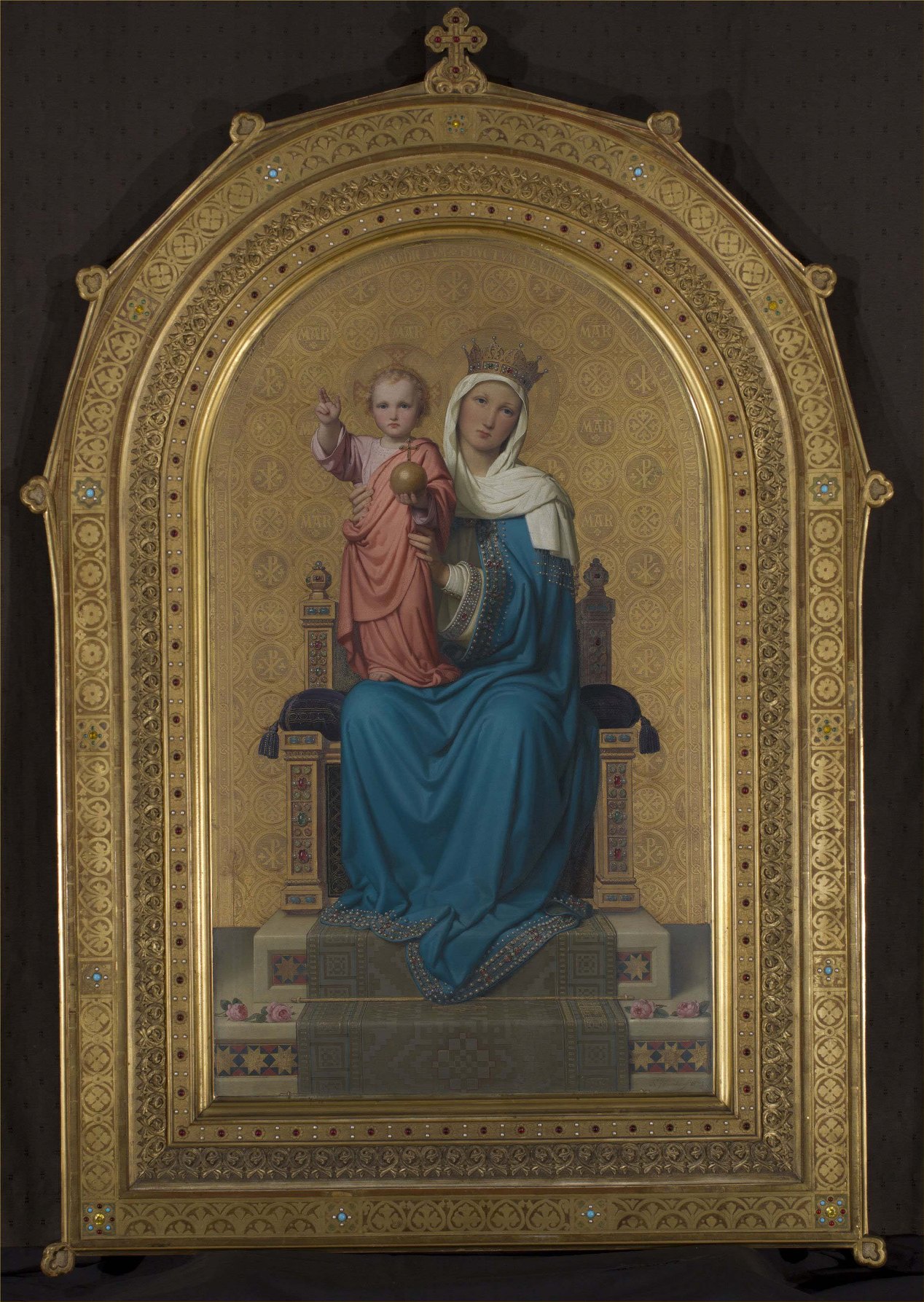
From the Collection—Mother of the World by Franz Ittenbach

Franz Ittenbach (German, 1813–1879), Mother of the World, 1872. Oil on panel. Milwaukee Art Museum, Purchase, René von Schleinitz Memorial Fund and with funds in memory of Betty Croasdaile and John E. Julien.

From the glittery gold background to the touching depiction of the Madonna and child, the Milwaukee Art Museum’s new acquisition Mother of the World by Franz Ittenbach (German, 1813–1879) is a perfect subject for our blog post during the weeks leading up to Christmas.

At first glance, Mother of the World probably reminds you of the painting that I highlighted two years ago during the holidays: Nardo di Cione’s Madonna and Child. But Ittenbach is a German artist of the 19th century, not an Italian artist of the 14th century! Clearly, Ittenbach is looking back at paintings like the Nardo. This is because he is part of a German art group called the Nazarenes.

Categories
Art Collection Curatorial European

Questions of Provenance—Doubting Thomas by Adriaen van der Werff, Part 1

Adriaen van der Werff (Dutch, 1659–1722). Doubting Thomas (The Incredulity of St. Thomas), 1710. Oil on wood panel. 24 15/16 × 18 15/16 in. (63.34 × 48.1 cm). Milwaukee Art Museum, Gift of Mr. and Mrs. R. V. Krikorian M1971.60. Photo credit: P. Richard Eells.

Remember in an earlier post when I said that the study of provenance can tell us a lot about the history of taste? We’ll see how by taking a closer look at one of the paintings in the collection of the Milwaukee Art Museum.

The painting is Doubting Thomas—sometimes called The Incredulity of St. Thomas—by Dutch artist Adriaen van der Werff (1659–1722).

Adriaen van der Werff started his career by painting in the style called Fijnschilder, which literally means “Fine School”. In Fine School painting, the goal was to create a painting that is so smooth and pristine that individual brushstrokes could not be seen. Often the artworks were small and filled with details that required close looking and layers of symbolism. A perfect example is our A Young Woman at a Window with a Parrot and a Birdcage, which you can see bellow (and which will be discussed in a future blog post!).

By the late 17th century, van der Werff began to change his style, painting in a classical style that was popular in France. Doubting Thomas is a perfect example of this classical style. You can see it in the long, elegant proportions of his figures and in his rich depiction of costume.

Categories
Art Behind the Scenes Collection Curatorial European

Questions of Provenance—The Marriage Trap by Jan Victors, Part 4

Jan Victors (Dutch, 1619–after 1676), The Marriage Trap, ca. 1640–60. Oil on canvas. Milwaukee Art Museum, Gift of Richard and Erna Flagg M1974.233. Photo credit: John Nienhuis, Dedra Walls.

With The Marriage Trap as an example, we have seen that it is an immense task to do provenance research for all paintings that were probably in Europe from 1933 through 1945! Museums, however, have accepted this ongoing project as an important part of the stewardship of their collections.

In this particular instance, at least we know that our painting was processed through the appropriate channels after World War II. It was returned to Austria for restitution to its owner; we do not know who ended up with the painting. All we can do is be transparent about the provenance and hope more information comes to light in the future.

So, now that we’re done as much as we can about the provenance with the resources easily available to us, all of the documentation goes into the file for the object.  Then, it’s time to write up the information for our collection database.  Like most museums, the Milwaukee Art Museum uses a database for keeping track of all things related to the collection.  We use one called The Museum System, or TMS, You can see a screen shot of it at the bottom of this post.

Categories
Art Behind the Scenes Collection Curatorial European

Questions of Provenance—The Marriage Trap by Jan Victors, Part 3

Jan Victors (Dutch, 1619–after 1676), The Marriage Trap, ca. 1640–60. Oil on canvas. Milwaukee Art Museum, Gift of Richard and Erna Flagg M1974.233. Photo credit: John Nienhuis, Dedra Walls.

In the last two posts we’ve looked at the earliest known and most recent provenance of our painting The Marriage Trap.

We also know that in 1947 the painting was processed at the Munich Central Collecting Point, or MCCP.

This means that the painting was looted by the Nazis during World War II.

The MCCP was one of the offices set up by the Allied forces at the end of World War II to process the repositories of Nazi-confiscated works of art. These stashes were hidden in Germany and Austria. Managed by the Monuments, Fine Arts and Archives Service (MFA&A) of the military, they were staffed by soldiers and art historians that became known as the Monuments Men. Collecting points were also set up in Marburg, Wiesbaden, and Offenbach. The one in Munich, however, was the largest. The offices there handled a wide variety of material such as painting, sculpture, textiles, and metalwork.

Categories
Art Behind the Scenes Collection Curatorial European

Questions of Provenance—The Marriage Trap by Jan Victors, Part 2

This post is part of a series that that will highlight some of the interesting provenance cases in the Milwaukee Art Museum’s Collection. 

Jan Victors (Dutch, 1619–after 1676), The Marriage Trap, ca. 1640–60. Oil on canvas. Milwaukee Art Museum, Gift of Richard and Erna Flagg M1974.233. Photo credit: John Nienhuis, Dedra Walls.

Last time we looked at The Marriage Trap’s provenance and attribution just before and since its acquisition by the Milwaukee Art Museum. That’s usually the easiest part.

In this post, we’ll see how piecing together the ownership of a painting requires pulling information from a number of sources, thinking critically about what we find, and then sometimes making an educated guess (noted as such, of course).

Categories
Art Behind the Scenes Collection Curatorial European

Questions of Provenance—The Marriage Trap by Jan Victors, Part 1

Jan Victors (Dutch, 1619–after 1676), The Marriage Trap, ca. 1640–60. Oil on canvas. Milwaukee Art Museum, Gift of Richard and Erna Flagg M1974.233. Photo credit: John Nienhuis, Dedra Walls.

Jan Victors (Dutch, 1619–after 1676) was probably a student of the famous Dutch Golden Age artist Rembrandt (Dutch, 1606–1669). Just like his contemporaries, Victors created works with various popular subjects, including religious scenes, portraits, and genre paintings.

The Milwaukee Art Museum has a market scene in its collection which falls into this last category. The Marriage Trap is set along the familiar canals of Holland. A peasant wedding party is purchasing a fish for the ensuing celebration.

But the Dutch loved layering painting with many layers of symbolism–often for a humorous result.  Victor’s ability in combining realism with humor is illustrated by the context and placement of the fish.  It is most likely intended as a sexual metaphor!

Recently, The Marriage Trap was on our list for submission to the Art Loss Register. A quick look at the thick object file—where we keep records and correspondence related to one artwork—showed me that there was some untangling to do! So, I carefully read through everything, looked for more resources, and double checked it all before organizing it in a clearly stated entry for our collection database.

Categories
Art Collection Curatorial Modern

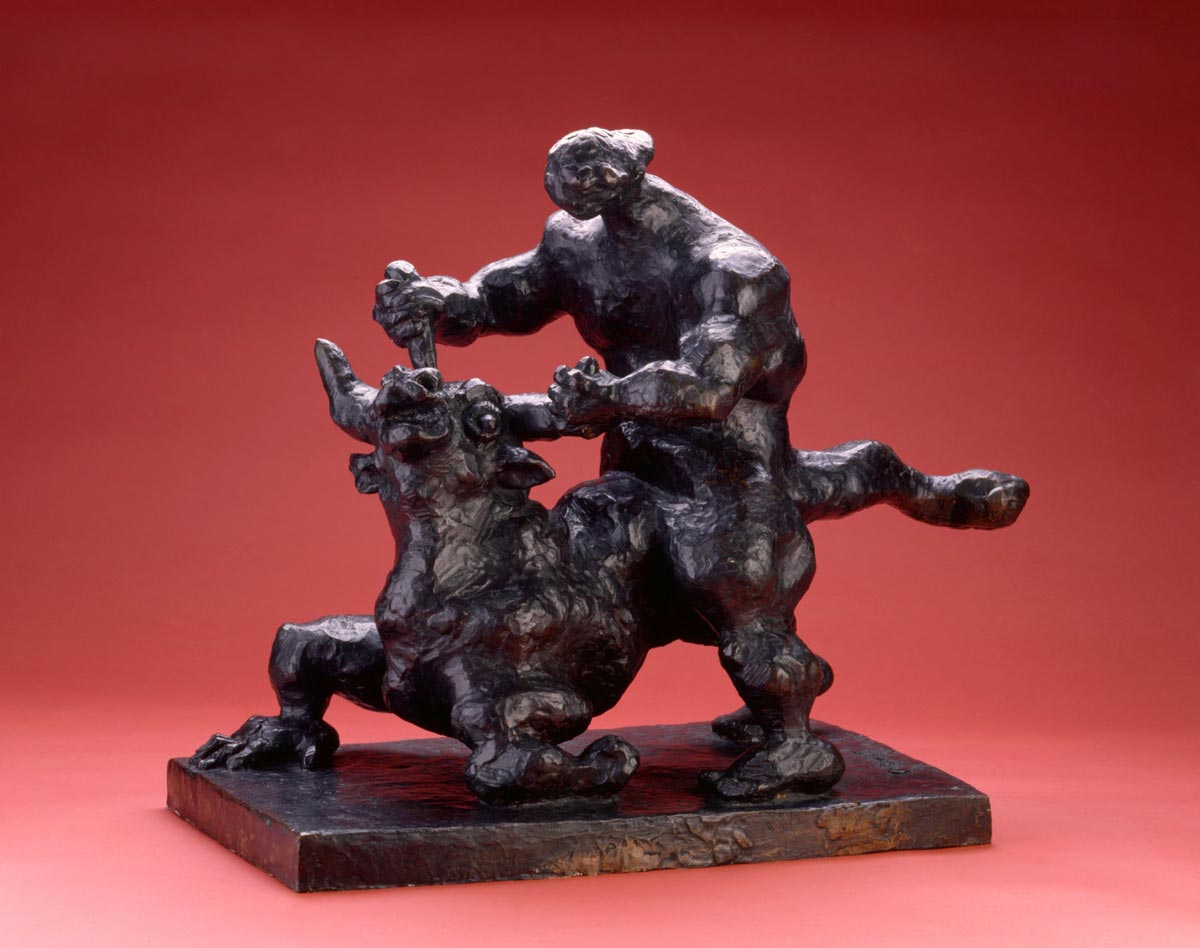
From the Collection: Theseus by Jacques Lipchitz

Black sculpture of a man grabbing a minotaur by the horns
Jacques Lipchitz (French, b. Lithuania, 1891–1973, active in the United States), Theseus, 1942 (detail). Hollow bronze cast. height: 23 3/4 in. (60.33 cm). Milwaukee Art Museum, Gift of Mrs. William D. Vogel M1956.80. Photo credit by Larry Sanders. © Estate of Jacques Lipchitz, all rights reserved.
Black sculpture of a man grabbing a minotaur by the horns
Jacques Lipchitz (French, b. Lithuania, 1891–1973, active in the United States), Theseus, 1942. Hollow bronze cast. height: 23 3/4 in. (60.33 cm). Milwaukee Art Museum, Gift of Mrs. William D. Vogel M1956.80. Photo credit by Larry Sanders. © Estate of Jacques Lipchitz, all rights reserved.

Many of the artists featured in the special exhibition Van Gogh to Pollock: Modern Rebels, Masterworks from the Albright-Knox Art Gallery are also represented in the collection of the Milwaukee Art Museum. This is the first in a series of blog posts that will highlight Milwaukee’s artworks during the run of the exhibition.

Knowledge of classical mythology is one of those subjects that will always help the student of art history, no matter what period you study. Over the last few years, I have explored mythological subjects in the Milwaukee Art Museum’s collection represented in ancient Greek hydriae; Baroque decorative arts and painting; and nineteenth century German ceramics.

Modern art is no exception. We have to look no further than the sculptures of Jacques Lipchitz (1891–1973).

Jacques Lipchitz was a Jewish artist from France who was born in Lithuania. He was classically trained in Paris, although he soon worked in a cubist style, such as Sailor with Guitar in the collection of the Albright-Knox Art Gallery.