
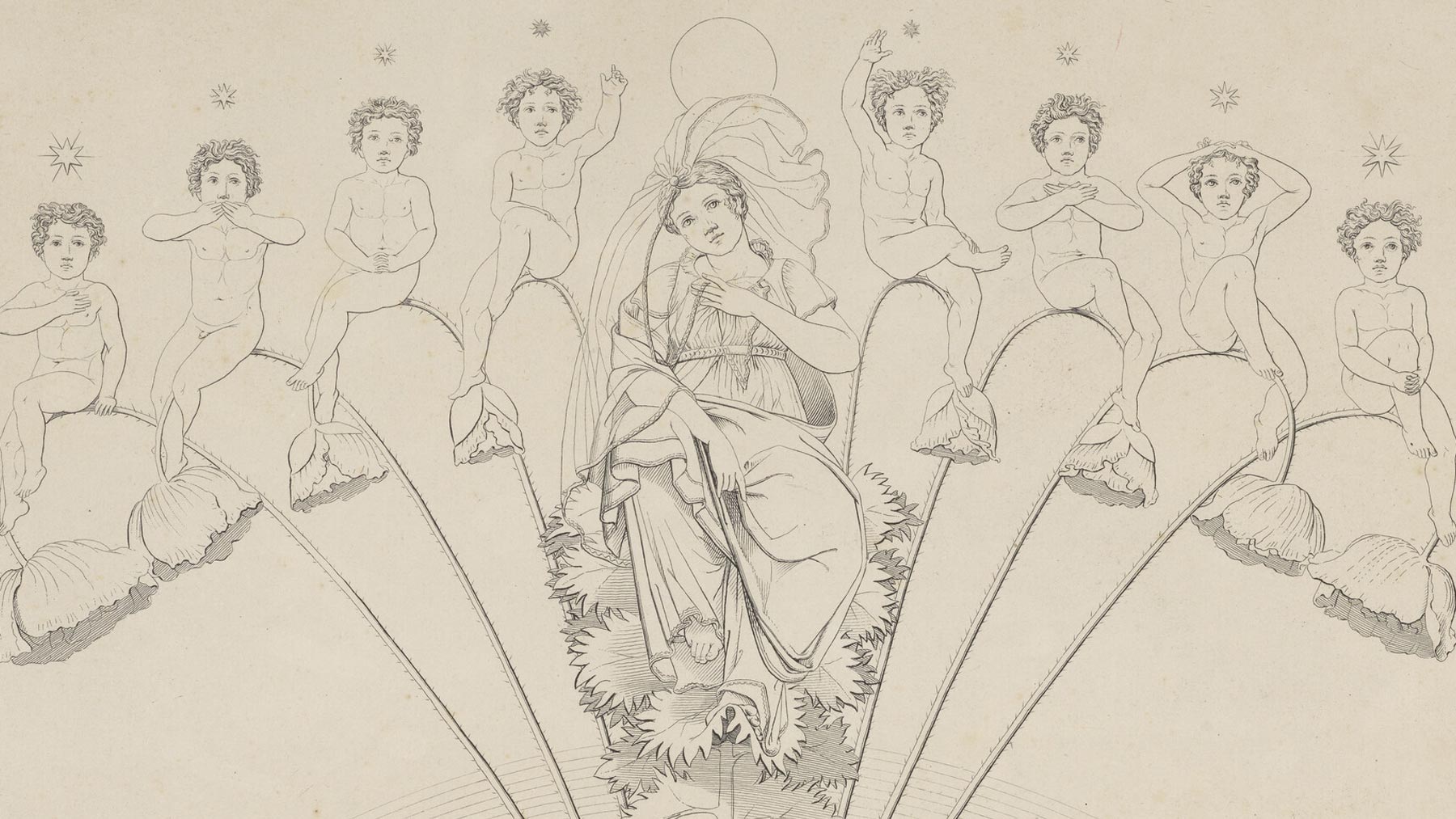
Nikki Otten, associate curator of prints and drawings, introduces the exhibition, revealing how German Romantic artists searched for meaning through nature, religion, and journeys of the self.
German Romanticism, a movement active from about 1770 to 1850, spanned styles and subject matter. Some works featured sublime waterfalls and towering trees, while others focused on biblical scenes and religious devotion. Despite these differences, Romantic artists were united by their interest in gaining a deeper understanding of universal questions. They faced uncertain times—much as we are now—including France’s invasion of Germany during the Napoleonic Wars (1803–15) and a changing worldview that valued feeling and emotion in addition to reason. Such events led artists to reconsider their sense of self and national identity, as well as their relationship to nature and the divine. Through works selected from the Milwaukee Art Museum’s collection of German Romantic works on paper—one of the strongest in the United States—Seeking Revelation examines how artists attempted to comprehend and shape their world. Ultimately, even when it did not uncover answers, the act of seeking offered its own reward.
“They faced uncertain times—much as we are now—and a changing worldview that valued feeling and emotion in addition to reason.”
The exhibition is organized around three themes: nature, religion, and journeys. The sections are meant to be fluid, showing that a shared philosophy connected the strands of the movement. A portfolio by Philipp Otto Runge is an example of prints that combine nature and religion. Between 1802 and 1810, he planned an ambitious work representing the four times of day that would include music, paintings, and poetry. The prints in the portfolio are based on his drawings for the visual program. Each image includes allegorical figures and plants that refer to the seasons and stages of life in addition to the times of day. In Night, for example, a goddess and mystical beings perch on the spiny stems of poppies, which symbolize sleep. Childlike figures in the lower left and right corners and background doze in leaf-covered shelters. Iconography referring to Christ’s birth, crucifixion, and resurrection appears in the margins of each work in the portfolio. The dove in the upper center of this print indicates that eternal life will follow death, just as morning brings renewal after night. Come see the three remaining prints in this series, along with the additional works in Seeking Revelation, opening in June.
Learn more about the exhibition and related programs at mam.org/seeking-revelation.
Member Preview Day
Thurs, June 18, 10 a.m.–8 p.m.
Open to all Members
Enjoy exclusive first access to the exhibition before it opens to the public.
Seeking Revelation: German Romantic Prints and Drawings
June 19–November 1, 2026
Bradley Family Gallery
Support
Supporting sponsors
Katharine and Sandy Mallin
Milwaukee Art Museum’s Print Forum
Additional support provided by

Drs. Peter Drescher and
Karin Madsen Drescher
The Milwaukee Art Museum extends its sincere thanks to the visionaries for their support of the exhibition program.
Mark and Debbie Attanasio
Donna and Donald Baumgartner
Murph Burke
Bill and Sandy Haack
Chris Harned and Elizabeth
Quadracci Harned
The Helmerich Trust
Kenneth and Alice Kayser
Joan Lubar and John Crouch
Jeff and Gail Yabuki
Continue reading


Image: Philipp Otto Runge (German, 1777–1810), etched by Johann Adolph Darnstedt (German, 1769–1830) and Ephraim Gottlieb Krüger (German, 1756–1834), published by Friedrich Christoph Perthes (German, 1772–1843), Night (Nacht), from the series Times of the Day (Die Zeiten), 1803/05, published 1807. Etching. Milwaukee Art Museum, Purchase, René von Schleinitz Memorial Fund, M1996.338.4.