
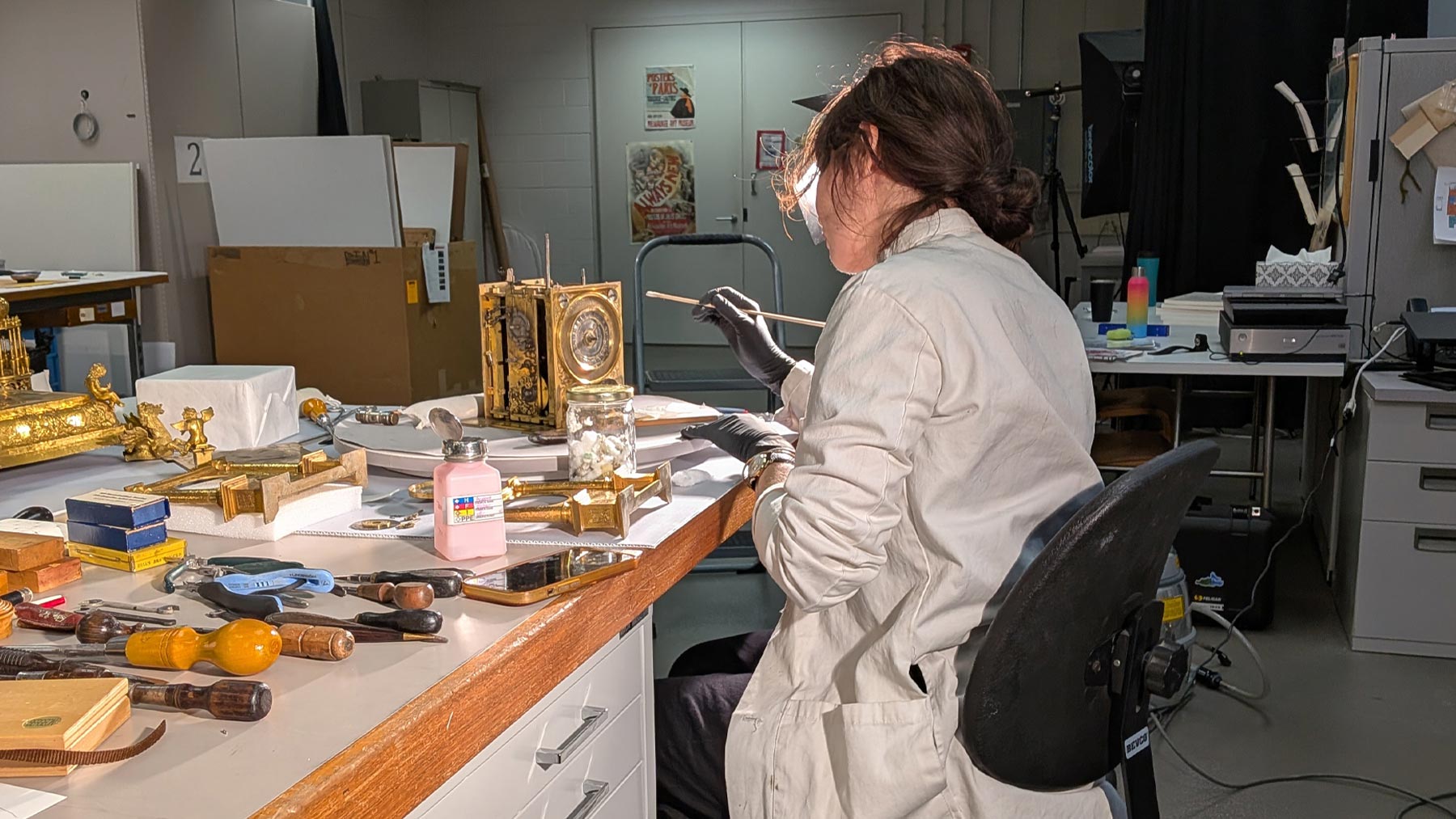
Peek behind the scenes with Tanya Paul, Isabel and Alfred Bader curator of European Art, as the Museum embarks on a major conservation effort to bring its Renaissance clocks back to life.
You’ve likely walked past the Renaissance clocks and admired their intricate cases and remarkable craftsmanship. Few visitors realize they are part of an incredibly significant collection of German Renaissance clocks. Several are considered masterworks, created as “master clocks,” the ambitious pieces clockmakers produced at the end of their apprenticeship to prove their skill to the guild. These were not simply timekeepers, they were declarations of mastery—objects that are fused with innovation, precision, and spectacle.
Part of the celebrated Flagg Collection, these German clocks mark an early moment when telling time became mechanical, exact, and sometimes even theatrical. Look closely and you’ll find more than hands circling a dial. The collection includes clocks that track saints’ days, phases of the moon, and even the zodiac. Many were designed to move or chime. To own one was a status symbol—an early technological marvel meant to impress guests as much as inform
“These clocks are extraordinary works of art and engineering, and I’ve long wondered what it would mean to see them in motion again,” said Tanya Paul, Isabel and Alfred Bader Curator of European Art. “That hope has been building for years. Thanks to the generosity of a donor who understands how crucial conservation is to the care of our collection, we’re finally able to explore what’s possible.”
As part of the Museum’s ongoing commitment to researching and caring for the collection, we’ve partnered with Brittany Cox, an antiquarian horologist—a specialist in historic clocks and automatons. She visited the Museum back in early November to evaluate which of the Renaissance clocks might safely be reanimated. In the coming months, up to three clocks will travel to her studio to receive conservation treatment, where their intricate mechanisms will be carefully studied and restored.
When they return, they may look much the same—perhaps a bit brighter after thoughtful cleaning—but the true transformation will be within. The Museum plans to introduce new video and photography into the galleries, allowing visitors to look inside the mechanisms, understand how they work, and watch them move once again to reveal layers of ingenuity that have been there all along.
As a Member, you have the unique opportunity to follow this story as it unfolds. Join us in the galleries to take a closer look, and stay tuned for a future event when Brittany will visit the Museum to lecture and demonstrate the clocks running as they were originally intended.
Conservation funds generously provided by Wendy Sleight.
Continue reading



Image: Brittany Cox, an antiquarian horologist specializing in historic clocks and automatons, evaluates one of the Museum’s Renaissance clocks in the conservation lab during her initial assessment visit.