
Most artists begin with a blank canvas. George Morrison began with the shoreline.
Along the beaches of Lake Superior, the Ojibwe artist collected weathered pieces of driftwood shaped by wind, water, and time. In his hands, these ordinary materials became something extraordinary. Rather than using paint to imitate the landscape, Morrison transformed the landscape itself into art, assembling hundreds of pieces of wood into abstract compositions that evoke vast horizons, restless water, and the quiet rhythm of nature.
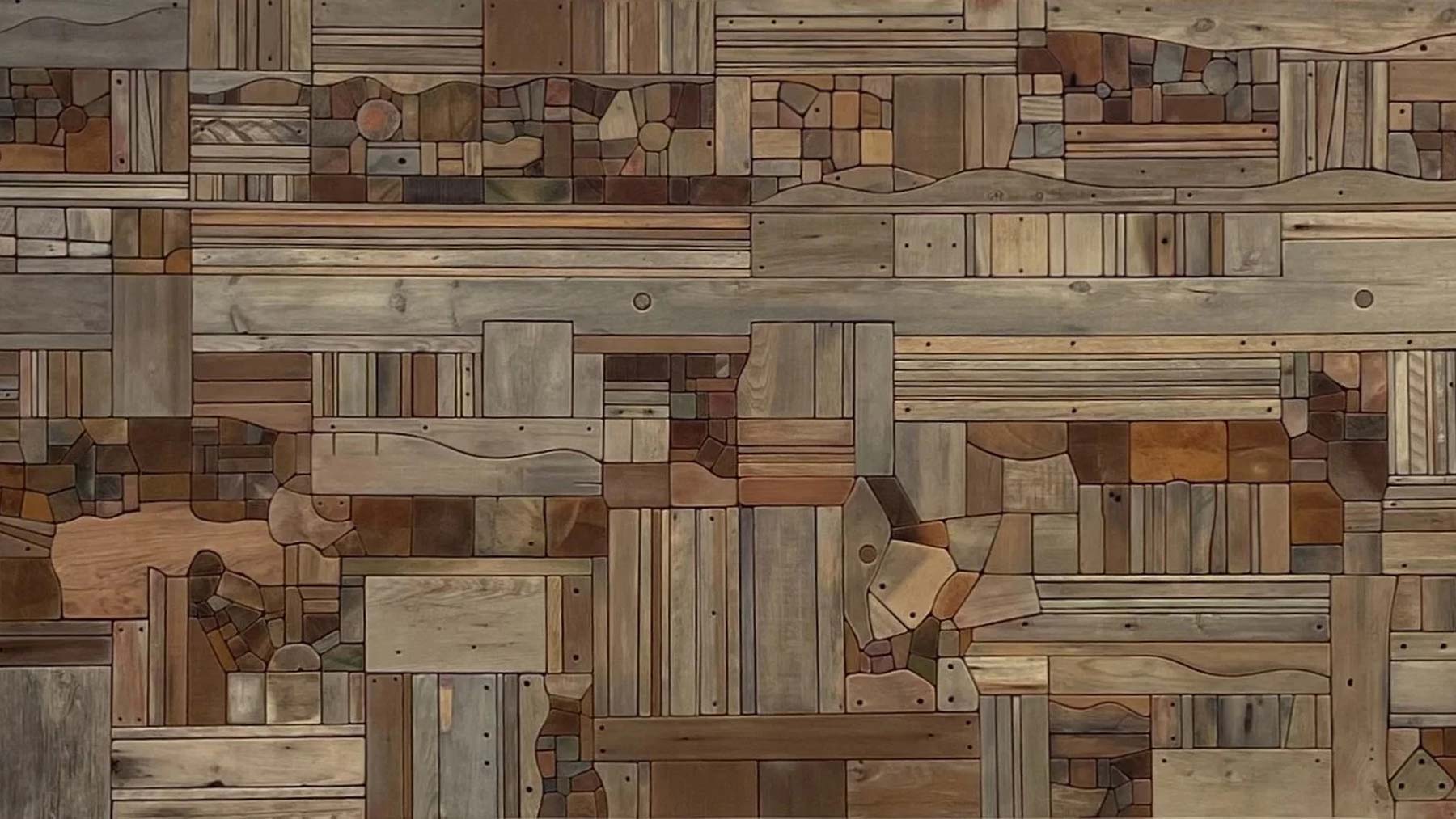
For an entire year, visitors to the Milwaukee Art Museum’s American Wing will have the opportunity to experience a remarkable work by one of the most important Indigenous artists of the twentieth century. On long-term loan from Art Bridges, George Morrison’s monumental Landscape (1986) will be on view in the Museum’s Homelands gallery (K223) beginning August 8, 2026.

At first glance, Landscape seems surprisingly straightforward. Stretching twelve feet across, the work is composed entirely of pieces of wood carefully assembled into a sweeping composition. Yet the longer one looks, the more the work reveals itself. Subtle shifts in color, texture, and shape create a rhythm that suggests water, shoreline, horizon, and movement. Rather than depicting a landscape, Morrison invites us to experience one.
This approach is deeply rooted in the artist’s own life.
Born in 1919 in Chippewa City, Minnesota, near the Grand Portage Indian Reservation (Gichi Onigaming) on the shores of Lake Superior (known as Gichigami in the Ojibwe language), Morrison remained profoundly connected to the landscape that shaped his childhood. Although his career took him to Paris, New York, and some of the nation’s leading art schools, the expansive horizons, rocky shoreline, and ever-changing light of Lake Superior continued to inform his work throughout his life.
Associated, at first, with East Coast Abstract expressionists like Franz Kline, Jackson Pollock, and Willem de Kooning, Morrison often challenged conventional ideas about what a painting could be. Beginning in the 1960s, he started collecting driftwood from beaches in Provincetown, Massachusetts, where he liked to summer.

He arranged these found materials into intricate compositions that he described as “paintings made of wood” or wood collages. In them, hundreds of pieces of prepared weathered wood come together in a carefully balanced arrangement. Horizontal, vertical, and diagonal elements create a sense of motion that recalls the constant movement of water and the meeting of water and sky. Morrison’s geometric approach reflects his engagement with modernist movements such as Cubism, which emphasized breaking forms into essential shapes. Yet the work is also inseparable from the environment that inspired it: the landscape is present not only as subject matter, but through the very material from which the artwork is made.
Morrison created many of his wood landscapes after returning to Minnesota in 1970 to teach. There, he turned to using driftwood gathered along the shores of Lake Superior. This period marked a renewed engagement with his Ojibwe heritage, his family, and the northern woodlands that shaped his identity. Scholars have noted that these works reflect a powerful connection to place, one that merged personal memory, cultural belonging, and artistic innovation.
Today, Morrison is recognized as a trailblazing figure in American modernism and Native American art. His work demonstrates that abstraction can be deeply rooted in lived experience and that landscapes, especially one’s homelands, can be expressed through feeling, material, and recollection rather than direct visual representation.
As Landscape joins the Milwaukee Art Museum American Wing for the coming year, it invites visitors to experience Morrison’s unique vision: one in which wood becomes paint, abstraction becomes place, and nature becomes a lasting work of art.
The Milwaukee Art Museum is grateful to Art Bridges for making this extraordinary opportunity possible. Through this exceptional loan, visitors can experience one of George Morrison’s most celebrated works and discover a new perspective on Lake Superior through the vision of one of the twentieth century’s most significant Indigenous artists.
