

Tanya Paul, Isabel and Alfred Bader Curator of European Art, introduces a new portrait in the galleries.
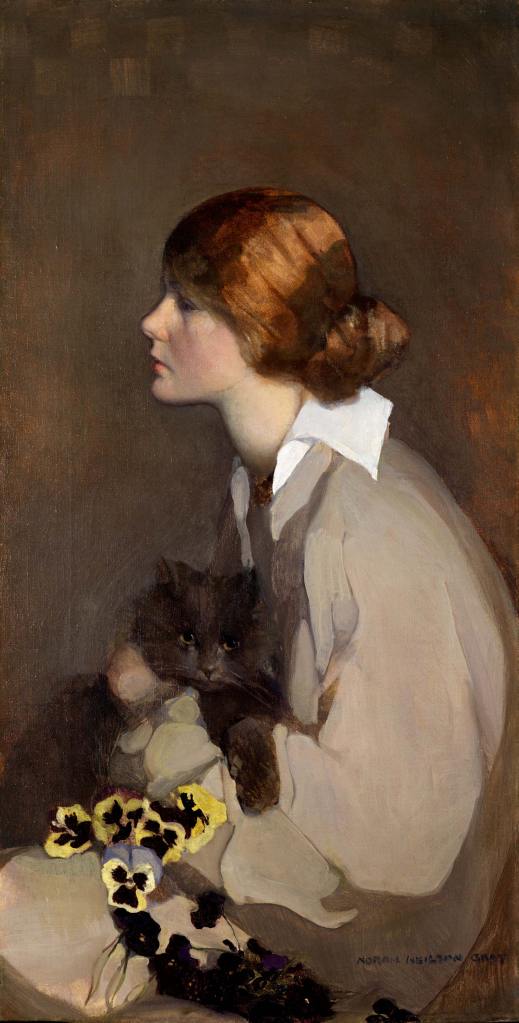
One of the things I prioritize as I search for historic paintings for the Museum’s collection is the work of women artists. Women were regularly overlooked and marginalized by an artistic establishment that not only wasn’t designed for them but also often barred their participation. Being purposeful in seeking out work by women helps offset that historic imbalance. Recently in the Netherlands at an art fair, I discovered a striking painting and a prime example of Norah Neilson Gray’s engaging work. Her 1917 portrait Golden Eyes now hangs in the Impressionism gallery (S203).
Norah Neilson Gray (1882–1931) trained and later taught at the renowned Glasgow School of Art in Scotland. She and a group of women based there around 1900 formed the so-called Glasgow Girls, an informal artistic collective. The women were skilled in painting, illustration, metalwork, ceramics, needlework, and design. Gray had a successful career, exhibiting internationally and winning awards for her work. Like many, her life collided with World War I, and she volunteered as a nurse on the front lines in France.
Gray came from a large family, and much like her sisters, Muriel and Tina, a lecturer in English at Glasgow University and a surgeon, she had an ambitious career for the time. She argued that her work should be considered on an equal footing with the work of men, a perspective her sisters and the Glasgow Girls shared. Indeed, a contemporary review of an exhibition of her paintings noted that she “could hold her own with any of the men.”
Golden Eyes embodies Gray’s distinctive brand of modernism, which balances a powerful emotive quality with an elegantly reductive focus on form and color. Flat planes of color capture the woman’s garment, and the gridded band along the top of the canvas references contemporary design. The pansies are likely the “golden eyes” of the title (believed to be an old varietal name), and while the cat lounges in the lap of a woman who resembles Christina (Chris) Eadie Anderson, a former student who modeled for later paintings by Gray, the sitter remains unknown. Gray’s painting symbolizes the rich artistic community in Glasgow around World War I and reinforces the central role women played in advancing artistic innovation in the 19th and early 20th centuries. I invite you to come experience this magnetic painting for yourself.
Continue reading






Image: Norah Neilson Gray, Golden Eyes, 1917. Purchase, with funds from Avis Martin Heller in honor of the Fine Arts Society