

The pioneering sculptor, educator, and arts activist Ruth Asawa spent most of her life in California, but she has a surprising—and significant—connection to Wisconsin and the city of Milwaukee. A new work acquired in 2020 and recently installed in the 20th- and 21st-Century Design Galleries represents Asawa’s time in the city and speaks to its impact on this influential artist and her career.
Born in California to Japanese immigrant farmers, Asawa first showed interest in art as a young child. But it wasn’t until her family’s forced relocation to an internment camp during the Second World War when she was 14 that she began formal study. The federal government separated her family in 1942, sending her father to a Justice Department Camp in New Mexico. Asawa, along with her mother and sisters, was interned first at the Santa Anita racetrack in Los Angeles, where she practiced drawing with fellow detainees who were Disney Studio artists. Six months later, she was sent to the Rohwer War Relocation Center in Arkansas. She spent a year acting as art editor for the yearbook and completing her senior year of high school surrounded by watchtowers and barbed wire. Reflecting on this unimaginable hardship, Asawa said, “Sometimes good comes through adversity. I would not be who I am today had it not been for the Internment, and I like who I am.”
Asawa completed high school in 1943 and was released from internment that same year. She enrolled in the Milwaukee State Teachers College (now University of Wisconsin, Milwaukee) with the plan of becoming an art teacher. Asawa took courses in painting, drawing, jewelry making, and weaving with faculty that inspired and challenged her—so much so that she once described them collectively as “a ball of fire.” She even exhibited in the 33rd Annual Exhibition of Wisconsin Painters and Sculptors, a yearly competition held at the Milwaukee Art Center (the precursor to the Milwaukee Art Museum). However, her opportunities continued to be limited by prejudice. In Asawa’s third year, her participation as an assistant teacher was denied out of concern over lingering anti-Japanese sentiment.
Prevented from completing her degree in Milwaukee, Asawa was inspired by her artist friends, sisters Elaine and Elizabeth Schmitt and Hazel-Frieda Larsen, to apply to Black Mountain College. BMC was an idealistic, experimental, and progressive liberal arts school in North Carolina, and a home for avant-garde thinking and art-making notable for its impressive roster of artist-instructors. The school was created with the intent of rejecting conventional structures of education and championing individualized exploration driven by each student’s curiosity. Art was central to each student’s studies regardless of major, exams were rare, and graduation was voluntary.
Additional Milwaukee friends recognized Asawa’s talent and supported her move to North Carolina. The German-Jewish couple Helmut and Cecilie Sieverts sent a letter of support to the college on her behalf. Asawa and the Sieverts shared a love of classical music and a bone-deep understanding of the costs of intolerance and bigotry—the Sieverts had escaped Nazi Germany with their two young sons in 1937. In their letter, they wrote, “I regard Ruth Asawa as an unusually fine person…. Hers is an innate tolerance and understanding. Her creative abilities are way above average. She has good ideas and work—both poetry and art—has originality and quality.”
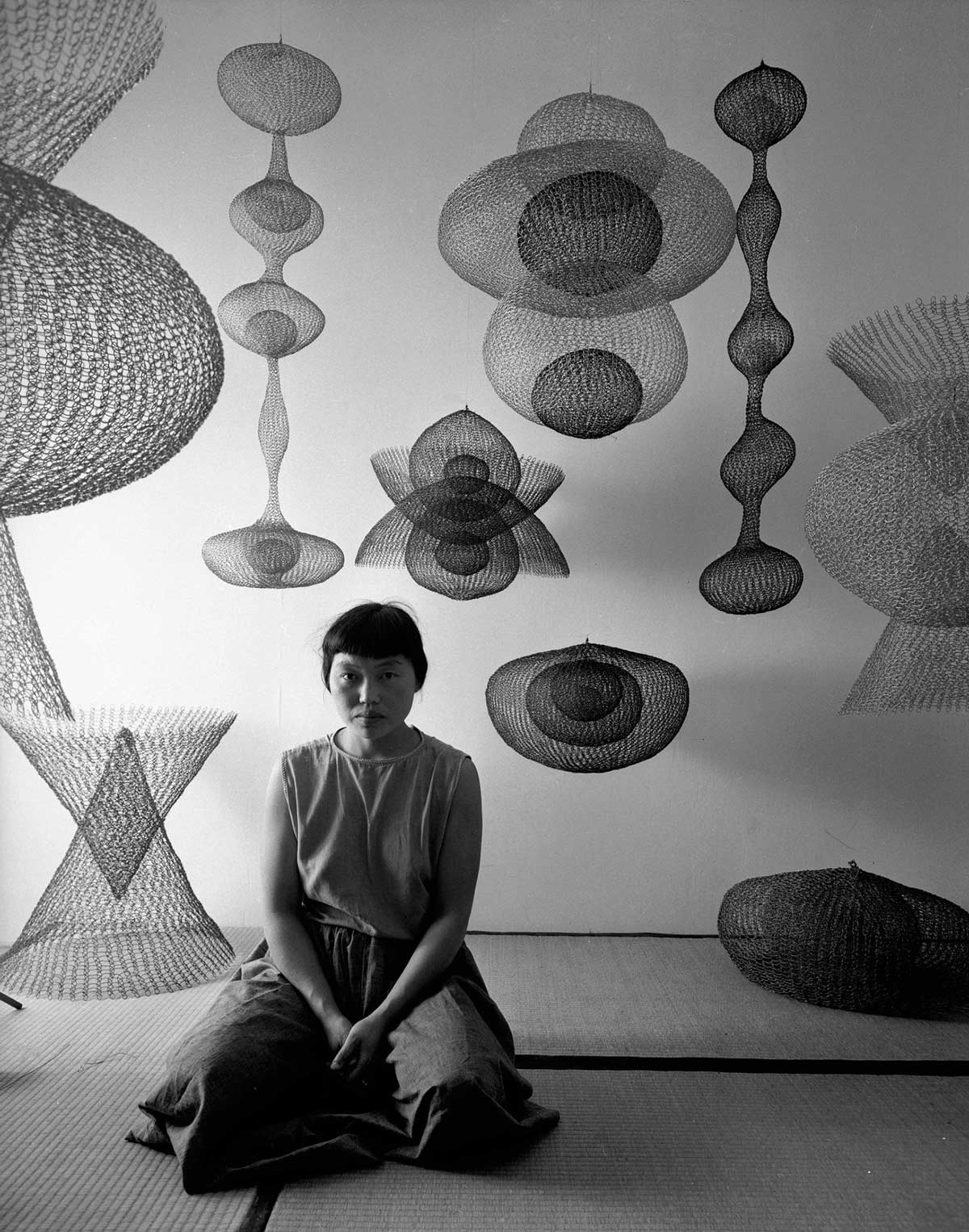
Asawa’s decision to leave Milwaukee for Black Mountain was a turning point in her career. There she studied under artists Josef Albers and Ilya Bolotowsky, architect Buckminster Fuller, and dancer Merce Cunningham, among others. The influence of Black Mountain College on Asawa’s life and career cannot be overstated. The experimental approach pioneered there had a profound impact on Asawa, and it was during this time—specifically, following a trip with Albers to Mexico—that she began producing the abstract woven wire sculptures that would define her practice for years to come.
Asawa’s bowl now in the Museum’s collection is a reminder of the artist’s perseverance in the face of great challenges, including the fraught environment she found here in Milwaukee. Produced in 1946 before her departure for North Carolina, this small bowl now on view in gallery K116 suggests that the artist was already thinking creatively about shape and material while she was in Milwaukee. She formed the bowl by planishing a sheet of copper, a term that refers to the process of painstakingly hammering and smoothing the metal to achieve the desired shape—in this case, a gentle and open curve. Asawa returned repeatedly to basket and bowl shapes in her looped wire sculptures, and this vessel can be understood as an early exercise in the development of form.
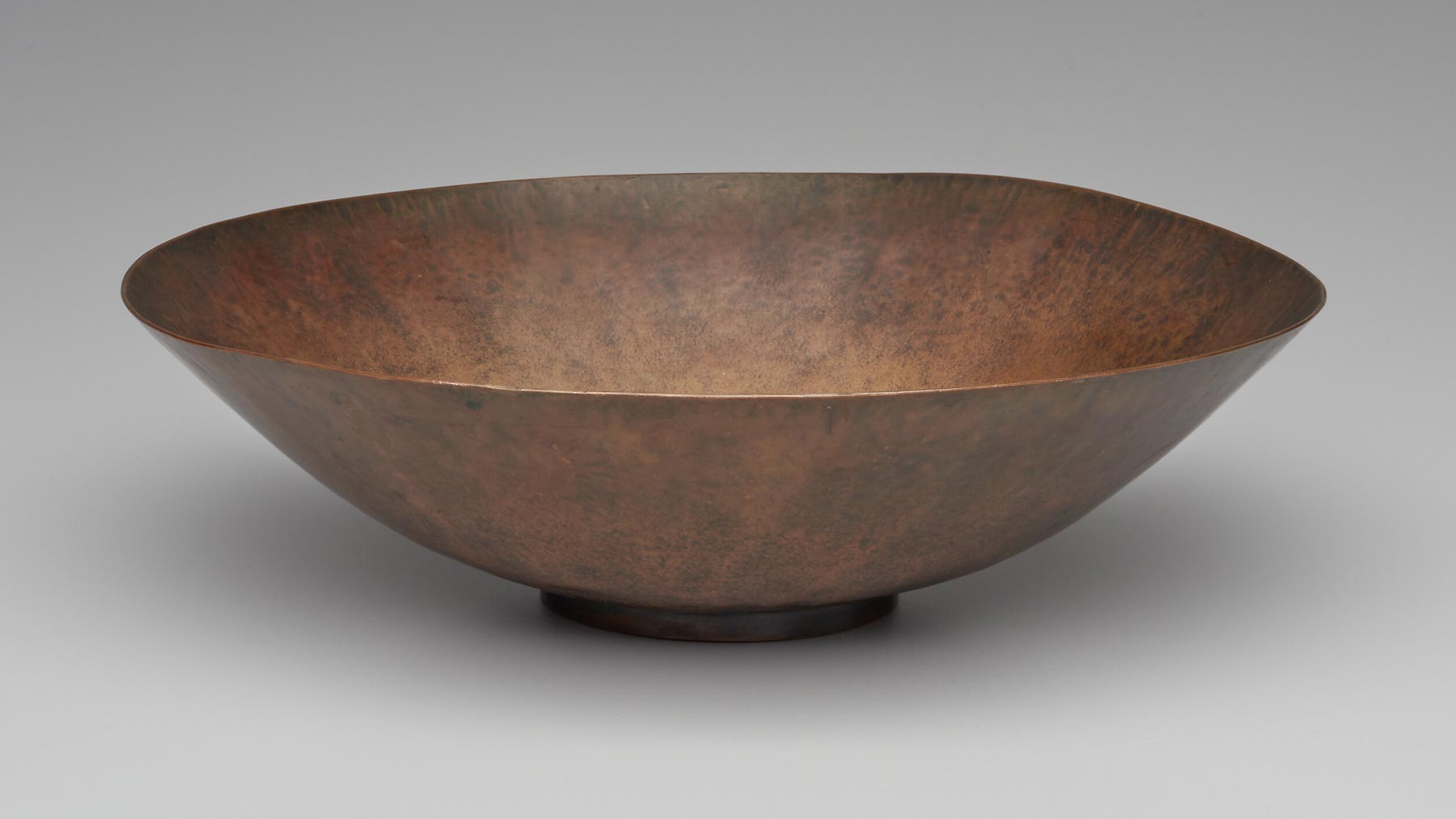
Asawa made this bowl as a gift for the Sieverts, the immigrant couple she had grown close to in her time in Wisconsin. A humble form, the bowl was an appropriate gift for the husband and wife who had such an impact on her; they had met, after all, through Quaker social activism. Despite—or perhaps because of—its simplicity, the bowl both speaks to the obstacles Asawa overcame as a student in Milwaukee and marks her transformation into an artist.
This artwork was purchased by the Milwaukee Art Museum with funds provided by the Demmer Charitable Trust in honor of Dr. Charles Brindis and Dr. Robert Goisman.
Image:
1. Ruth Asawa with her works in 1954. Image by Nat Farbman/Time & Life Pictures
2. Ruth Asawa, 1957. Photograph by Imogen Cunningham © 2021 Imogen Cunningham Trust. Artwork © 2021 Ruth Asawa Lanier, Inc./Artists Rights Society (ARS), New York.
3. Ruth Asawa (American, 1926–2013), Untitled (S.854), 1946. Hand-formed copper. 2¾ × 9½ × 9¾ in. (6.99 × 24.13 × 24.77 cm). Purchase, with funds from the Demmer Charitable Trust in honor of Dr. Charles Brindis and Dr. Robert Goisman, M2020.44. Photo by John R. Glembin © Ruth Asawa Lanier, Inc. / Artists Rights Society (ARS), New York

Shoshana Resnikoff is the Demmer Curator of 20th- and 21st-Century Design and oversees the research, exhibition, and acquisition of modern and contemporary design for the collection.