

Experience master paintings by El Greco, Velázquez, Zurbarán, and more. The Brilliance of the Spanish World opens to Members May 1. Tanya Paul, Isabel and Alfred Bader Curator of European Art, spotlights compelling distinctions between artworks coming to the Museum from the most significant collection of Hispanic art outside of Spain.
The paintings that will be on view in The Brilliance of the Spanish World are exceptional. They come from the most significant collection of Hispanic art outside of Spain, New York’s Hispanic Society Museum & Library, and the exhibition’s breadth has me particularly excited. The works by artists spanning different time periods and locations provide us with an opportunity to make interesting comparisons. Four distinct examples of the Immaculate Conception, for instance, offer insight into evolving cultural influences and personal stories. The Roman Catholic Church teaches that Mary, the Mother of God, was born without original sin, unlike other humans. The Immaculate Conception is an essential belief in Catholicism and frequently appears in Spanish art due to the country’s strong Catholic tradition. The examples in the exhibition range from large canvases to highly personal nuns’ shields.
In 1649, Francesco Pacheco laid out a detailed iconography for the depiction of the Virgin of the Immaculate Conception based on descriptions in the Catholic Bible. A Spanish artist and theorist, Pacheco was also the teacher of Diego Velázquez, another artist represented in the exhibition. Pacheco established that the Virgin be portrayed as a beautiful young girl dressed in a white robe and blue mantle with flowing blond hair. She must be wearing a crown of 12 stars and standing on a crescent moon.
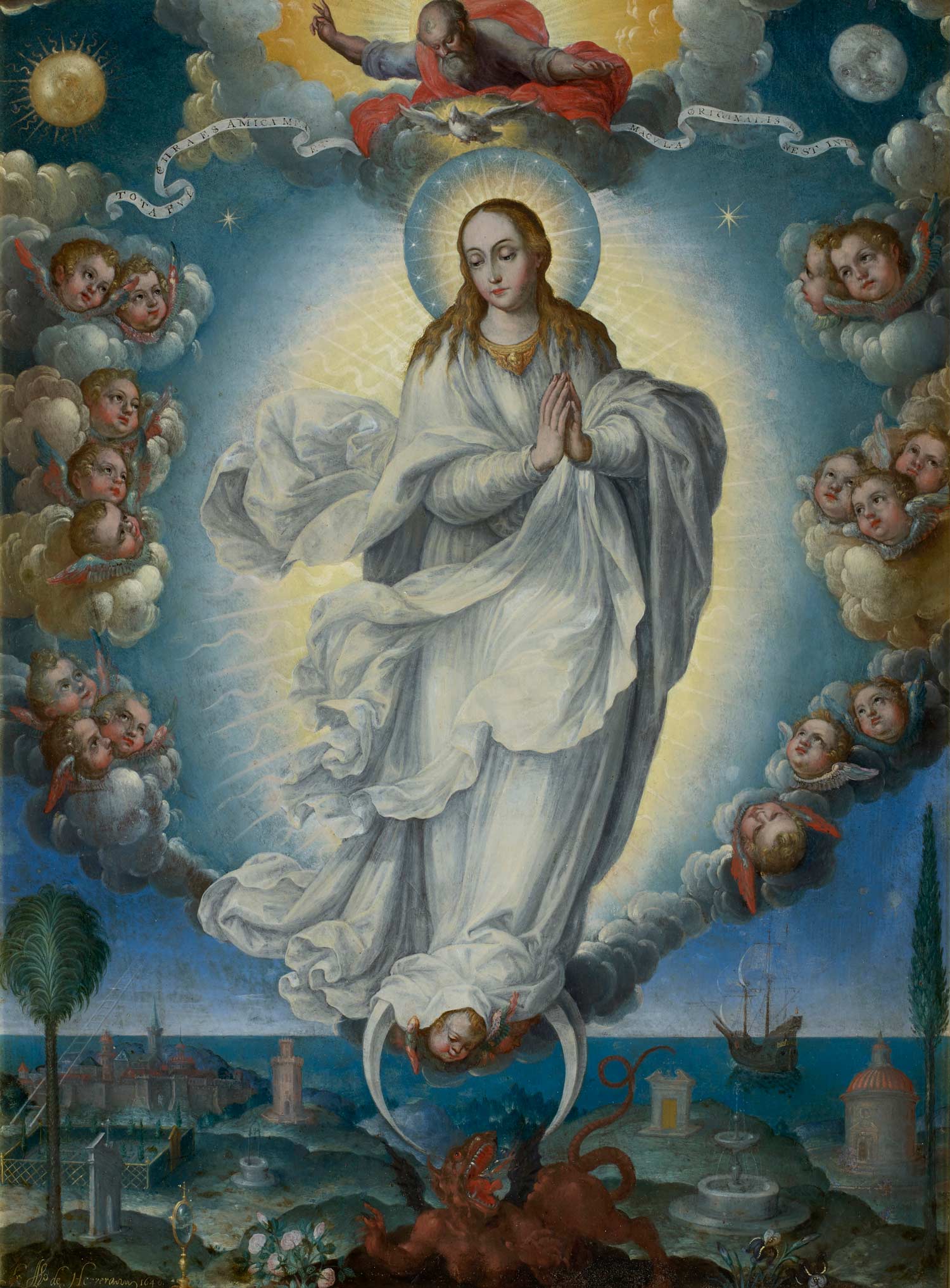
Juan Carreño de Miranda and his student Mateo Cerezo, who worked in Madrid, painted grand, classic examples of the Virgin, buoyed up by a cast of putti. Fray Alonso López de Herrera’s painting, on the other hand, deviates from this model. Born in Spain, López de Herrera traveled in his late 20s to Mexico, where he decorated churches and joined the Dominican order. His depiction of the Virgin is clad all in white and joined by God the Father and the dove of the Holy Ghost. A serpent beneath her feet references original sin and the snake who successfully tempted Adam and Eve in the Garden of Eden. Most fascinating, however, is López de Herrera’s inclusion of a cityscape that situates the Virgin in a contemporary place and time. The Spanish ship and ocean view further allude to the artist’s journey to a new land.
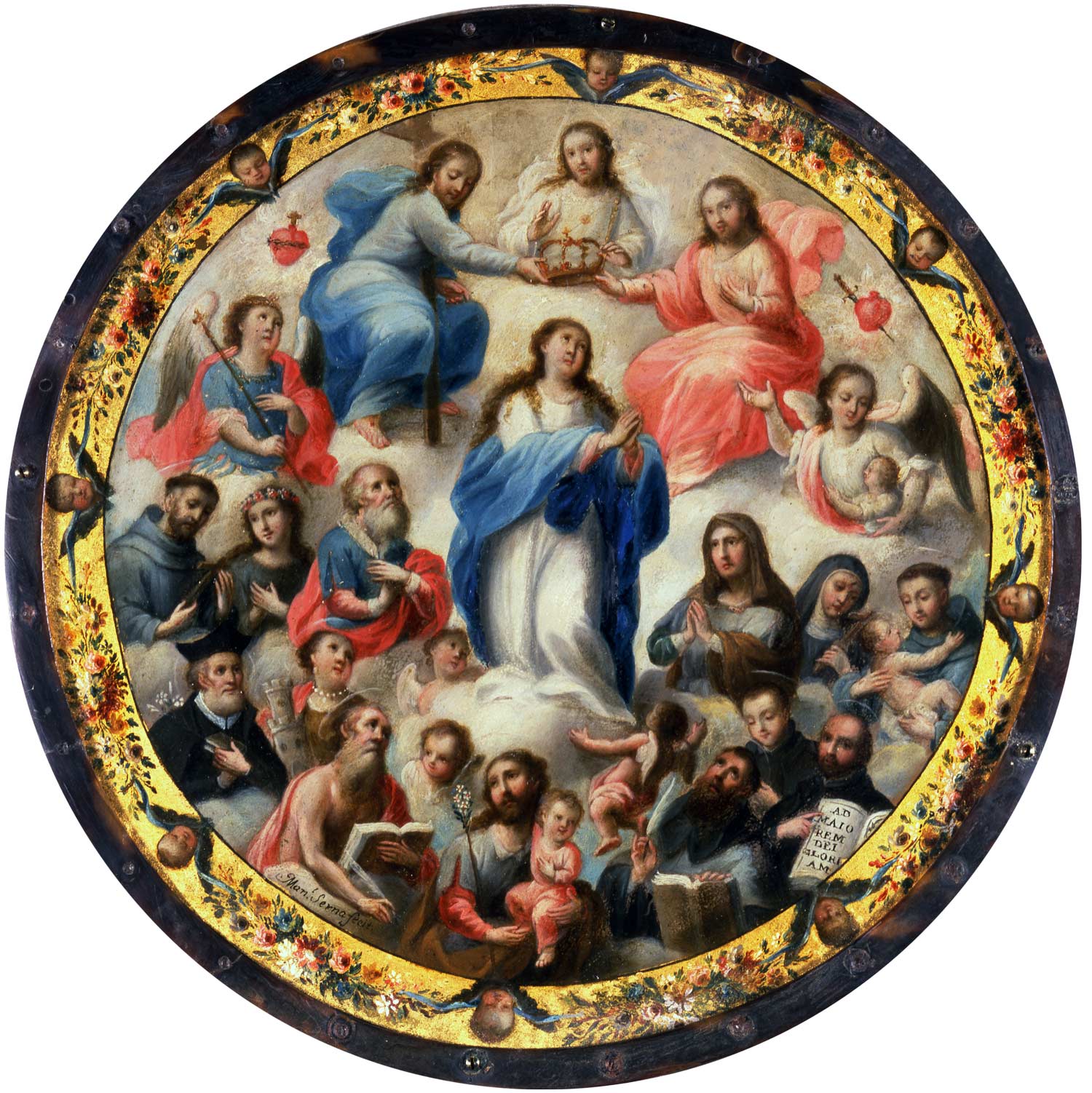
The fourth and final image of the Virgin appears on a nun’s shield painted by Mexican artist Manuel Serna. The nun for whom Serna painted the shield would have worn it as a personal marker of her role and a symbol of her faith. Saint Barbara, pictured holding a tower, is one of the numerous saints surrounding Mary who would have had personal significance for the nun.
We can examine yet another adaptation of this subject with the Guatemalan polychrome sculpture of the Immaculate Conception the Museum recently acquired. It resides alongside Francisco de Zurbarán’s Saint Francis of Assisi in His Tomb (1630/34) in gallery S114. Together, these works broadly reflect the many stories and perspectives this exhibition—and the works in our collection—allow us to illuminate.
Learn more about the exhibition and related programs at mam.org/brilliance.
This exhibition was organized by the Hispanic Society Museum & Library, with support from The Museum Box.

The Brilliance of the Spanish World: El Greco, Velázquez, Zurbarán
Baker/Rowland Galleries
May 2–July 27, 2025
President’s Circle Preview Celebration, April 30
Gallery Talk, May 22
Support
Leadership sponsors
Collectors’ Corner, Inc.
Milwaukee Art Museum’s Friends of Art
Carl & Marilynn Thoma Foundation

Supporting sponsors
Bob and Judy Scott
Wendy Sleight
Contributing sponsors
Jon and Colleen Bassindale
Anthony and Andrea Bryant
Media sponsor


Continue browsing





Image: Juan Carreño de Miranda, Virgin of the Immaculate Conception (detail), 1670. Courtesy of The Hispanic Society of America