



The Chipstone Foundation’s upcoming exhibition at the Milwaukee Art Museum Face Jugs: Art and Ritual in 19th-century South Carolina opens April 26. I will write more about the exhibition next month, but I want to give you a preview of one of the objects that the Chipstone Foundation just acquired for its collection.
In preparation for the Museum exhibition, I have been researching face jugs and visiting institutions and collectors around the United States for the past year; viewing their collections and learning more about the different forms. Chipstone owned one face jug, which is what first piqued my interest in the subject, but the rest of the objects for the exhibition needed to be borrowed from other institutions and private collections. There is a limited number of the early African American made face jugs, and they don’t come up for sale often.
So then, imagine my surprise and excitement when a few weeks ago Chipstone was offered the opportunity to purchase one of these rare 19th-century vessels!
Face jugs are stoneware vessels with faces on them. The eyes and the teeth are made of kaolin, which is the material that porcelain is made out of. They were created by slaves in the Edgefield District of South Carolina in the second half of the 19th century, and were produced for a period of only about 30 years.
The face jug offered to Chipstone is amazing. It has a face that is different from any other face vessel that I have seen, and the jug’s form suggests that it is early, probably from around 1862. The unique features weren’t the only thing that captured my attention though–this particular face jug has writing on the back!


Writing on a face jug is very unusual. There is only one other face jug, owned by the Smithsonian National Museum of American History, that I have seen with an inscription. One of the peculiarities of face jugs is that the individual makers are not known. Would this new face jug give us a clue as to who made it? Would it provide us with the name of a slave potter?
Needless to say, the Chipstone Foundation purchased the rare, inscribed face jug.
When it arrived, it was clear that the script did not match the Smithsonian’s face jug’s lettering, eliminating the possibility that they were made by the same maker. The writing also did not match the famous Edgefield potter known for writing on his vessels, Dave Drake. That eliminated the possibility that the face jug was made by Dave.
One of the words on the back (as you can possibly make out on the detail above) spelled “Squire”, but the other was much more ambiguous. The Chipstone curators and other Southern ceramic scholars came up with two possibilities for the second word. It could be either “Peter” or “Posey”. Initial research turned up that a slave working at the Thomas Davies pottery, a pottery known for producing face jugs, had one child named Squire and one child named Peter. Could he have been the maker of the face jug? Did he make any of the other face jugs that will be exhibited this spring?
What if the second word actually spells Posey? I then did initial research on the name Squire Posey and came up with a planter who was born in South Carolina and moved to Alabama. Was he the owner of the slave who made the face jug?
Was this jug a present for Posey, or was the inclusion of the name a way for the slave to ward off the master’s fury?
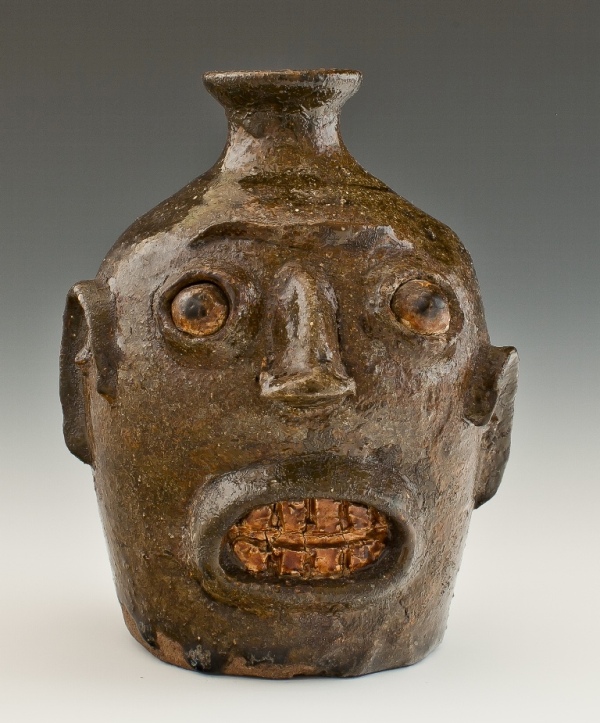
At the moment, there is no conclusive answer, but come by to see Face Jugs: Art and Ritual in 19th-century South Carolina between April 26 and August 5 in the Museum’s Decorative Arts Gallery and see this wondrous face jug for yourself.
What do you think it says?


Claudia Mooney worked for Chipstone, the Milwaukee-based foundation dedicated to promoting American decorative arts scholarship. She researched objects and created relevant programming for Chipstone’s exhibitions at the Milwaukee Art Museum and in the community.